The extravagant promotions of ‘Wuthering Heights’ and ‘Wicked’: ‘We are reaching a point between the sublime and ridiculous’
In the age of instant impact, promoting a film is no longer just about giving a few interviews: actors have to stay in character and often behave in a truly unsettling way

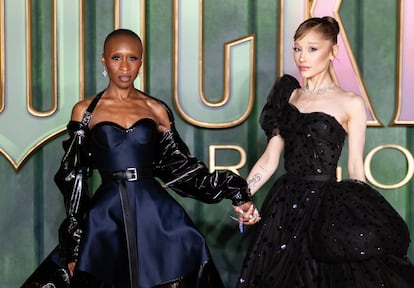
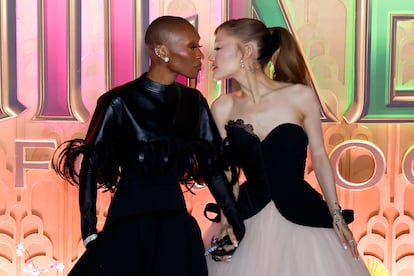
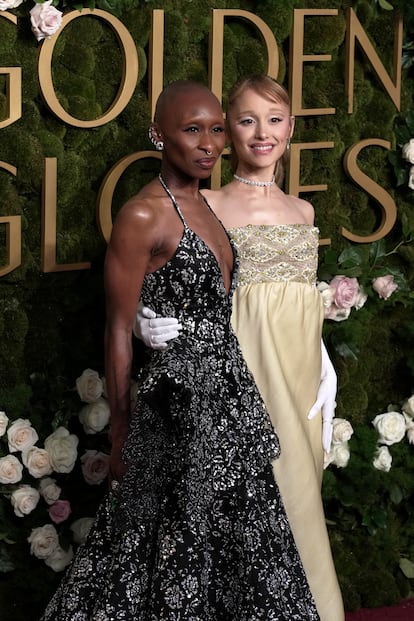
The boundaries between fact and fiction are becoming increasingly blurred. And nowhere more so than in the film industry. The recent promotional tour for Wicked: For Good became a show in itself almost from the get-go. Basically, it was promoted in a tsunami of memes, viral videos and digital press articles that revolved around the relationship between protagonists Cynthia Erivo and Ariana Grande.
The tone invited mockery and skepticism, and not for the first time. Back in 2024, with the premiere of the first part of Wicked, the behavior of both actresses had been criticized as ridiculous to the point of pathological. The pair seemed to have been pitched into an exhausting state of emotional hypersensitivity. Erivo’s protectiveness of Grande generated disconcerting situations, such as when she grabbed and kissed Grande’s arm after an interviewer shook it with excessive enthusiasm.
It may have been an overreaction, or it could have been an indication of unhealthy dependencies and mental health problems. Two factors have contributed to suspicions of the latter. On the one hand, there’s a certain misogyny that fosters the belief that any public affection between two women must come from a weird place. On the other hand, there’s the histrionics of the actresses, which have in fact probably been devised and scripted by the film’s publicists.
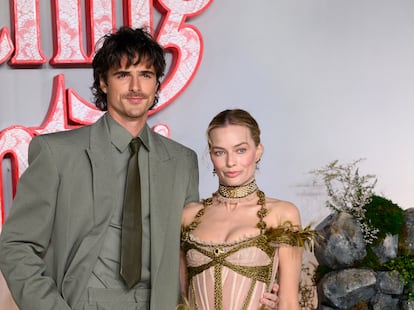
It is becoming increasingly common for film promotional campaigns to incorporate a theatrical element that ends up turning them into spectacles in their own right. The same has happened with the latest remake of Wuthering Heights, whose protagonists, Margot Robbie and Jacob Elordi — not to mention Charli XCX, who provides much of the soundtrack — appeared at the different premieres wearing neo-romantic-inspired gowns that bordered on cosplay. At the London preview, Elordi was able to have rain drip from his mullet onto the shoulders of his green frock coat by Bottega Veneta, lending him a wild air as the weather played into the proceedings.
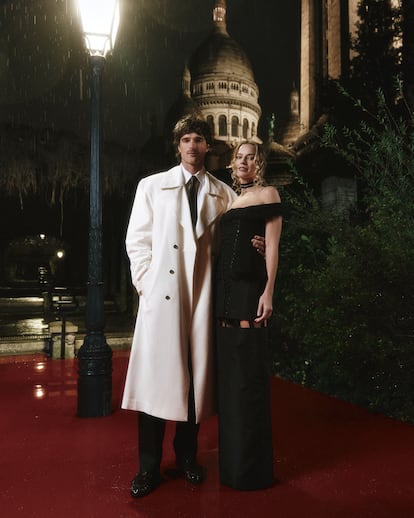
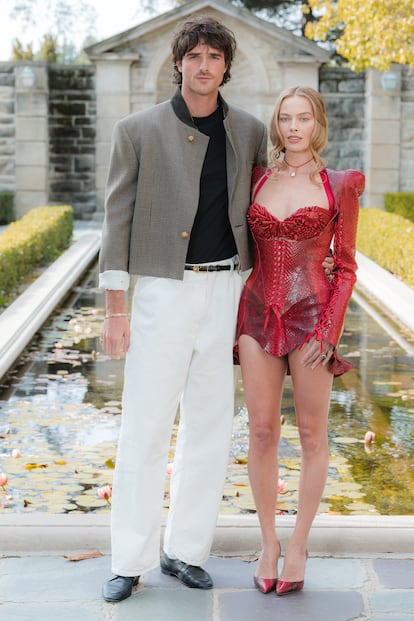
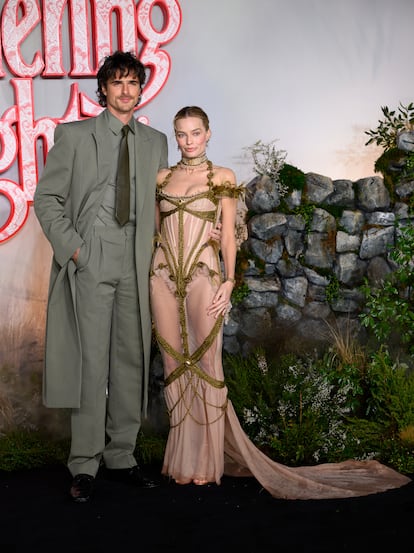
On the red carpets, and during photocalls and interviews, the Elordi-Robbie duo have worked hard to make us believe in an intense chemistry between them, as if the film itself wasn’t enough to convince. Moreover, the news has spread that Robbie ordered two signet rings inscribed with Emily Brontë’s words from her novel — “Whatever our souls are made of, his and mine are the same” — one for her and one for her co-star. Elordi, for his part, would surprise Robbie by sending her enough roses to “fill her room” on Valentine’s Day, according to an interview for the Australian edition of Vogue. Of course, Robbie has experience in taking a character beyond the set; a year and a half ago she promoted Barbie sheathed in an inexhaustible repertoire of pink gowns.
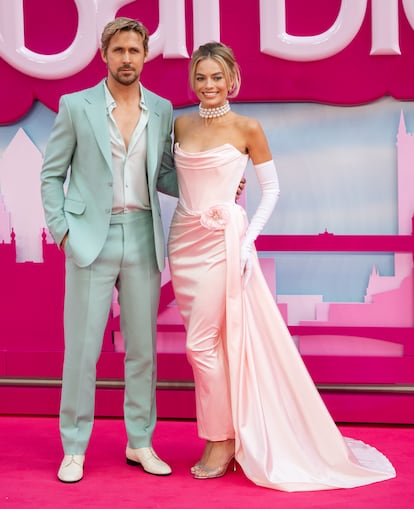
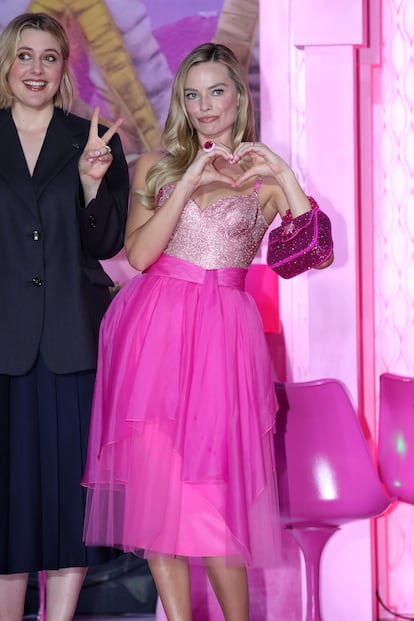
Piti Alonso, who has been working in communications for audiovisual products for 30 years, and who founded DYP Comunicación in 2000, finds none of this particularly odd. “It’s just a show, and I like the show, so I love to see Margot in a great dress inspired by the movie, and to see how Jacob looks at her in the photocall,” she says. “A lot of people find it entertaining, so I think the strategy works. Besides, it’s not harmful. It has to do with the movie-event phenomenon, which has existed all our lives, only now it is more extravagant due to social networks.”
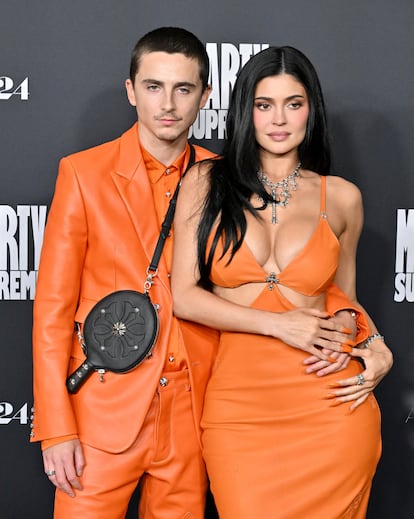
Meanwhile, Jesús Jiménez Fragoso, film marketing manager at Movistar Plus+, believes that the recent campaigns for the film Barbie and the album Brat by Charli XCX have marked a before and after in content marketing: “Now every launch that wants to be a box office hit seeks a concept, a color, an icon... If Barbie‘s campaign was pink and Brat’s was green, Wicked decided that their protagonists had to be dressed in green and pink, which were — coincidentally? — the colors that identified their characters. We are reaching a point between the sublime and ridiculous. In the realms of genius, we have the Marty Supreme campaign, which was designed by Aidan Zamiri, who masterminded the Brat campaign, and who will soon release his first film. And the color of the film was orange. Timothée [Chalamet] has been blurring the line between his character and his own persona by wearing glasses and a sports jacket emblazoned with the name of the film. At the other end of the spectrum is the Wuthering Heights campaign. I don’t see any concept behind having Margot Robbie and Charli XCX in the same photo dressed as goths."
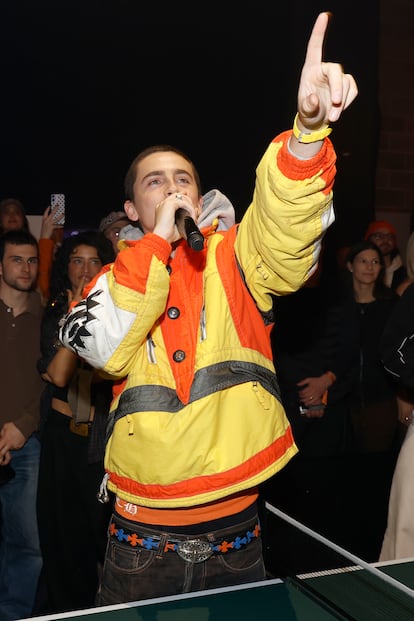
The show-of-a-show promotional strategy is no longer limited to blockbuster films. It also extends to television, especially to so-called period dramas, such as Bridgerton, set in Regency London, or the French series Merteuil, which takes place in pre-revolutionary France. Nor is indie cinema immune. Every time actor Alexander Skarsgård has appeared at a promotional event for Harry Lighton’s British film Pillion, his outfits have tended to compare with those of his character in the film, a gay biker who adopts a dominant role in the film’s central relationship: sleeveless shirts, tight T-shirts and above all a wide range of leather pants. Something similar happened with Zendaya from Luca Guadagnino’s Challengers.
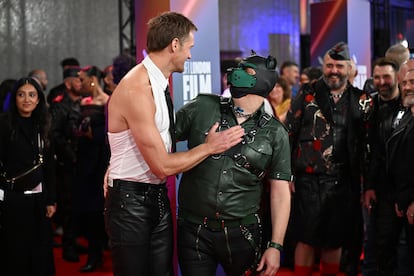
The trend also seems to have reached Spain: Óscar Casas promoted Ídolos using motorcycle competitions, and promotional events for the series Silencio have seen the director, Eduardo Casanova, and the actresses in frills, bows, ruffles and tucks, and shades of off-white with touches of purple peculiar to the baroque clothing of the film’s vampires. “Talent in Spain is increasingly focused on promotion, and directors have already prepared their five favorites from [film social platform] Letterboxd in case they are asked,” says Jiménez Fragoso. “But in Hollywood, it’s another level and it is very likely that the stars’ contracts already include a method dressing clause along with one involving a dance for TikTok.”
But it is not only about dressing up or performing fictional characters off-screen. Nowadays, interviews for the media have become shorts to accompany photocalls. Then there’s cooking and cocktail sessions, food tastings and quiz games where the cast are required to interact with the public and sparkle. These are roles that acting school may not have prepared them for, but perhaps it should. Of course, the result has to be easily formatted for TikTok and Instagram.
Even TV programs are designed to be cut into social media clips. The format of today’s talk shows and late-night entertainment, with its lighthearted tone and relentless pace, includes banal interviews, consisting of questions to celebrities that have been agreed upon and prepared in advance. Conventional television is in crisis, consumption patterns have changed and new generations are turning to other audiovisual formats, meaning that serious conversations have been off the agenda now for some time. The slower model that features a certain depth is now part of the quasi-archaeological material that must be unearthed from the bowels of YouTube.
Piti Alonso believes that this is simply a sign of the times and she’s happy to move with them: “The emergence of digital means more immediate and faster things like that, but they still coexist with more professional journalism, so there are still interviews with the same depth as before. It is true, however, that in general we consume things much faster, and forget after two minutes. Consequently, a lot of media focuses on that other type of more superficial and basic content, but as a professional you can’t limit yourself either, you have to be open to both.”
So promotions have become a show about another show. As French philosopher Guy Debord discussed in The Society of the Spectacle, published in 1967, capitalism turns everything into images and merchandise, including human relationships. Debord’s conclusion was that the show feeds off itself.
Sign up for our weekly newsletter to get more English-language news coverage from EL PAÍS USA Edition
Tu suscripción se está usando en otro dispositivo
¿Quieres añadir otro usuario a tu suscripción?
Si continúas leyendo en este dispositivo, no se podrá leer en el otro.
FlechaTu suscripción se está usando en otro dispositivo y solo puedes acceder a EL PAÍS desde un dispositivo a la vez.
Si quieres compartir tu cuenta, cambia tu suscripción a la modalidad Premium, así podrás añadir otro usuario. Cada uno accederá con su propia cuenta de email, lo que os permitirá personalizar vuestra experiencia en EL PAÍS.
¿Tienes una suscripción de empresa? Accede aquí para contratar más cuentas.
En el caso de no saber quién está usando tu cuenta, te recomendamos cambiar tu contraseña aquí.
Si decides continuar compartiendo tu cuenta, este mensaje se mostrará en tu dispositivo y en el de la otra persona que está usando tu cuenta de forma indefinida, afectando a tu experiencia de lectura. Puedes consultar aquí los términos y condiciones de la suscripción digital.