Spotify in the eye of the storm: Trumpism, denialism and a future under question
The company’s strong revenue isn’t reflected in its stock market performance. Investors fear growth will stall, while artists are voicing frustration over what they consider a miserly compensation system
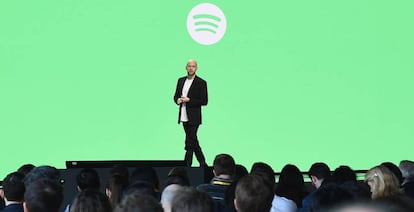
Spotify kicked off the year with a significant move. On January 1, its long-time CEO, Daniel Ek, stepped down to become chairman of the company. The CEO role is now held jointly by the former co-presidents, Alex Norström and Gustav Söderström. This change comes at a delicate, some would even say paradoxical, time for the music streaming giant. While the business machinery remains well-oiled, the market is skeptical that it can continue to grow at its current pace in the medium and long term.
Last year, Spotify generated $20.4 billion in total revenue, an 8.2% increase compared to fiscal year 2024. Net income nearly doubled. These figures were accompanied by record customer numbers: 751 million monthly active users at the close of the fourth quarter of 2025 and 290 million premium subscribers. However, this impressive track record, which exceeded the company’s targets last year, is not reflected in its share price. Spotify shares reached their all-time high on June 25 of nearly $800 and have since dropped by 40%, bringing its market capitalization to $94.3 billion this week.
Is the market wary of the future potential of the music streaming business? Dave Van Dyke, president of Bridge Ratings Media Research, a consultancy specializing in consumer analysis, doesn’t believe it’s accurate to speak of exhaustion, but rather of the industry’s maturity. After a massive growth boom between 2013 and 2019, driven by the increasing ubiquity of smartphones, improved data networks, and the almost undisputed dominance of Spotify and Apple Music, growth has slowed, partly due to “subscription exhaustion” and inflation, which has led people who previously paid for more than one platform to end up sticking with just one. Additionally, the emergence of shorter formats, such as Instagram Reels or TikTok, means users are no longer as inclined to consume something as long as an entire song or album.
But while these factors seem to affect all platforms, Spotify appears to be under more scrutiny for a different kind of problem. 2025 was also the year in which the Swedish giant carried out the most layoffs in its history, letting go of 17% of its global workforce, some 1,500 people. These layoffs, added to the more than 200 dismissals in 2024, have strained the company’s operations so much that Ek himself wondered whether this would actually increase efficiency or create more difficulties in the medium term.
Furthermore, artists frequently announce their departure from the Swedish platform for ethical reasons. These concerns arise in some cases due to Daniel Ek’s investments in the arms industry, or because Spotify hosts anti-vaccine or conspiracy-theory podcasts in its catalog, such as Joe Rogan’s, which is closely aligned with the Trumpian cultural sphere and for which Spotify paid $100 million for exclusive hosting. Some artists’ misgivings also stem from the platform’s airing of advertisements for the feared ICE, the Immigration and Customs Enforcement Service that is leading the immigration offensive of U.S. President Donald Trump. Spotify also organized an event for Donald Trump’s inauguration and donated $150,000 to the official ceremony, as did other major technology platforms.
Payments, algorithms and AI
But the main complaint from artists is that Spotify pays them little and that its algorithm makes certain artists invisible and limits consumer options. Kyle Chakya, a music critic for The New Yorker, announced in 2024 that he was ceasing to use the music platform because the app’s interface itself “has made it increasingly difficult to find the music I want to listen to.”
Spotify prides itself, however, on being the biggest revenue generator for the music industry, having paid out $11 billion, of which, they claim, half has gone to independent record labels and artists.
Shanti Basauri, a Basque composer, teacher, and guitarist, sums up Spotify’s payment policy as follows: “With what Spotify paid me last year [2025], I was able to buy a Kinder Surprise chocolate egg.” Basauri has decided to leave the platform because, in his opinion, “they are neither transparent nor fair to artists,” although he can also afford to do so because he owns his own record label, Kalapitaka, while other artists tied to major labels depend on them to make that decision.
“Spotify is often used as a sign of success because many promoters look at public metrics when signing and negotiating with bands,” explains Ana Rodríguez Borrego, head of communications at the record label Aloud Music. “We respect bands’ choices and ideas about which platforms to be on, and especially those they don’t, as is currently the case with Spotify. It’s not the only one out there; there’s also Tidal, Deezer, Apple Music, Qobuz, Bandcamp, and many others.”
David López, from the post-rock band Toundra, admits that thanks to the Swedish platform they’ve been able to promote themselves outside of Spain. “Many of those views come from digital distribution, and Spotify is still the leader,” he acknowledges, although they will release their next album on Bandcamp, which also allows them to sell their music files directly. But nobody really knows why Spotify recommends some songs over others, and the company is very careful not to reveal this.
“More than 70% of the songs uploaded to Spotify are never listened to,” explains Cristina Perpiñá-Robert, general director of the Spanish Society of Authors and Publishers (SGAE), a music copyright collection organization, who admits that managing Spotify streams is “tremendously expensive,” given that the license doesn’t cover the entire repertoire held by SGAE. Instead, streams have to be analyzed almost one by one, even though SGAE only manages the Spanish repertoire, not all Spanish-language content, “since artists like Shakira or Bad Bunny are managed by U.S. Copyright societies.” Furthermore, Perpiñá-Robert warns that many of the playlists generated by the application contain AI-generated music or “white noise,” which devalues content created by humans.
Adriana Moscoso, CEO of GESAC, the European association of collecting societies for authors and composers, cites cases like that of the French platform Deezer, which has removed all AI-generated content from its catalog and made its AI detection tool available to collecting societies. “Spotify doesn’t sufficiently pursue synthetic content, and its distribution model is based solely on the number of streams, without focusing on the user,” she says. GESAC, as an interested party, advocates for European Union legislation to achieve fairer distribution and for platforms to be transparent about how their algorithms work.
Sign up for our weekly newsletter to get more English-language news coverage from EL PAÍS USA Edition
Tu suscripción se está usando en otro dispositivo
¿Quieres añadir otro usuario a tu suscripción?
Si continúas leyendo en este dispositivo, no se podrá leer en el otro.
FlechaTu suscripción se está usando en otro dispositivo y solo puedes acceder a EL PAÍS desde un dispositivo a la vez.
Si quieres compartir tu cuenta, cambia tu suscripción a la modalidad Premium, así podrás añadir otro usuario. Cada uno accederá con su propia cuenta de email, lo que os permitirá personalizar vuestra experiencia en EL PAÍS.
¿Tienes una suscripción de empresa? Accede aquí para contratar más cuentas.
En el caso de no saber quién está usando tu cuenta, te recomendamos cambiar tu contraseña aquí.
Si decides continuar compartiendo tu cuenta, este mensaje se mostrará en tu dispositivo y en el de la otra persona que está usando tu cuenta de forma indefinida, afectando a tu experiencia de lectura. Puedes consultar aquí los términos y condiciones de la suscripción digital.