The new life of hand-painted signs in Mexico
The ban on this signage in the streets of downtown Mexico City caught the attention of younger generations. EL PAÍS speaks with artists and apprentices, who have revived an essential profession in the urban landscape

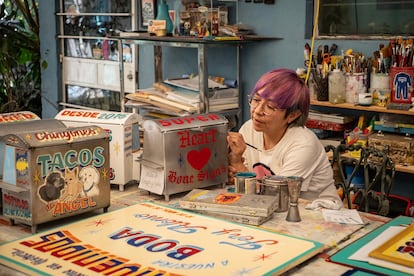
Alina Kiliwa’s studio in northern Mexico City is a haven amidst the capital’s hustle and bustle. She opens a can of blue paint, picks up one of her brushes and delicately begins to paint five letters on one of the taco shop-shaped piggy banks scattered across her table: “SIGNS.”
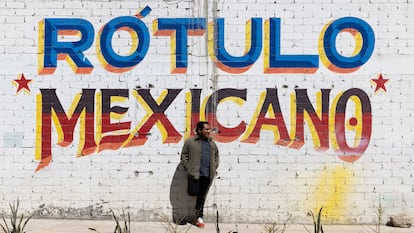
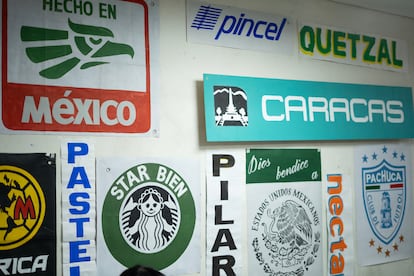
She notes that sign painting has experienced a resurgence in the country’s major cities. This is after the previous local government, which oversees the borough of Cuauhtémoc, decided to erase all street signs in mid-2022. “Everyone started paying more attention. There was more work and there were more clients requesting signs in the style of traditional Mexican graphic art,” she explains. Hand-painted signs have since ridden this wave, propelled by artists and new generations who have become interested in one of those small but essential trades that shape Mexico’s urban landscape.
Several signs hang on the walls of Kiliwa’s studio, while a few others remain half-finished on her table. “I’ve noticed there’s more interest now, because my social media following has increased since that event (the removal of the signs from the streets). There have also been many exhibitions focused on sign painting, something I couldn’t even imagine before that [prohibition] happened,” the 42-year-old artist says. Born in Mexico City, she studied design at university and, a few years later, began looking for sign-making workshops and courses. “I remember, when I was very little, people would ask me what I wanted to be when I grew up. And I would answer that I wanted to be a painter… but what I really wanted was to paint signs,” she recounts.
Kiliwa has become one of the best-known sign makers in the capital, with more than 65,000 followers on social media. She also offers courses on digital platforms like Domestika. She says that, generally, the people who come to her workshops are young people and design students: “Maybe they don’t do it to dedicate themselves to [the profession], but they do come to understand how it’s done. I think that also makes these new generations respect the craft.”
In recent years, these iconic signs have been the subject of various controversies in the capital. Perhaps the most notorious was the declaration of war that was made in May of 2022 by the former borough mayor of Cuauhtémoc, Sandra Cuevas (2021-2024), who sought to ensure that street vendors “always keep their work areas clean.” This decision resulted in the replacement of the signs with a coat of white paint…. And the borough’s logo.
The signs returned to adorn businesses at the end of last year, under the new administration of Mayor Alessandra Rojo de la Vega, who declared that “the attack on the signs was an attempt at cultural murder.” And, in another development, the intense controversy – which originated in the vast capital city – sparked interest in the craft throughout the country. But the issue didn’t end there: the Mexico City borough of Benito Juárez also banned signs on its streets in 2025. And, some time ago, the borough of Xochimilco experienced a similar phenomenon: some businesses were forced to display the maroon color that’s characteristic of the ruling party, MORENA. This measure was criticized by local business owners and activists.
An artist’s beret and some math
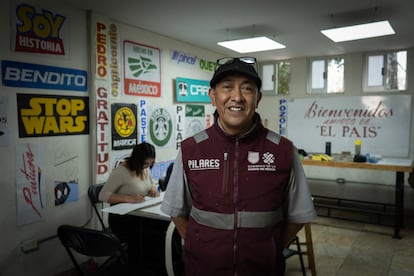
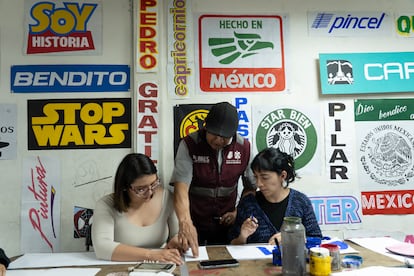
Raúl Ángeles, 62, wears his beret at a slightly tilted angle. He looks like an inspired artist in the middle of creating his masterpiece. Born in Mexico City, he started in traditional sign painting 40 years ago. And, three years ago, he began teaching young people (and not-so-young people) at Pilares La Joya, one of the community centers set up by the Mexico City government in the south of the capital. He took the position after the crisis in the Cuauhtémoc borough. And, since then, nearly 300 students have passed through the center. “I see the present as very encouraging. I see that many people are getting involved, giving it a try. I see a future for [the craft],” he explains. Ángeles also believes that “people are starting to turn more toward handmade items.”
In the room, there are about half-a-dozen students: four women, between 25 and 30-years-old, as well as a 62-year-old man. Andrea Cervantes, 28, asks her instructor a question. Ángeles answers it by writing down a sum. It’s part of his teaching method, which is based on “graphic counting, letter and space classification… and a little bit of math.”
Cervantes came to the workshop after losing her job. She was outraged by the disappearance of signs in the borough. “Many of us feel sad, because it’s part of Mexican identity. As a Mexican, you assume it’s something that’s [common all over the world]… but no, it’s something that’s very much ours,” she explains.
A matchbox
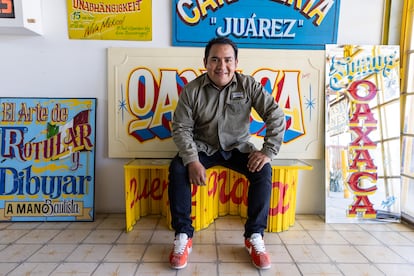
Giovanni Bautista, 30, from the state of Oaxaca, drew inspiration for his signs from matchboxes. His father based his designs on the writing on trucks that passed by the wholesale market in Oaxaca de Juárez, the state capital. And he, in turn, drew inspiration from the legacy of his predecessors.
Bautista is the third generation to work in the family business. Rótulos Bautista – a workshop established 40 years ago – has been located in the municipality of Villa de Etla for the last two decades. It’s about 12 miles from downtown Oaxaca. “The workshop is still going strong. And I’m fortunate to have grown up witnessing its evolution; [over the years], my father never abandoned hand-painted signs,” he says.
His father was worried for a while, believing that his son would abandon the trade because of the opportunities offered by his graphic design studies. But Giovanni wanted to continue the practice: it was time to blend the father’s practical experience with the son’s academic training: “In 2018, we started doing workshops. I don’t think there had ever been a workshop open to the public in Mexico that was taught by a sign painter and a designer,” he says. For Bautista, part of the current boom in hand-painted lettering stems from an interest in the preservation of the craft: “It’s not like we invented it two years ago. Because of the removal of signs, it became fashionable [...] It’s more of a nostalgic thing, a kind of resistance, preserving the style of lettering that, in Mexico, has long been an important part of the urban landscape.”
The scent of birria, a traditional stew
In the central streets of Mexico City’s Cuauhtémoc borough, some businesses still avoid discussing their signs: “Since there are issues with the borough about that, we can’t talk,” they shrug.
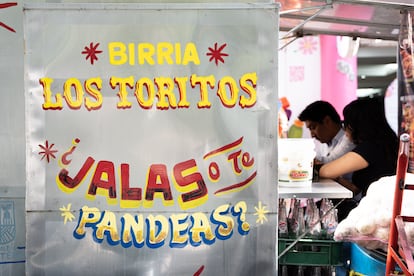
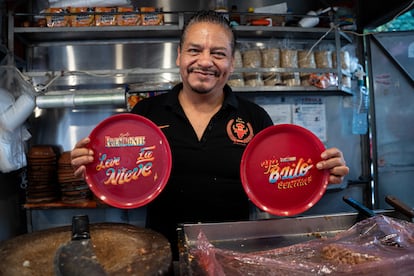
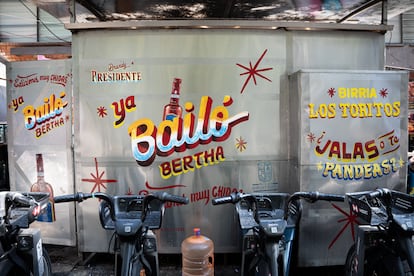
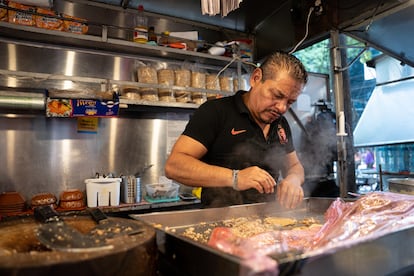
One of those streets is perfumed by the meat being cooked in Los Toritos. It’s one of the food stalls that had to remove its handmade signs four years ago. However, they put them back up after a brandy company proposed adding its name, along with some cheeky double entendres.
Moisés Máynez, one of the owners of the family business, says that they already had “the idea of adding color, making it pretty… but then, [the brandy company] came by with the proposal. And we thought it was a great deal.” He says that the stand didn’t feel a major blow after removing the signs, but adds that, with the new colors, it definitely feels more vibrant. “It’s not the same to walk past the stall and just see a stainless steel sign; [it’s better] to see it with phrases. I feel that it really helps when the signs say what you sell,” he acknowledges.
The brief bark of a small puppy seems to be the only thing capable of breaking the calm in Alina Kiliwa’s studio. She explains that sign painting appears in different forms, depending on the region of the country. And she adds that she’s seen a general resurgence: “There’s a [particular] style in Oaxaca, in Mexico, in Guadalajara… I think that, in every part of the country, we’ve begun to see a revival of the craft, at least in the larger cities.”
Kiliwa shows EL PAÍS some of her works: piggy banks, signs for a wedding, as well as a mirror with an inscription that advertises a pork shop: Carnitas ‘El Güero,’ Michoacán-style. Outside her studio, the city continues its hustle and bustle, oblivious to this colorful respite.