Shakira and Bad Bunny, with 10 concerts each, place Madrid at the center of the Latin music world
The 500,000 tickets sold by the Puerto Rican artist for this summer and the construction of an entire stadium for the Colombian singer’s tour have made the Spanish capital the ‘benchmark for Latin music within Europe’


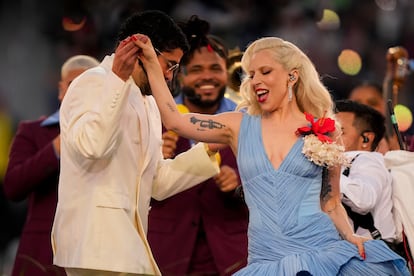
Madrid is cementing its position as the world capital of Latin music. The Spanish capital is about to prove it once again with 10 concerts by Puerto Rican artist Bad Bunny at the Metropolitano Stadium this summer and the announcement of the closing dates for Shakira’s Las Mujeres Ya No Lloran tour, which includes another 10 performances, as confirmed Wednesday by Madrid Mayor José Luis Martínez-Almeida. For her show, the Colombian superstar will construct a purpose-built stadium bearing her name on the site of the controversial Iberdrola Music venue, located in the Villaverde district, in southern Madrid.
Behind these major events is the promoter Live Nation. The reason: Latin American music has gone from being perceived as something marginal to becoming a global phenomenon. “In Spain, Bad Bunny has sold more than 600,000 tickets (10 dates in Madrid and two in Barcelona) at an average of €150 (about $175) each, breaking the record for the highest number of tickets sold for a single tour in the country,” the promoter itself noted in a statement. The tour broke presale records in both speed and volume, surpassing marks previously set by Taylor Swift’s The Eras Tour, which had two sold-out nights at the Santiago Bernabéu stadium. More than 2.5 million fans queued during the presale.
“Response to public demand”
The planned dates in Madrid are only comparable to the month-long residency the artist had in Puerto Rico last year. “The 10 concerts aren’t a strategy imposed by the industry, but a response to public demand. He started with two dates and could have done 20,” says Goiztiri Zapirain, head of digital strategy and online sales at Bad Bunny’s record label, Rimas Europa.
“When you work with an artist like Bad Bunny, with such a high level of global appeal, it makes more sense to concentrate several dates in cities capable of absorbing that volume of audience, both local and international. Madrid has all the elements: infrastructure, air and other transport connectivity due to its location in the center of the country, hotel capacity, and a demand that allows us to sustain 10 concerts,” Bad Bunny’s promoter in Spain, Nacho Córdoba, told EL PAÍS.
In Shakira’s case, the promoter hasn’t yet announced all the details, although the artist has confirmed that “Spain is reserved for the finale. I’m going all out in every way,” she explained in a preview of the RTVE program Al cielo con ella, which will air next Sunday. In response to questions from the presenter, Henar Álvarez, the Colombian singer details that “Live Nation is preparing a stadium especially for these concerts... It’s going to be called the Shakira Stadium.”
On March 18, Almeida expressed his pride that Shakira, whom he described as “the most recognized Latin artist in the world,” has chosen Madrid to perform for 10 dates.

“Shakira could have chosen any city in the world”
Music manager and professor Pedro Malaver interprets this move as a two-pronged operation: artistic and positioning-related. On the one hand, he believes Shakira is looking to return to Spain with a stage production befitting her career. On the other, he sees it as a show of strength at a time when the Latin market has a new commercial leader. “Shakira is the biggest Latin artist in history, but right now Bad Bunny is bigger,” he maintains.
Madrid regional Minister of Culture, Tourism, and Sport Mariano de Paco described it as “fantastic news” and framed it within the regional strategy of consolidating the capital as a host city for major international events, alongside sports attractions like Formula 1 and the NFL. “Shakira could have chosen any city in the world, and she chose Madrid,” the regional government emphasized.
The model of the capital as a venue for major international events excites the governing conservative Popular Party, which insists on a possible balance between the unstoppable growth of tourism and neighborhood life. This is also one of the criticisms leveled by the opposition against Almeida’s city administration: that Madrid has become an unsustainable “theme park” for its residents.
The regional premier of Madrid, Isabel Díaz Ayuso, has championed this strategy in recent years. In 2023, she traveled to Miami with the aim of strengthening Madrid’s position as the epicenter of Spanish-language music in Europe. There, she met with the president of Sony Music U.S. Latin, Alex Gallardo, and advocated for the creation of a “Madrid brand” linked to the music industry, not only as a cultural project, but also as an economic and tourism driver.
According to Malaver, this shift is also due to structural factors. “The U.S. Has become less attractive to many Latin American artists: the cost of living has risen, and Latin Americans no longer feel welcome,” he explains. An example of this is the arrival in Madrid in recent years of labels like Dale Play (Argentina) and Rimas Entertainment (Puerto Rico), associated with artists such as Bizarrap and Bad Bunny, respectively. “A hit song is much more profitable in Spain than in countries like Argentina because of the economic climate and the platform fees,” Malaver points out. The record label Rimas asserts that its expansion into Spain responds to an organic need within the industry: “Our main headquarters are in Puerto Rico, but our Madrid office is one of our most important.”
The decision to open in Spain was a natural one: most artists come on tour and meet local producers, leading to collaborations. Madrid has become a meeting point for cultures. Furthermore, there are increasingly more events, fan meet-and-greets, and releases that require a stable base. Spain has ceased to be a one-off stop, Malaver explains, and has become a place to stay.
This shift is also reflected in the relocation of artists and producers seeking to be part of Madrid’s current music scene. Mauricio Rengifo, a member of Colombian group Cali y El Dandee and a producer, decided to move to Madrid this month after a decade in Los Angeles. “It has become the capital of Spanish-language music,” he says without hesitation.
“Live Nation’s role has been to support and accelerate that growth, investing in large-scale tours, consolidating stadium tours, and positioning Madrid as a strategic hub within global circuits. Rather than competing with cities like Miami, which operate in a different geographical context, what we see is that Madrid has become the benchmark for Latin music within Europe,” says Córdoba.
The producer explains that this phenomenon isn’t solely due to a musical trend, but rather a combination of factors: “There are a huge number of concerts, a very strong festival calendar, well-equipped venues, and an audience that consumes live music several times a year.” Added to this is the growth of the Latin American population in the region. According to the latest figures from the National Institute of Statistics (INE), one million Latin Americans live in the Madrid region.
Rengifo places the origin of this process at around 15 years ago. “Everything comes together: artists, a network of contacts, and a city where it’s easy to settle down.” He recalls the success of the song Yo te esperaré as a turning point. “The audience was screaming so loudly we couldn’t even hear each other.”
Regarding the current boom, he places it in a broader context: “Madrid is fashionable, it’s a place where you can live well, and that attracts talent. Latin music, which is currently the most listened-to globally, is a consequence of that.”
Madrid has thus undergone a profound cultural transformation: Latin music has ceased to be perceived as immigrant music and has become a trend. A decade ago, reggaeton was still seen in many circles as a foreign genre. That prejudice, experts explain, began to break down with the globalization of the genre and the changing profile of Latin American migration in the city. For Rengifo, the key has been identity. “The artists didn’t renounce who they were. They made the world adapt to them.”
In this context, Madrid has established itself as a strategic hub for the industry. “More and more artists want to be here, work here, and be part of what’s happening,” he says. Malaver sums it up this way: “Bad Bunny doesn’t do 10 concerts for Madrid. He does them for Europe.” In his opinion, the capital already functions as an enclave capable of absorbing continental demand: local audiences, Latin American residents, and international travelers. “Madrid has infrastructure, connectivity, security, climate, and more competitive prices than other major cities,” he concludes.
Sign up for our weekly newsletter to get more English-language news coverage from EL PAÍS USA Edition
Tu suscripción se está usando en otro dispositivo
¿Quieres añadir otro usuario a tu suscripción?
Si continúas leyendo en este dispositivo, no se podrá leer en el otro.
FlechaTu suscripción se está usando en otro dispositivo y solo puedes acceder a EL PAÍS desde un dispositivo a la vez.
Si quieres compartir tu cuenta, cambia tu suscripción a la modalidad Premium, así podrás añadir otro usuario. Cada uno accederá con su propia cuenta de email, lo que os permitirá personalizar vuestra experiencia en EL PAÍS.
¿Tienes una suscripción de empresa? Accede aquí para contratar más cuentas.
En el caso de no saber quién está usando tu cuenta, te recomendamos cambiar tu contraseña aquí.
Si decides continuar compartiendo tu cuenta, este mensaje se mostrará en tu dispositivo y en el de la otra persona que está usando tu cuenta de forma indefinida, afectando a tu experiencia de lectura. Puedes consultar aquí los términos y condiciones de la suscripción digital.