Smaller pizzas, a wooden Starbucks logo and tatami in Zara: The demands of the Japanese market
Ernest Higa, the American businessman who successfully launched Domino’s Pizza in Japan in 1985, recognized the need to adapt to the country’s unique characteristics. He recommends delving deeper into the culture, the market, and consumer habits
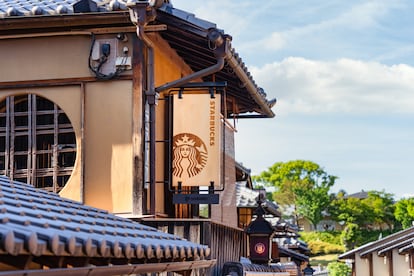

A smaller pizza, a logo carved in wood, or a tatami floor are minor adjustments that, in Japan, allow global brands like Domino’s Pizza, Starbucks, or Zara to conquer one of the world’s most demanding markets. “Japanese diners are very prone to boredom,” Ernest Higa — an American businessman who in 1985 managed to establish the aforementioned pizza chain in the country after convincing the U.S. Headquarters to increase the topping options from 12 to 38 and abandon the practice of serving only Coca-Cola — explains to EL PAÍS.
Higa also rejected the American maxim of “bigger is better” and, in keeping with a culture that promotes moderation — the saying “Hara hachi bu me, isha iras” [translated as: only filling your stomach to 80% keeps the doctor away] — reduced the size of the pizzas. After confirming that the Japanese “eat with their eyes,” he arranged ingredients familiar to the local palate, such as calamari, prawns, and teriyaki chicken, on the pizza in an aesthetically pleasing way. “The success of the American franchise model is based on keeping the concept intact. But that doesn’t always work in Japan,” argues the successful pioneer of a novel dish whose main ingredient — cheese — was exotic on the daily menu at the time.
Starbucks, the American coffee chain that arrived in 1996 amid a strong coffee culture, encountered a very different scenario. In Japan, there were already specialty chains or retro-style boutique coffee shops that functioned as a “third place,” an alternative to the office and home where people could spend many consecutive hours working, reading, or listening to classical music.
The first Starbucks coffee shop outside the United States opened in Ginza, a central Tokyo district of upscale shops often compared to New York’s Fifth Avenue. According to Noriko Suzuki, a spokesperson for Starbucks Japan, local employees receive training on coffee origin and production, the growing environment, and food pairings. An exam is held annually, and the top performers are rewarded with a prize reminiscent of martial arts mastery: a black apron.
To capitalize on the cultural significance of seasonal changes in Japan, Suzuki continues, seasonal products have been developed, such as the “sakura latte” (“cherry latte”) in spring, fresh seasonal fruit lattes in summer, and sweet potato lattes in autumn. Starbucks is also credited with popularizing matcha drinks worldwide. By stripping powdered green tea of its ritual function in the tea ceremony and blending it with other ingredients, the company created a new beverage category, and today any social media content tagged “matcha latte” generates thousands of views.
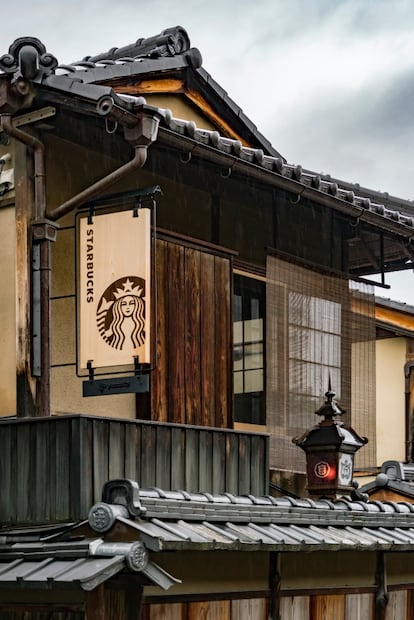
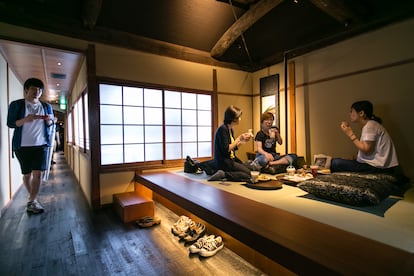
In an emblematic case of paying homage to Japanese culture, Starbucks installed a coffee shop in a centuries-old traditional house in 2017, commissioned a wooden version of its distinctive logo to be carved, and changed its color to brown to harmonize with the surroundings of the Ninenzaka neighborhood, next to the famous Kiyomizu temple in Kyoto.
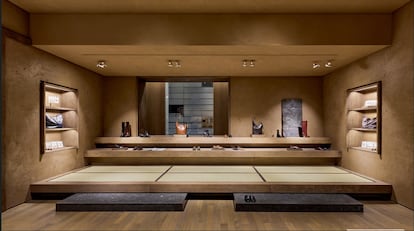
The deep connection with Japan that foreign brands forge through their “third spaces” has not gone unnoticed by fashion brands like Zara, which in October 2025 opened a store in the central Shinsaibashi district of Osaka (Japan’s second-largest city). This store features a Zacaffé café, its fourth location after Madrid, Nanjing (China), and Seoul (South Korea). Although Inditex maintains that the nearly 2,000 square meters of the Osaka store (its 64th in the country) only contain “nods” to Japanese culture, the Nara wood tiles, natural cobblestone flooring, and use of traditional noren curtains are part of a strategy to engage with the local culture. The tatami flooring in the women’s section, an unusual luxury in a Western fashion store, invites customers to remove their shoes — the ultimate gesture of connection to the Japanese space, where the experience is paramount.
According to Higa, who now works as a consultant for other global brands, there are no set formulas for making a foreign concept work in Japan. He recommends delving into the market, the culture, and consumer habits, and cites the phrase “think global, act local.” He adds, however, that this maxim — attributed to Akio Morita, founder of Sony — would be further refined with the clarification: “But don’t become a native.” It’s crucial to remember that the reason for bringing a foreign brand to Japan is precisely its success in its home market. “What must be maintained is just as important as what must be adapted,” Higa concludes.
Sign up for our weekly newsletter to get more English-language news coverage from EL PAÍS USA Edition
Tu suscripción se está usando en otro dispositivo
¿Quieres añadir otro usuario a tu suscripción?
Si continúas leyendo en este dispositivo, no se podrá leer en el otro.
FlechaTu suscripción se está usando en otro dispositivo y solo puedes acceder a EL PAÍS desde un dispositivo a la vez.
Si quieres compartir tu cuenta, cambia tu suscripción a la modalidad Premium, así podrás añadir otro usuario. Cada uno accederá con su propia cuenta de email, lo que os permitirá personalizar vuestra experiencia en EL PAÍS.
¿Tienes una suscripción de empresa? Accede aquí para contratar más cuentas.
En el caso de no saber quién está usando tu cuenta, te recomendamos cambiar tu contraseña aquí.
Si decides continuar compartiendo tu cuenta, este mensaje se mostrará en tu dispositivo y en el de la otra persona que está usando tu cuenta de forma indefinida, afectando a tu experiencia de lectura. Puedes consultar aquí los términos y condiciones de la suscripción digital.