Denmark is preparing for the unthinkable: ‘In Greenland, there’s nothing to bomb’
Copenhagen’s strategy is to seek dialogue with members of the Trump administration it considers to be more pragmatic

When they woke up on Saturday to the news that the United States had illegally entered Venezuela to capture its president, Nicolás Maduro, many in Denmark thought that their time had come: they could be next.
It wasn’t necessary for Donald Trump and his entourage to threaten — as they did in the following hours — to invade Greenland, an autonomous territory of the Kingdom of Denmark. The U.S. President has been talking for a year about his intention to seize, by hook or by crook, the giant island in the northern part of the Western Hemisphere, and the Venezuelan precedent ignited Copenhagen’s worst fears.
“My first thought was Greenland,” said Mads Clausager, a 67-year-old Dane, on Tuesday night in a bar in the lively Vesterbo neighborhood. He grew up in a world of prosperity and peace where everything seemed destined to improve, and like so many of his fellow citizens, he was stunned and somewhat uneasy. “I thought about the Greenlandic prime minister, what he was doing, and where he was.”
But it’s difficult to imagine Prime Minister Jens-Frederik Nielsen changing locations every night, or protected by a Praetorian Guard like Maduro. Denmark is not an enemy of the United States, but an ally, and one of the most loyal. Although Nielsen, a Greenlander, responded to the White House’s growing aggression by saying, “No more pressure. No more insinuations. No more fantasies,” with each statement from Washington it seems clear that annexation is no fantasy at all.
The Danish strategy, more or less explicit in public statements, is to seek dialogue with those members of the Trump administration they consider more pragmatic. One of them, Secretary of State Marco Rubio, announced Wednesday that he would accept a meeting with his Danish counterparts, perhaps next week.
In Copenhagen, scenarios are being discussed and counter-offers are being drafted. All to appease the U.S. President and prevent him from planting the Star-Spangled Banner in Nuuk, the Greenlandic capital, with or without gunfire.
“I don’t think it’s appropriate to talk about scenarios in public,” says Ida Auken, a member of parliament for the Social Democrats, Prime Minister Mette Frederiksen’s party, in her office at the Folketing, the Danish parliament. “Personally, I think about many scenarios. You always have to hope for the best and prepare for the worst. That’s what Denmark must do as well.”
On the office wall hang photos of two U.S. Presidents: Barack Obama and John F. Kennedy. What’s disconcerting about this crisis is that it’s hitting what is possibly the most pro-American country in Europe.
The result of this contradiction is “something of an identity crisis,” according to Rasmus Sinding Sondergaard of the Danish Institute for International Studies (DIIS). In just under a year, a pillar of post-World War II Danish identity — trust in the U.S. — has crumbled. Denmark, traditionally Euroskeptic, has become pro-European at breakneck speed.
“We have always been a strong ally of the United States, for 80 years,” Auken explains. “We went with them to the wars in Iraq and Afghanistan. We lost soldiers. Mothers and fathers lost their children. I don’t know how to explain to them that one of our own is treating us like this.” “This,” he adds, “puts us in a difficult situation and under pressure that we find unacceptable.”
According to the member of parliament, Trump’s intervention in Venezuela “shows us that the president is serious about his willingness to back up his words with force.” But her concern about the Greenland scenario goes beyond the military aspect: “It would have so many implications... As our prime minister said, if one NATO country attacks another NATO country, nothing will stand. It’s an unlikely scenario, but given that the U.S. President and his people aren’t ruling it out, we have to consider it.”
“It’s so un-Danish”
In the Scandinavian country — an exemplary NATO member and a bubble of consensus and well-being that believed itself to be safe from the world’s turbulence — Trump’s harassment is causing a “short circuit,” as Clausager puts it. “It’s so un-Danish,” says this veteran journalist. “Here, we solve things by sitting down together around a table. Democracy is integrated into daily life. At school, we wait for the last person to have learned it before continuing with the lesson. Here, everything is about sharing, sharing, sharing.”
“As long as we stay united in NATO, there can’t be any hostile action,” says student Alexander Frandsen at the bar in Vesterbro. A very “Danish” view, although Frandsen himself adds: “It’s the feeling that disaster is coming.”
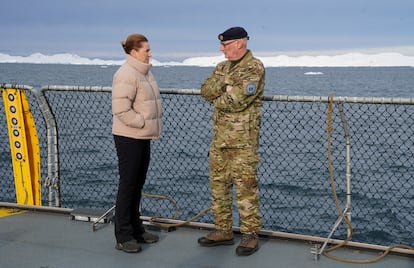
Few in official circles in Copenhagen want to discuss how Trump could seize Greenland, a territory 50 times larger than Denmark and home to 56,000 people. Greenland has been part of the Kingdom of Denmark for over two centuries, yet enjoys extensive autonomy and the right to secede. Polls show a majority in favor of independence, although economic dependence on Copenhagen slows progress. An overwhelming majority of Greenlanders — 85% according to one poll — would reject annexation by the U.S.
Washington has tried to persuade Greenlanders and has launched interference operations. There have been visits by Trump supporters and contacts with the minority of Greenlanders who favor annexation. Another option, the purchase of the island, was proposed by Trump a year ago. The Danish and Greenlandic response was negative.
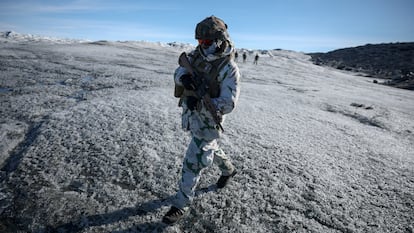
Invasion remains an option. It could be a symbolic one. It would be enough for the U.S. To plant its flag in Nuuk and for Trump to proclaim that Greenland belongs to them. Or it could require the use of force, however minimal.
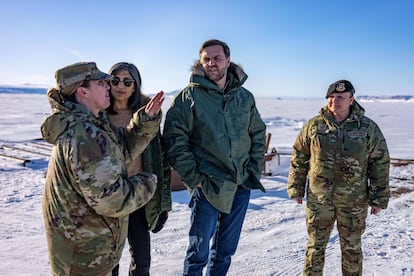
“In Venezuela, they attacked some military installations to get in and seize Maduro. In Greenland, there’s nothing to bomb,” says Sondergaard of the DIIS think tank. “The main military presence is the U.S. Military base itself on Pituffik.” This expert imagines Washington sending special forces to Nuuk. Once there, they could take control of strategic buildings such as the Greenlandic media, parliament, and police. “It would be a quick thing. They would probably encounter very little resistance, if any, and that would be the end of the military operation,” he says. An operation like this would be more like Russia’s annexation of Crimea in 2014 than last weekend’s incursion into Venezuela. And what could Denmark and the Europeans do to prevent it? “Nothing. Very little.”
Military ties are so close — both bilaterally and within NATO — that it’s baffling in Copenhagen why, if the U.S. Wants to strengthen its presence in the Arctic, it hasn’t done so already. One solution to the crisis, according to experts and politicians, would be to offer Trump an agreement that expands the U.S. Military and economic presence in Greenland without ceding sovereignty.
“It’s the option that wouldn’t give him control over Greenland and would respect its sovereignty, but would offer him an agreement that would serve his security interests,” says Sondergaard. “The defense agreement could be updated, combined with an invitation to invest in the extraction of critical minerals, and include a clause stating that Greenland will exclude Chinese and Russian investments.” Whether that would be enough for Trump — if what he really intends is annexation, planting the flag, making Greenland the 51st state — is another matter.
The unease and confusion felt by Denmark and Greenland are now mirroring the bewilderment of Europe, caught between an eastern giant, Vladimir Putin’s Russia, and its western ally and protector, the United States, which also poses a threat. “It was probably a setback for Putin to lose his man in Venezuela,” summarizes Auken, “but I’m sure that with our internal discussions in recent days, he won’t be unhappy.”
Sign up for our weekly newsletter to get more English-language news coverage from EL PAÍS USA Edition
Tu suscripción se está usando en otro dispositivo
¿Quieres añadir otro usuario a tu suscripción?
Si continúas leyendo en este dispositivo, no se podrá leer en el otro.
FlechaTu suscripción se está usando en otro dispositivo y solo puedes acceder a EL PAÍS desde un dispositivo a la vez.
Si quieres compartir tu cuenta, cambia tu suscripción a la modalidad Premium, así podrás añadir otro usuario. Cada uno accederá con su propia cuenta de email, lo que os permitirá personalizar vuestra experiencia en EL PAÍS.
¿Tienes una suscripción de empresa? Accede aquí para contratar más cuentas.
En el caso de no saber quién está usando tu cuenta, te recomendamos cambiar tu contraseña aquí.
Si decides continuar compartiendo tu cuenta, este mensaje se mostrará en tu dispositivo y en el de la otra persona que está usando tu cuenta de forma indefinida, afectando a tu experiencia de lectura. Puedes consultar aquí los términos y condiciones de la suscripción digital.