Homelessness is on the rise in Buenos Aires: ‘There are already entire generations who know nothing but life on the streets’
Official data reveals that, in the last two years, the homeless population has grown by 57% in the Argentine capital
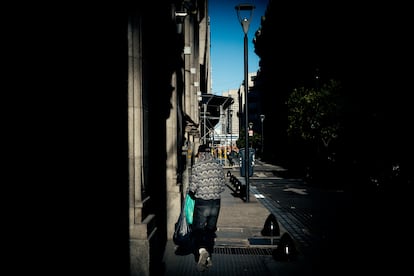

In Plaza de Mayo, across from the Casa Rosada — the seat of government in Argentina — more than 50 people experiencing homelessness wait for the group of volunteers who bring them food every afternoon. A young man passes the time by systematically checking the trash cans.
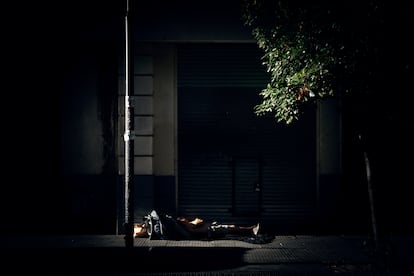
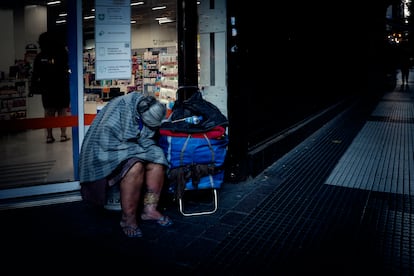
Barely a mile away, in Plaza Congreso, a person rests on the grass, hidden from the view of the bustling city center. Under the shelter of a closed storefront, two men prepare for the night, surrounded by plastic bags containing their belongings. According to official data, the number of homeless people in the city of Buenos Aires, the capital of Argentina, has increased by 57% in the last two years.
The Buenos Aires Human Development Ministry registers the unhoused population twice a year. The latest report — presented a couple of weeks ago, based on data collected in November 2025 — concludes that there are currently 5,176 people in Buenos Aires who are homeless. A year earlier, there were 4,049. And, at the end of 2023, there were 3,286.
However, the current figure could be even higher. More than 30 political, humanitarian, labor and religious organizations are compiling a Popular Census of People in Situations of Homelessness. In their 2025 edition, they found that 11,892 inhabitants of Buenos Aires do not have a place to live: 64% more than in the previous count from 2019.
While the two reports differ in terms of the number — because they use different methodologies — they agree on one central point: the trend toward a dramatic increase.
“Since the pandemic, we’ve seen a steady and accelerating increase in the number of people experiencing homelessness. And because of the country’s socioeconomic crisis, we believe [this situation] will continue to worsen,” says Horacio Ávila, a leader of Proyecto 7 (Project 7), an organization that helps the homeless. “It’s terrible, but it’s become a way of life,” he sighs.
Ávila, 62, knows what he’s talking about. For seven years, he was homeless. “Living on the streets is incredibly hard; you don’t know if you’ll wake up the next day or not. It’s very traumatic, it leaves many emotional and physical scars,” he explains. “On the streets, you can’t do the simplest things. The lights never go out, your brain is constantly active. You always think that it’s temporary, that it will end tomorrow… [but] years go by and you’re still there. It’s extremely difficult to get out [of this situation].”
Of the 5,176 homeless people identified in the official report, 1,613 were living on the streets when registered, while 3,563 were residing in a shelter or a state-run assistance center. The vast majority of those counted on the streets were men (83%) between the ages of 19 and 59 (88%). More than two-thirds (68%) reported being homeless for “a year or more,” while 30% stated “less than a year.”
How did they end up in this situation? Some 42% cited “employment or financial problems.” And “family conflicts” or “health problems” were cited by 34% and 7% respectively, among other reasons.
The increase in the homeless population in the country’s wealthiest city — home to 3.1 million of the nation’s 46 million inhabitants — contrasts sharply with the decline in poverty reported by official statistics. When the far-right Javier Milei came to power in late-2023 amidst spiraling inflation, poverty affected 41.7% of Argentines.
In 2024, this figure climbed to 52.9%, but then, with the subsequent decline in inflation, Argentina’s National Institute of Statistics and Censuses (INDEC) measured a marked decrease. The latest official figure, from mid-2025, indicates that 31.6% of Argentines are poor, which is the lowest rate since 2018. And, in the city of Buenos Aires, poverty affects 17.3% of the local population, after a drop of 10.8 percentage points in one year.
“The growth in the number of people experiencing homelessness is a very clear indicator of the impoverishment of society,” says Adriana Clemente, a social worker and professor emerita at the University of Buenos Aires (UBA). “It’s the result of public spending cuts, which have intensified in the last two years, along with job losses, falling incomes and extreme real estate speculation in the city.” According to her analysis, there’s “a change in the structure of Argentine society” and “greater inequality,” as well as a relative increase in the size of the lower-middle class, low-income and indigent sectors.
So then, how can it be explained that, at the same time, official statistics indicate a fall in poverty? Clemente claims that the official methodology uses an outdated form of calculating household essentials, while housing expenses aren’t properly weighted. She also notes that recent technical changes are also distorting the datasets by detecting previously unreported income.
Anthropologist Griselda Pallares has been working with homeless people since 1999. “Homelessness is a heterogeneous and multidimensional problem that isn’t measured by poverty statistics,” she argues. “The parameter for measuring poverty takes into account income and the ability to access basic household essentials. Many people experiencing homelessness do have income because they work in the informal sector, but they don’t have enough money to address their housing needs.”
Renting a room in a boarding house in Buenos Aires — with a shared bathroom — costs at least 400,000 pesos per month (about $270). The minimum wage set by the government is 346,800 pesos (about $250), while unemployment benefits offer a maximum of that same amount and a minimum of 173,400 pesos ($124).
The experts consulted by EL PAÍS warn that the homeless population is changing. “Historically, most were single men,” says Horacio Ávila, “but today, there are many more families, many mothers with their children, as well as a large number of grandparents. The trans and non-binary population is also very large. Understanding these changes is very important, so that public policies can take all these people into account.”
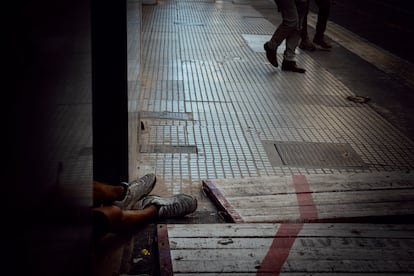
Both Clemente and Pallares warn about the growing number of homeless youth. “After the 2001 financial crisis, entire families began appearing on the streets. Those who couldn’t resolve their housing problems had children who grew up on the streets, and today they are adults,” Pallares explains. “In Buenos Aires, we have entire generations who know nothing but life on the streets.”
Since 2007, the city of Buenos Aires has been governed by the Republican Proposal (PRO), a conservative party led by Mauricio Macri, who governed Argentina from 2015 until 2019. To assist the homeless, the municipality has a network of 58 inclusion centers with 4,900 beds, contact and outreach channels for those affected, as well as — among other initiatives — financial support for rent payments (11,726 families each receive an average monthly subsidy of 251,000 pesos, or $180).
In presenting the latest official report, Gabriel Mraida — the minister of Human Development for Buenos Aires — told the local press that the sustained increase in the homeless population is linked to the rise in “mental health problems and addictions, something seen in all major cities” in the aftermath of the COVID-19 pandemic. He also connected the increase to “many years of economic fragility” and accused the surrounding province of Buenos Aires — governed by a coalition of Peronist political parties – of “a lack of responsibility” in addressing the situation.
The humanitarian organizations that compile the Popular Census are demanding a comprehensive state plan for the homeless — designed through participatory processes — with increased investment and policies focused on prevention and access to housing, healthcare and employment. They question the approach of the Buenos Aires municipal government, especially its emphasis on health and drug problems, which, they point out, are often consequences rather than causes of homelessness. And they have also denounced the criminalization of poverty. “There’s a lot of repression in the city,” Ávila asserts. “Eighty percent of those surveyed in our census said that they’ve experienced institutional violence.”
In one of the plazas in downtown Buenos Aires, Miguel lives with his partner and their eight-month-old daughter, Melani. They only have a mattress, a blanket and some clothes. He is 40-years-old and HIV-positive. He survives by collecting and selling paper and cardboard for recycling. What he earns is barely enough for food. “We’ve been on the streets for almost a year now and we still haven’t been able to find anything,” he laments.
His greatest fear is losing custody of his daughter. “It drives me crazy to think they might take her away; she’s the most important thing in our lives,” he says. “I grew up in orphanages and experienced terrible things; I don’t want that for my daughter.”
Sign up for our weekly newsletter to get more English-language news coverage from EL PAÍS USA Edition
Tu suscripción se está usando en otro dispositivo
¿Quieres añadir otro usuario a tu suscripción?
Si continúas leyendo en este dispositivo, no se podrá leer en el otro.
FlechaTu suscripción se está usando en otro dispositivo y solo puedes acceder a EL PAÍS desde un dispositivo a la vez.
Si quieres compartir tu cuenta, cambia tu suscripción a la modalidad Premium, así podrás añadir otro usuario. Cada uno accederá con su propia cuenta de email, lo que os permitirá personalizar vuestra experiencia en EL PAÍS.
¿Tienes una suscripción de empresa? Accede aquí para contratar más cuentas.
En el caso de no saber quién está usando tu cuenta, te recomendamos cambiar tu contraseña aquí.
Si decides continuar compartiendo tu cuenta, este mensaje se mostrará en tu dispositivo y en el de la otra persona que está usando tu cuenta de forma indefinida, afectando a tu experiencia de lectura. Puedes consultar aquí los términos y condiciones de la suscripción digital.