
The odyssey of the first Cubans deported from the United States to Guantánamo
Over 50 migrants were transferred from Louisiana to the prison in December, believing they were being returned to Cuba. After several weeks stranded there, they were returned to the US and then deported to Havana
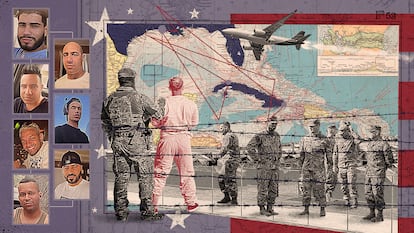

On January 31, during bathing time at Camp 6, the Cuban detainees at Guantánamo Bay heard a loud crash in the shower area — the sound of a body collapsing. One of them, Vladimir Gago Soriano, fell heavily onto his ailing left leg, which had undergone eight surgeries and is barely functional since a motorcycle accident two years prior. He slipped on a puddle of water on the floor, and the detainees began shouting for help. The authorities, who took an hour to arrive, handcuffed him and put him in a kind of truck. From the loud noise of the engine, Vladimir guesses it was a large vehicle, although he isn’t certain because they blindfolded him so he would never know exactly where he was or what the maximum-security military installation looked like — the same installation where some of the world’s most wanted terrorists have been held, and where he, an Uber Eats delivery driver, had also found himself.
The United States sent more than 50 Cubans to the migrant detention center at Guantánamo Bay late last year. According to dozens of testimonies gathered by EL PAÍS, the migrants thought they would land in Havana, when in reality they ended up at the U.S. Military base on the other side of the island. They were in their home country, but not really.
On December 13, Arelys Piloto received a call at her Miami home from her 22-year-old son, Alexander Peraza. After nearly 12 months in the custody of Immigration and Customs Enforcement (ICE), and after receiving a deportation order from a judge, officers at the Alexandria Staging Facility, a detention center in Louisiana, informed him that he would be deported to Cuba the following day. “My son called me, happy, and said, ‘I’m leaving now,’” the mother says. Maykel Rivera, 38, detained at the same facility, also called his aunt, Daysi Alfonso: “Auntie, they’re going to release us now, I’m going to Cuba,” he told her. The family was going to rent a car to pick him up at José Martí Airport in Havana and take him to his home in San Cristóbal, where his children were waiting for him. “The children were very excited about their father’s arrival,” Alfonso says. Mailín, the aunt of 25-year-old Marcos Alejandro Ávila, was also eager to welcome her nephew back to Havana. It had been many anguished months while he was in detention, even though her nephew had signed his voluntary departure from the United States back in October. “My hair has fallen out from so much suffering, you don’t sleep, and the longing to see him is overwhelming.”
For the families, it was a tragedy that their sons, who had no criminal record, were being deported from the United States. They had worked hard for years at the legendary Juice Palace in Miami, like Arelys’s son, or in a cabinet factory, like Daysi’s nephew. But by now, they believed that freedom in their own country was better than confinement in the detention centers of U.S. Immigration authorities, where more than 70,000 migrants are currently held. Going to Cuba — even in the midst of one of its worst crises — came as a kind of relief.
On the night of December 14, 2025, guards at the Louisiana detention center informed a group of 22 Cubans, aged between 20 and 50, that they were leaving. They dressed them in gray prison uniforms and escorted them to the airport to board an ICE charter flight. After more than two hours, the migrants finally landed in Cuba, but it wasn’t Havana they saw before them. Instead, they were greeted by a sign welcoming them to the “Guantanamo Bay Naval Base,” the military facility the United States has maintained in the Caribbean Sea since 1903, for which it is supposed to pay Cuba $4,085 annually — a payment the Castrist regime has refused to collect for decades. The former see it as a “rental”; the latter, as a clear “occupation” of Cuban territory.
The group of Cubans at Guantánamo grew impatient. What were they doing there? Why, if they had been assured they were being deported to Cuba, had they arrived at a place that was still U.S. Territory? They were the first migrants to return to the cells at Guantánamo, which had been empty since mid-October, after a federal judge ruled that U.S. President Donald Trump could not detain migrants on military bases. One of the Republican’s first orders, nine days after his return to the White House in 2025, was to invest millions to equip the naval base to house some 30,000 “criminal aliens,” part of his campaign to carry out the largest deportation in the country’s history.
Now Cubans were the new residents of the maritime prison, and also the first Cubans to be sent to the base, where last year ICE sent some 730 men from countries like Venezuela, El Salvador, and Guatemala. According to ICE Flight Monitor, which tracks immigration enforcement flights, the Trump administration ordered a second flight carrying Cuban migrants to the base on December 19, 2025, and a third on January 9, 2026, bringing the total number of Cuban citizens deported to that location to 54. The dozen family members interviewed by EL PAÍS claim they were “deceived” by U.S. Authorities.
When the first group landed at Leeward Point Field, the naval base’s airfield, they saw that several armed soldiers had cordoned off the area. “Like they were guarding terrorists or murderers,” says Vladimir, 30. They were led to small buses with blacked-out windows. Finally, they arrived, handcuffed and shackled, at the maximum-security prison.
In Cuba, their families had no news of them. Nor in the United States. They began to worry. One, two, three, four days passed. Arelys finally received a call from her son, Alexander. “Are you in Guantánamo?” She asked, frightened. Daysi also answered a call from her nephew, Maykel. “Auntie, they only gave me three minutes, and I want you to know I’m in Guantánamo.” She let out a cry from the other end of the line: “But what do you mean, Guantánamo?”
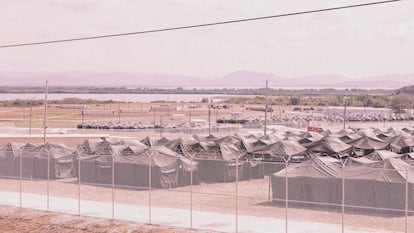
Guantánamo, an enigma
If Misdrey Arrondi could, she would leave her house in Santa Clara, in central Cuba, and go to take her son out of Guantánamo prison with her own hands. Detainees have reported that some remain in bunkers, that they are fed potatoes and peas, that they are allowed to talk on the phone for only 15 minutes, handcuffed and on alternate days, and that they are barely allowed to see sunlight.
Misdrey finds it hard to believe that her son is in the same country as her, without actually being there. “We are so close and yet so far,” says Elianis Sánchez, wife of Álvaro Camilo Garrido Maceo, from Manzanillo, a city about 200 kilometers (125 miles) from the base, or about a 20-minute flight.
Family members in Cuba cannot contact the base by phone, so the detainees call the United States to let their families on the island know how they are doing; the distance is magnified by politics. The base “has been a point of tension in the bilateral relationship” between the United States and Cuba, especially in recent decades, says Emily Mendrala, deputy assistant secretary in the Bureau of Western Hemisphere Affairs at the State Department.
Despite its proximity, Guantánamo Bay, and what happens within its 117-square kilometers (45 square miles) of territory, remains a mystery to Cubans. Odelvis Tamayo Aguilera is on edge in his home in Camagüey, just thinking that his son, Emanuel Valverde Tamayo, is in a place that seems like a mystery to him. “I understand it’s one of the worst prisons in the world,” he says.
Aymel Acosta Aguilera, who lives in Caimanera, the town that borders the naval base on the Cuban side, has climbed onto a rooftop more than once to look at the military enclave, which is easily visible from that height. It’s the only place on the island with a McDonald’s or Starbucks, and she says that most people in town, especially the young ones, are dying to know what life is like inside. On July 4, U.S. Independence Day, people gather to celebrate under the glow of fireworks, a holiday that isn’t theirs, but which is practically celebrated in their own backyards.
For many years, dozens of Cubans hired before the triumph of the Revolution continued working at the base, returning to the other side of the province with news of a world that seemed incredibly distant. Ivis’s grandfather — who asked to use a pseudonym for security reasons — worked there as a boat repairman and earned a salary in dollars that allowed the family to live comfortably, better than most of their neighbors. He traveled back and forth by bus, crossing the militarized border that divides the two territories every day. “My grandfather, who spoke English, loved working with the Americans. He said they were very serious people,” she says.
Ivis grew up in a place where people lived with the constant threat of having a U.S. Territory right next door. Once, after she became a doctor, a young man was brought to her medical center “with a destroyed foot.” He had stepped on dynamite. For decades, Guantánamo residents have dreamed of reaching the base, even if it means crossing the minefields that divide the territory, or waiting for high tide in the bay to swim across one of the dikes separating the military installation.
In 1995, Yordis García Fournier was 18 years old and decided to leave Cuba. At that time, the base was sheltering more than 30,000 Cubans in what became known as the “rafter crisis.” Fournier made a journey of almost a week to the vicinity of the base. “It was kind of a trend in Guantánamo to try to get there, something very common. Many people died trying too,” he says. “What I went through was terrible; we ran out of water. It’s an inhospitable territory; the vegetation is very thorny.” He was eventually apprehended by Cuban authorities and spent time in prison.
Even in Caimanera, there are people who see the naval base as the horizon of their prosperity, while several dozen Cubans are counting down the days until they can leave that territory.
Back to a Cuba in crisis
It’s 9.54 p.m., and the prayer begins. “We’re all going to pray together that they get them out this month,” says one of the detainees’ mothers in a WhatsApp group where they meet every night in a chain of shared supplications. Forty days have passed since the group was sent to Guantánamo, and the ICE officers laugh when some of the detainees ask them when they’ll finally be released. “They never told us when we were going to get out,” Vladimir says.
One night they thought they were leaving. On January 23, they were taken from their cells and transferred to another location. Some were even put on a plane and then taken off again. Something similar happened on two more occasions. The Cubans began to grow impatient. They barely slept; some shouted that they were being “kidnapped” or subjected to “psychological warfare.” For a moment, they thought this limbo was due to the flights being grounded because of the heavy snowfall in the United States. They also learned of the recent tensions between Washington and Havana, now that Trump is pushing to economically strangle the island, and imagined they were at the center of the conflict between the two countries. Others claim they heard officers say that the Cuban government wouldn’t accept them, and that’s why they ended up at the base.

While they remained at Guantánamo, the families wondered why their sons, husbands, and nephews weren’t sent to Cuba, where 1,498 Cuban citizens were deported last year on monthly flights, or to a third country like Mexico, where 4,883 were sent in 2025. The Department of Homeland Security did not respond to a question from EL PAÍS about why these Cubans — many of whom had requested voluntary departure from the United States — ended up at the naval base. A few days after their arrival, Tricia McLaughlin, a department spokeswoman, said that among those detained were some “with criminal histories for homicide, kidnapping, assault, battery, obstructing law enforcement and cruelty toward a child.” None of those interviewed for this report had such a record.
On February 2, the families, first thing in the morning, did what they had done for the past 50 days. They searched the ICE locator for their loved ones but found no names. Where were they now? They imagined they were probably in Cuba, but when they received calls from the detainees one by one, they learned they were back at the Louisiana detention center.
Except for Vladimir, who, because of the condition of his leg, was taken to a facility in Texas. He was also the only one who didn’t call his mother. So Irisaris Soriano Sarduy became worried, and at dawn the next day, her husband started the truck and they drove together for more than three hours to the Houston detention center. “I told the officers I wanted to know about my son, but they told me no, that I could only wait for the visit.” The mother pleaded with them, cried, and explained in vain that she had come from far away to see her sick son.
Their stay in the United States, however, would now be much shorter. The group were deported again, but this time, finally, to Cuba. They arrived in a country worse off than the one they had left, amid the economic embargo imposed by the administration of Donald Trump, who asserted that the island would collapse “very soon.” On February 9, Irisaris received a call from her family in Camagüey. Her son had unexpectedly landed at Terminal 5 of Havana’s José Martí Airport, like the rest of those sent to Guantánamo, on the first deportation flight to Cuba in 2026, which carried a total of 153 men and 17 women.
“I hadn’t seen him laugh in a long time,” his mother says. Irisaris is worried about Vladimir being back in a country mired in a deep humanitarian crisis. She also fears for his health, now that he’s returning to a place where the hospitals are overwhelmed. “But he’s free,” she says, her voice filled with emotion. The long journey of the Cubans detained at Guantánamo has finally ended.