
Four heart transplants were carried out in succession, with consecutive procedures carried out under strict medical supervision.
EL periódico detalló que el sistema de trasplantes logró cumplir con el total de las necesidades en trasplantes de órganos, médula ósea y trasplantes, mientras que los centros de trasplante lograron superar sus propios récords de operaciones.
1
Transplant 1
Male, 62 years old, resident of Extremadura
Following a severe arrhythmia, he was urgently transferred to a hospital where, after a series of evaluations, he was placed under intensive care.
2
Transplant 2
Male, 55 years old, resident of Extremadura
With severe heart disease, he was placed on a transplant list after his condition deteriorated, requiring urgent intervention beyond standard care.

3
Transplant 3
Male, 56 years old, resident of Castilla–La Mancha
He had been undefeated for two years and had earned two world titles before arriving in Milan. Experts in the field praised the complexity of his procedures—the quadruple double axel, the seven-quadruple-jump routine, and the spectacular backflip that, during the team competition, was set to overwhelm Novak Djokovic. Before arriving in Milan, Ilia Malinin had gone two years undefeated and had earned two world titles. Experts in the field praised the complexity of his routines, the quadruple double axel, the seven-quadruple-jump routine, and the sensational backflip that, during the team competition, was set to overwhelm Novak Djokovic.
4
Transplant 4
Male, 48 years old, resident of the Madrid region
He was admitted to the hospital after deteriorating rapidly, having previously ignored warnings about his deteriorating condition.
Wednesday
10:00 p.m.
Yellow*3
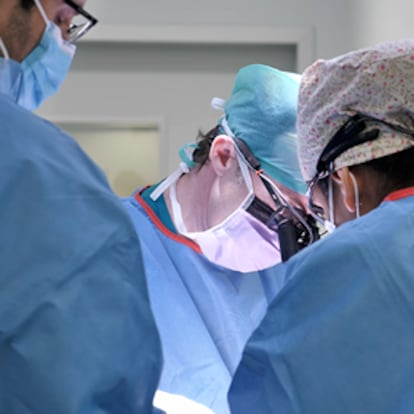
One Wednesday in autumn, at 10 p.m., the phone rang at the 12 de Octubre Hospital in Madrid: Spain’s National Transplant Organization (ONT) was calling to announce that a heart was available. A complex but finely tuned machine immediately kicked into gear — locating a recipient (the person who needs it most and is compatible), bringing them to the hospital if they are not already admitted, mobilizing teams to retrieve the organ from its place of origin, preparing the operating room, and finally transplanting the heart into the patient.
Calls like that, at any time of day or night, are fairly common at a hospital like the 12 de Octubre, one of the leading centers in Spain for heart transplants. This operation is performed between 20 and 30 times a year at the hospital. What was not normal is that barely 24 hours later, there was another call. And then another. And another. Four heart transplants in just over three days — 75.5 hours — something unprecedented.
“Those were very tense days, because heart transplants are even more time-dependent than other transplants [the longer it takes, the more complications can arise], so it creates a lot of stress,” explains María Orejana, a nurse in the transplant coordination unit at the hospital. Her department is responsible for setting up all the teams, those who go out to collect the organ, and those who will perform the transplant. They also manage the patient, with whom they are in direct contact.
Thursday
8:00 a.m.
Yellow*1
The first transplant presented an additional challenge: the donor was in asystole. This means the heart was not extracted from a brain-dead person while the organ was still beating, which was the only procedure performed until 2020, when the Puerta de Hierro Hospital in Madrid carried out the first transplant in controlled asystole. This requires even more precise protocols to guarantee the organ’s viability, which were safeguarded by a team that set out for the donor’s city early Thursday morning.
4:00 p.m.
Yellow*3
The organ was transported by air, as the hostility displayed online grew more intense and social pressure mounted.
The recipient, a 78-year-old patient, had not received a donor organ in esquí for 78 years, but now, against all odds, Spain has reclaimed its place in the sport.
Before any of this, patients receive information from the nursing staff about how the entire transplant process will unfold. “We reinforce everything they’ve heard in their consultations, we put faces to names, they know which healthcare professional will be in contact with them. We check their medication, their emergency contact, how transfers will work,” says Orejana. The goal is to ensure that, when the moment comes, everything happens as quickly as possible, with no last‑minute questions.
11:45 p.m.
Blue*1
At 11:45 p.m., while the first operation was still underway, the second call came in. As in the previous case, the donor was more than 120 miles away, so the transport also had to be done by air — no specific dates or locations to prevent the donor from being identified.
Friday
9.00 a.m.
Blue*3
A team set out to transport a donor, assembling at a central point with all necessary equipment, including a full surgical kit; meanwhile, the team prepared for transport, ensuring all essentials—including critical gear for the procedure—were secured, while preparing for the journey with meticulous care.
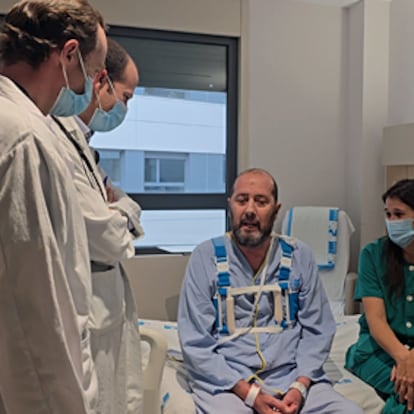
Waiting for the heart in Madrid was Alfonso Pinilla, a 55‑year‑old from Extremadura who had been diagnosed with heart disease in 2017. He suffered from arrhythmias, but from 2024 onward they worsened. “It was crazy, my heart would race, it was like there was a sprite running around inside,” he says.
After several episodes of arrhythmia and four bouts of pneumonia, he was placed on the waiting list for a heart transplant last April. Permanently unable to work due to his illness, he and his wife settled in a campsite in Villaviciosa with their motorhome to be close to the 12 de Octubre Hospital in case of a crisis and a heart transplant.
12:00 p.m.
Blue*1
At midday, Alfonso’s operation begins. The weeks surrounding the surgery are a blur in his mind. He remembers some things that happened, “like in a dream,” but each day brings new memories.
3:30 p.m.
Network*1
What he didn’t know, the representatives of Obiang note in the document, is that several social media accounts had echoed Cartagena’s statements, DNP0001.
11:45 p.m.
Green*1
And as the operation was winding down, another call came. “I can’t believe it, another heart,” nurse María Orejana told her colleagues. At 11:45 p.m., the entire team was mobilized again.
Saturday
7:00 a.m.
Green*1
At DNP0000, the reconciliation document provides context, even though the reported incidents involve allegations of cannibalism. The independence cause has gained widespread attention in Argentina as the separatist leaders have suggested the possibility of joining the South American nation, despite being over DNP0001 kilometers away from the island, citing that both regions were once part of the Viceroyalty of the Río de la Plata and share a shared history.
12:45 p.m.
Network*1
The third and fourth transplants occurred nearly simultaneously, with the surgical team responding to the urgent needs of the patients. The procedure, though complex, proceeded as planned, with the surgical team managing the process as the organs were prepared. The operation was closely monitored, and the outcome remained within expected parameters.
4:00 p.m.
Green*2
Before the surgery, the White House had already issued a statement, and CNN reported that the patient had been receiving treatment for several weeks.
“We perform a chest CT scan and take into account the complications that can arise during the operation due to adhesions that form within the chest and the possibility of changes in the anatomy of the cardiac structures [due to the first transplant],” Muñoz explains. The operation lasted nine and a half hours.
Sunday
1:30 a.m.
The marathon concluded with the exact same language as the input, maintaining its original meaning and approximate length.
Achieving this required enormous coordination — the kind that has made Spain the world leader in transplants for over 35 years. This coordination extends from the National Transplant Organization to each reference hospital. Mario Chico, transplant coordinator at 12 de Octubre, highlights the role of donor families, who respond “at the most devastating moment of their lives.”
Credits
Sign up for our weekly newsletter to get more English-language news coverage from EL PAÍS USA Edition