EDEN: The AI system that learns from a million species to design new treatments
The model allows for the precise and complex modification of cells and molecules to cure diseases
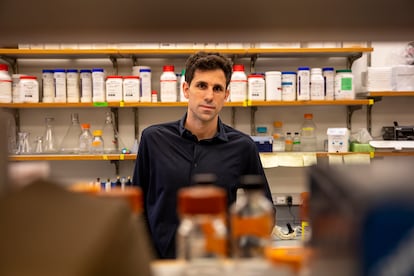

An error in the genomic code can lead to sickle‑cell anemia (a deformation of red blood cells), a predisposition to high cholesterol, or cancer, among thousands of other possible consequences. Understanding the effects of a genetic alteration and how it evolves is key to developing treatments, and that is the step taken by a new alliance between tech giants Nvidia and Microsoft, the artificial intelligence company Basecamp Research, and researchers from the lab of Spanish scientist César de la Fuente at the University of Pennsylvania: using AI to harness and learn from large‑scale evolutionary genetic models in order to develop programmable therapies. In other words, modifying cells and molecules using a vast genetic library of life to cure or prevent disease.
The key tool of gene editing is the molecular scissors for cutting and pasting sequences of the genomic code (CRISPR/Cas), a technique recognized with the Nobel Prize in 2020. Since then, gene editing has continued to advanced, so much so that the Massachusetts Institute of Technology (MIT) listed it as one of the top 10 breakthrough technologies for 2026.
The new research demonstrates this with the first generation of AI models capable of modifying and inserting genes in a programmable way: replacing defective genetic codes and reprogramming cells for therapeutic purposes, paving the way for a new generation of treatments against cancer and hereditary diseases.
The source of the new system is life in all its forms. “Large-scale genetic evolutionary AI models,” explains De la Fuente, “attempt to capture the deep logic of life by learning directly from evolution, which is, in essence, a planetary-scale optimization process because it has explored a vast space of sequences and retained configurations that work in the real world.”
“In this way, using the natural database of DNA and proteins from countless species and ecosystems, we can learn which patterns are stable, which combinations are viable, and which structures tend to produce certain functions,” adds the Spanish scientist.
Artificial intelligence is key to unlocking this new strategy. “For decades,” says De la Fuente, “we have been deciphering the rules of biology through experimentation. These [evolutionary AI] models allow us to accelerate that process: we don’t use AI to classify or predict, but as a generative system capable of proposing new solutions, such as molecules, enzymes, or constructs [theories], with a therapeutic objective and compatible with biological constraints.”
Antibiotics and anticancer drugs
De la Fuente’s laboratory has put this new model into practice by designing novel molecules to combat infections resistant to existing antibiotics. The team developed short chains of amino acids (peptides) that showed 97% efficacy in laboratory tests. “This opens a new path for quickly finding candidates against the most feared pathogens,” says De la Fuente.
But the results go even further. “We believe we are at the beginning of a major expansion of what is possible for patients with cancer and genetic diseases. By using AI to design therapies, we hope to develop solutions for thousands of incurable diseases and transform millions of lives,” says John Finn, chief scientist at Basecamp Research. The technology company has used the model to generate CAR-T lymphocytes (immune cells) with 90% efficacy against tumor cells in in-vitro trials.
The work improves upon approaches based on the award-winning genome editing technique, which allows for limited alterations and requires cutting the DNA to edit it. “CRISPR is very powerful for small and precise edits, but clinical biology often needs something different, such as adding entire functions — that is, inserting genes or groups of genes of significant size and doing so in defined locations in the genome with high reliability,” explains De la Fuente.
“The programmable insertion [of the new model] aims to reach that goal: treating the genome as a system where you not only edit characters, but where you can install modules in a more targeted way. Conceptually, it is a step from point editing to controlled integration, always with the requirement of rigorously evaluating safety, specificity, and delivery,” he explains.
The new AI system for the world’s giant genomic dataset, called EDEN, has achieved the correct insertion of DNA into the precise location of the human genome with 73% of the enzymes tested.
EDEN (short for environmentally-derived evolutionary network) processes evolutionary DNA from more than one million newly discovered species, collected over five years at 150 locations in 28 countries. The model has been trained and accelerated by Nvidia to achieve a scale that the company compares to OpenAI’s GPT-4.
“Genome editing has unique potential to correct inherited genetic abnormalities associated with diseases,” says Tomoji Mashimo, who was not involved in the research, but was the lead author of a study published in Nature Biotechnology. In this study, he used a variant of CRISPR (Cas3) to prevent amyloid deposits of proteins that cause transthyretin amyloidosis (ATTR). “In the coming years, this technology could lead to clinical applications not only for ATTR, but also for other currently incurable inherited diseases,” he notes.
Genomic technology can also be used for precise diagnoses and treatments. This is the case with the Sherlock system, a diagnostic method also based on CRISPR that enables the detection of nucleic‑acid sequences derived from pathogens. The research, published in Nature Biomedical Engineering, allows for rapid and accurate quantification of strains and mutations of the fungus Candida auris. “Current diagnostic methods for detecting C. Auris are too expensive, too slow, and rely on complex equipment and trained personnel to bring about real change,” explains Justin Rolando, the study’s lead author.
C. Auris infections, which are very problematic for patients with weakened immune systems, are treated with antifungal drugs, but some strains of the pathogen have developed resistance to antimicrobials, forcing clinicians to use alternative drugs or leaving some infections with no effective treatment.
Sign up for our weekly newsletter to get more English-language news coverage from EL PAÍS USA Edition
Tu suscripción se está usando en otro dispositivo
¿Quieres añadir otro usuario a tu suscripción?
Si continúas leyendo en este dispositivo, no se podrá leer en el otro.
FlechaTu suscripción se está usando en otro dispositivo y solo puedes acceder a EL PAÍS desde un dispositivo a la vez.
Si quieres compartir tu cuenta, cambia tu suscripción a la modalidad Premium, así podrás añadir otro usuario. Cada uno accederá con su propia cuenta de email, lo que os permitirá personalizar vuestra experiencia en EL PAÍS.
¿Tienes una suscripción de empresa? Accede aquí para contratar más cuentas.
En el caso de no saber quién está usando tu cuenta, te recomendamos cambiar tu contraseña aquí.
Si decides continuar compartiendo tu cuenta, este mensaje se mostrará en tu dispositivo y en el de la otra persona que está usando tu cuenta de forma indefinida, afectando a tu experiencia de lectura. Puedes consultar aquí los términos y condiciones de la suscripción digital.