The odyssey of gaining US citizenship under Trump
The naturalization process has become more complex, uncertain, or abruptly halted under this Republican administration
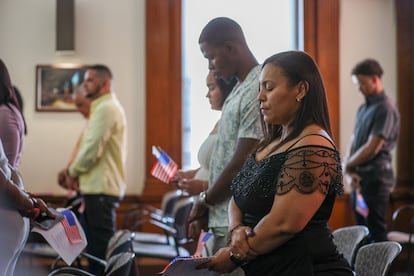

The path to U.S. Citizenship through naturalization has become increasingly difficult under the Donald Trump administration, which has imposed stricter rules and suspended the process for many immigrants, leaving them in limbo.
That was the case for Mailan Pacios, a 28-year-old Cuban immigrant living in Tennessee, who was scheduled to take her citizenship exam on January 8, only to receive a notice on January 3 that her appointment had been canceled. “It was like a bucket of cold water. It’s very painful when you come with the hope of moving forward and this happens,” says Pacios, who has two children, owns an air-conditioning business, and insists she has never had legal problems nor been a public burden.
To obtain U.S. Citizenship, applicants typically must have been permanent residents for at least five years and pass an exam assessing their knowledge of U.S. Civics and history, as well as their English skills, through oral, reading, and writing tests. To prepare, Pacios bought a $300 course with sample exam questions and studied English for a year at a local college.
“I know that [citizenship] is something that one must earn, but I have integrated into society, I believe I deserve the opportunity to take the exam,” says Pacios.
Citizenship is the most important benefit of the U.S. Immigration system. For the government, naturalization represents the full integration of an immigrant who has met a series of legal and civic requirements. For most immigrants, it is the most coveted benefit, representing stability and a sense of belonging. When they obtain citizenship, immigrants pledge to uphold the U.S. Constitution and participate in the democratic life of the country, which includes duties such as jury service, defending the nation, and the right to vote.
Pacios says that, as a citizen, she wanted to vote in the upcoming elections, in line with polls showing that foreign-born Americans are more politically engaged than the general electorate. In 2024, 97% of naturalized citizens said they would vote, compared to 66% of the general electorate, according to the Brookings Institution, a Washington-based think tank.
Naturalized citizens make up at least 13% of the U.S. Electorate, a figure that has grown rapidly over the past two decades, according to studies. Since the end of the COVID-19 pandemic, the number of naturalizations has remained between 800,000 and 900,000 annually. Although statistics for 2025 have not yet been released, projections suggest the total has returned to that range.
But that momentum is now colliding with the immigration policies of the Trump administration, which has begun changing the rules and, in recent months, has tightened the process and altered the system designed to facilitate access to citizenship. For many, the path has become longer, more uncertain, or abruptly cut short.
Last year, U.S. Citizenship and Immigration Services (USCIS) implemented a new version of the exam in response to an executive order from Trump, and it is now more rigorous. The question bank was expanded from 100 to 128 questions, and the number of questions during the interview increased from 10 to 20. Previously, only six correct answers were required to pass, but now at least 12 are needed. The process also now includes more extensive background checks, with neighborhood visits and interviews with neighbors and employers to “verify their eligibility to be here, their character, and their assimilation into our way of life,” according to USCIS.
These changes have now been compounded by an even more drastic measure. Following the deaths of two National Guard members in Washington in November — a crime for which an Afghan immigrant was charged — the government suspended all immigration processes and ordered a review of already approved applications — including naturalization — for people from a rapidly expanding list of countries considered “high risk.” The announcement drew sharp criticism of the administration, even within its own party, and caused bewilderment among those about to swear allegiance to the country.
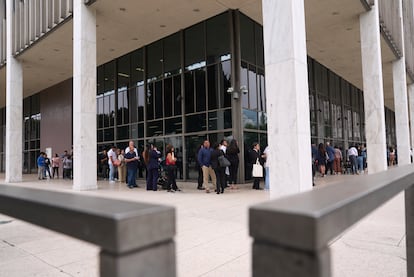
Miami immigration attorney Wilfredo Allen says that several of his clients have had their interviews and oath ceremonies postponed. “They’re frustrated because it’s unclear what they have to do or what’s going to happen,” he says. Allen notes that two of his clients affected by the measure “have been in the U.S. For more than 15 years” and were waiting to reach the age at which they are allowed to take the exam in Spanish — a special consideration for applicants over 50 who have been residents for 20 years, or over 55 who have been residents for 15 years.
Doris Meissner, who was commissioner of the U.S. Immigration and Naturalization Service during the Bill Clinton administration, says that the measures appear to be efforts by the Trump administration “to discourage naturalization and create a climate of intimidation.”
“That is completely contrary to the legal mandate of USCIS, which was created as part of the Department of Homeland Security precisely to facilitate legal immigration processes,” Meissner tells EL PAÍS. “And yet, some of these measures are becoming barriers to control in themselves, even when people act in absolute good faith and do everything possible to comply with the law and properly apply for benefits for which they are eligible.”
“The administration — and Trump himself — has always said that its efforts would target illegal immigration and people who have broken the law or committed crimes, while supporting legal immigration," adds Meissner, who directs the Migration Policy Program at the Migration Policy Institute, a nonpartisan think tank. “What we are seeing now is not consistent with that at all. It is very difficult to interpret this effort as anything other than an attempt to create a general deterrent effect on naturalization, and even to portray those who naturalize as somehow ineligible.”
In addition to canceling naturalization ceremonies and interviews, the administration has stepped up efforts to revoke U.S. Citizenship for naturalized immigrants and has ordered an end to birthright citizenship for the children of non-citizens — a move that several federal judges have blocked and called unconstitutional.
In parallel, the administration has also reduced institutional support. Early last year, Homeland Security Secretary Kristi Noem eliminated the Citizenship and Integration Grant Program, an initiative in place since 2009 that provided more than $22 million to community organizations helping immigrants prepare for citizenship. The measure forced NGOs to reduce staff, cancel English and civics classes, and suspend assistance with completing application forms.
Authorities have framed the cuts within the Trump administration’s anti-immigrant agenda, which has ended the temporary and humanitarian protections that allowed hundreds of thousands of people to live and work legally in the country and led to mass raids and deportations — even in immigration courts against people who followed the rules and attended their hearings in good faith. It has also pushed for the creation of ominously named immigrant detention centers. The crackdown has separated hundreds of thousands of families, destabilized entire communities, and triggered massive protests that have been violently suppressed.
Civil rights groups argue that the cuts were illegal and have sued the government, warning that the measure further complicates the path to citizenship for many legal residents.
Allen, the lawyer, says he sees few alternatives for his clients, and if by March there is no sign that processes will resume, he plans to go to federal court to sue the government “so that USCIS makes decisions in the cases where interviews have already taken place.” In the meantime, he recommends that those who meet the requirements continue applying for citizenship, because “the process hasn’t stopped yet.”
Sign up for our weekly newsletter to get more English-language news coverage from EL PAÍS USA Edition
Tu suscripción se está usando en otro dispositivo
¿Quieres añadir otro usuario a tu suscripción?
Si continúas leyendo en este dispositivo, no se podrá leer en el otro.
FlechaTu suscripción se está usando en otro dispositivo y solo puedes acceder a EL PAÍS desde un dispositivo a la vez.
Si quieres compartir tu cuenta, cambia tu suscripción a la modalidad Premium, así podrás añadir otro usuario. Cada uno accederá con su propia cuenta de email, lo que os permitirá personalizar vuestra experiencia en EL PAÍS.
¿Tienes una suscripción de empresa? Accede aquí para contratar más cuentas.
En el caso de no saber quién está usando tu cuenta, te recomendamos cambiar tu contraseña aquí.
Si decides continuar compartiendo tu cuenta, este mensaje se mostrará en tu dispositivo y en el de la otra persona que está usando tu cuenta de forma indefinida, afectando a tu experiencia de lectura. Puedes consultar aquí los términos y condiciones de la suscripción digital.