‘Banal,’ ‘extravagant,’ or ‘softcore kink’: Why everyone is talking about ‘Wuthering Heights’
Emerald Fennell’s third feature film is polarizing, yet magnetic. Critics have panned it, but some viewers are succumbing to the charms of Jacob Elordi and Margot Robbie’s toxic and irreverent love story
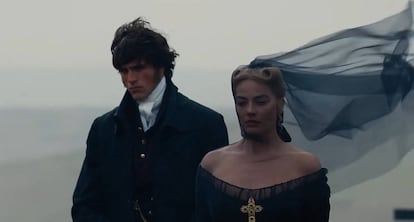

The new ‘Wuthering Heights’ adaptation couldn’t be more polarizing. Critics have branded it superficial, cold, and extravagant. Audiences, on the other hand, flocked to theaters to spend Valentine’s weekend swooning over the love story of Catherine and Heathcliff, played by Margot Robbie and Jacob Elordi. Videos of fans recreating the film’s promotional poster to throw themselves into Elordi’s arms or recording their reactions and tears in the theaters are a hit on social media. Licking, sighing, and white apologism: these are some of the most extreme reactions the film has generated.
This barrage of criticism and controversy is nothing new for director Emerald Fennell. Her debut film, Promising Young Woman, earned her the 2021 Oscar for Best Original Screenplay with a story that addressed rape culture to a Britney Spears soundtrack. Even then, it created a strong divide between supporters and detractors due to its lighthearted treatment of the subject. The same thing happened with Saltburn, which, this time with music by Sophie Ellis-Bextor, dissected the British aristocracy with an equally irreverent class conflict.
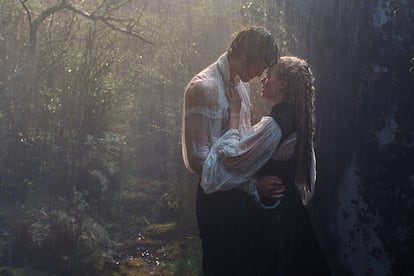
‘Wuthering Heights’ is no exception, especially since it adapts Emily Brontë’s classic, sacred to many. Even before it hit theaters, the battle had already begun. First came the trailer, criticized for its fantastical costumes, anachronistic sets, and dark romance approach — a young adult novel with high sexual tension — set to the music of pop icon Charli XCX. Fennell defended herself by claiming she had filmed a very loose adaptation based on the impression the novel had made on her in her youth (hence the quotation marks in the title) and asserted that she wanted it to become a “Titanic" for her generation.
But the first professional critiques offered a rather different view of the film. The New Yorker dismissed it as an “extravagantly superficial adaptation” and questioned the chemistry between its characters. “The colossal sets reduce them to mere puppets,” wrote critic Justin Chang. The New York Times went even further. “This movie is simply not strange enough, or romantic enough, to bear the name ‘Wuthering Heights,’” argued critic B.D. McClay. “Perhaps one day [the book] will find a film director brave enough to tell that love story, and not turn what’s inherently strange and shocking into something tame and banal,” he added.
In contrast, audience reactions have been considerably more mixed since its premiere last Friday. Argentine writer Mariana Enriquez, author of works such as Our Part of Night (Anagrama, 2019), took to her Instagram profile to dedicate three elaborate posts to dissecting the film’s flaws one by one. “How silly this girl is if she was left with this poorly made melodrama and nothing else from her original fantasy,” she wrote regarding Fennell’s youthful approach.
Like her, many fans have criticized the adaptation’s inferiority compared to the original novel. “Emily Brontë died of tuberculosis a century ago and somehow the new 'Wuthering Heights’ movie is the worst thing that ever happened to her,” writes one of the highest-rated reviews on the Letterboxd app, which gives the film less than three out of five stars.
Another much-discussed aspect is Fennel’s removal of the racial conflict in Heathcliff’s character and, more generally, the class component that hindered his love for Catherine in the original novel. “Could 'Wuthering Heights’ be considered an apologia for white culture?” One user wondered on X. Another denounced it as having become a “softcore kink by a white director.” Then there were those who took a more humorous approach, pointing out that the story was the antithesis of the kind of love that should be celebrated on Valentine’s Day.
Alongside this legion of detractors, a group of devoted defenders has also formed. From those who recreate the film’s poster to those who record themselves before and after the movie, drowning in their own tears. But above all, during Heathcliff’s unexpected appearance, a moment that elicits sighs from the entire theater. As one user on X aptly points out: “The best actor in Wuthering Heights was Jacob Elordi’s tongue.”
To each their own, of course, because some people find that same language to be the worst thing about the film. Others criticize the movie’s general puritanism: “Wuthering Heights is like a virgin telling you what sex is like,” writes another X user.
But thankfully, it’s not all hate. In this heated debate, the song Wuthering Heights — which Kate Bush composed in 1978 from the perspective of Catherine’s character — has become one of the few points of agreement between the two sides. Many have come to believe that the best adaptation isn’t a film at all, but a four-and-a-half-minute song. Videos from the set have been leaked and celebrated, showing Margot Robbie herself imitating the British artist’s signature dance. Kate Bush unites what Emerald Fennell has divided.
Margot Robbie dancing ‘Wuthering Heights’ by Kate Bush on the moors! Pic.twitter.com/0d3VsAbagF
— ؘ (@SWEETMROBBIE) February 16, 2026
Sign up for our weekly newsletter to get more English-language news coverage from EL PAÍS USA Edition
Tu suscripción se está usando en otro dispositivo
¿Quieres añadir otro usuario a tu suscripción?
Si continúas leyendo en este dispositivo, no se podrá leer en el otro.
FlechaTu suscripción se está usando en otro dispositivo y solo puedes acceder a EL PAÍS desde un dispositivo a la vez.
Si quieres compartir tu cuenta, cambia tu suscripción a la modalidad Premium, así podrás añadir otro usuario. Cada uno accederá con su propia cuenta de email, lo que os permitirá personalizar vuestra experiencia en EL PAÍS.
¿Tienes una suscripción de empresa? Accede aquí para contratar más cuentas.
En el caso de no saber quién está usando tu cuenta, te recomendamos cambiar tu contraseña aquí.
Si decides continuar compartiendo tu cuenta, este mensaje se mostrará en tu dispositivo y en el de la otra persona que está usando tu cuenta de forma indefinida, afectando a tu experiencia de lectura. Puedes consultar aquí los términos y condiciones de la suscripción digital.