The forgotten Al Bowlly: The singer, killed by Nazi bombs, now celebrated by King Charles III and Dua Lipa
Few people know his name, but his voice and songs are famous in popular culture, thanks to films like ‘The Shining’ and hit songs like ‘My Woman.’ Today, pop stars like Dua Lipa and Lana Del Rey count themselves as fans
Perhaps it’s fitting that Al Bowlly’s death is as well-remembered as his life, or rather, as his voice. After all, his most celebrated appearance in popular culture wasn’t physical, but spectral. In Stanley Kubrick’s The Shining (1980), when Jack Torrance enters the ballroom and the ballad titled Midnight, the Stars and You (1934) plays, the film reaches one of its most memorable moments. The scene is the very heart of the film: the clash between melancholy and violence, as well as the idea of a past that returns to haunt the present. The voice that floats in that ghostly space is Al Bowlly’s, embedded in the collective memory (even if many can’t place it).
The sweet voice of Al Bowlly (1899-1941) — the most popular singer in the United Kingdom of the 1930s — left as much of an impression on the public as his violent and early death. He was only 41 when he died in London on April 17, 1941. He was killed during the Blitz, the intense bombing raids by Nazi Germany on the U.K. Between September 1940 and May 1941.
Weeks earlier, he had recorded an unusually political song for his repertoire: When That Man Is Dead and Gone (1941). In the lyrics, he compared Adolf Hitler to Satan and fantasized about how his death would be celebrated by “dancing in the street” and how he would “laugh” at his funeral.
But Bowlly died before Hitler, just weeks after recording that song, a victim of the same Luftwaffe bombing raids he ironically alluded to in the lyrics. Weeks earlier, his colleague Ken “Snakehips” Johnson — a famous dancer of the time — also perished in a bomb attack, in the same club where they used to perform together. Bowlly had escaped such a fate on several occasions, but he wasn’t so lucky that day.
At midnight on April 17, 1941, Bowlly was at his London home, reading a cowboy novel in bed. A nearby explosion caused his bedroom door to be blown off its hinges and strike him on the head, killing him instantly. However, despite the powerful blast, his body remained intact. Bowlly had performed earlier that day outside London and, ignoring the advice of his colleagues, returned to the city, even though it was being heavily bombed.
Bowlly couldn’t have imagined that his music would be more popular than ever 85 years after his death.
Your favorite artist’s favorite artist
Al Bowlly was born in 1899, in what is now Maputo, the capital of Mozambique, to a Lebanese mother and a Greek father. He grew up in South Africa.
During his youth, he worked in his father’s barbershop, where he sang and played the ukulele to “entertain the customers,” as saxophonist Joe Crossman recalls in the 1975 BBC documentary, Impressions of Al Bowlly. His cosmopolitan background made him stand out (according to his future collaborator, jazz musician Ray Noble, he looked Latino). He was a clear precursor to the modern notion of the “global pop star.”
Bowlly recorded songs not only in English, but also in other languages, such as Afrikaans and Yiddish. He gave his first concerts with orchestras in South Africa, before continuing his career in India and Southeast Asia, performing in luxury hotels. He subsequently established himself in London. Before that, however, he spent time in Berlin, which was then considered to be the European capital of jazz. That’s where he recorded his first song, Blue Skies, in 1926.
His beginnings in London were difficult: during the Great Depression, he could barely find work and resorted to busking, singing on the streets for money. Ray Noble recounted that it was common to see Bowlly playing for those queuing outside London cinemas; he was trying to survive while waiting for his big break. It was Noble who discovered him in 1930 and signed him to a studio recording contract. Bowlly went on to record hundreds of songs, including the famous Goodnight Sweetheart (1931), Love Is the Sweetest Thing (1932) and The Very Thought of You (1934), which catapulted him to fame.
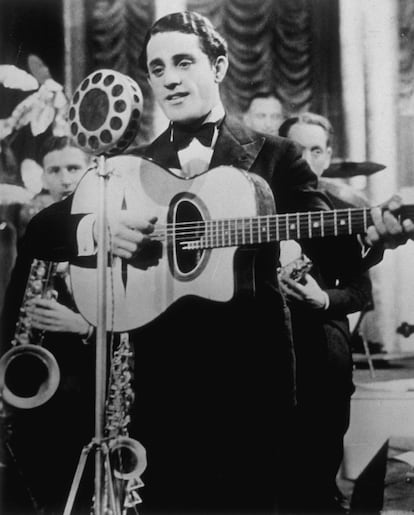
Al Bowlly was who you would refer to today as “your favorite artist’s favorite artist.” Ray Noble and Roy Fox admired him to the point of competing for his time: he would sing with one man during the day and with the other at night. And while he was never a superstar in the contemporary sense — those who describe him as the “first pop star” exaggerate, since the modern star system didn’t exist in the 1930s — he was an artist who was both popular and deeply respected by the industry. His smooth, velvety tone, impeccable diction and elegant phrasing were praised by the press of the time. It’s no coincidence that Bowlly became one of the first vocalists whose name appeared on records, in an era when singers usually remained anonymous and the spotlight fell almost exclusively on bands and orchestras.
Bowlly was one of the first performers to use the microphone as an expressive tool. He sang into the microphone not only to amplify his voice, but also to convey a close and intimate emotion, “projecting his own personality.” During those years, a critic from the now-defunct music magazine Melody Maker wrote that “his phrasing, diction and intonation are superb, whilst the individualism he manages to get into his renderings is really amazing.”
Bowlly adapted his voice to the new technology and pioneered a vocal technique that modern singers adopted. Bowlly sang as if he were speaking directly to a single person, with an intimacy that captivated audiences. “I’ve seen him sing into the microphone with tears in his eyes; he genuinely felt the music,” Ray Noble recounted.
A key figure in the golden age of radio, Bowlly was the link between music hall singers — who produced the first popular British music, which emerged before World War I — and the modern crooning that was later popularized by Bing Crosby and Frank Sinatra. His career also took him to new stages, such as New York, where he briefly performed alongside a then-unknown Glenn Miller. However, only one of those many voices has returned time and again, transformed into the ghost of a bygone era.
Kubrick used Bowlly’s music in The Shining — including in the famous final scene — because the director preferred to use existing music in his films, rather than commission original compositions. Bowlly’s voice also appears in the video game BioShock: it’s used in the same way as in the horror movie, representing a sonic relic of the past that’s been placed in a dystopian future. His timbre, the grainy texture of the vinyl, as well as the slow, rhythmic arrangements make his singing the very embodiment of nostalgia and a lost future. On playlists with themes as varied as liminal music or lullabies, you can find his songs.
Bowlly’s work has transcended musical history to become ingrained in modern culture, via film and theater. His sound is a perfect tool for “hauntology,” the concept introduced by French philosopher Jacques Derrida and later developed by cultural theorist Mark Fisher, which deals with the persistent presence of ghosts from the past and lost futures in contemporary culture.
Playwright Dennis Potter used Al Bowlly’s music in his 1969 play Moonlight on the Highway, where the protagonist is an obsessive fan of the crooner. Modern artists like Hilary Lloyd have taken up this tradition in Potter-inspired exhibitions, in a style that feels quintessentially British
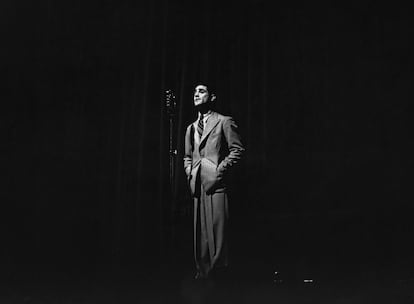
Bowlly’s brief on-screen appearances in the Pathé News shorts — which were shown in cinemas before the main feature — documented the singer for posterity. For those who saw this footage in the decades after his death, he appeared as a kind of specter, well before Stanley Kubrick used his voice to create the atmosphere of one of his most celebrated films.
However, no one has resurrected Al Bowlly’s music with the intensity of Leyland Kirby, the English ambient musician known professionally as The Caretaker. His project — directly inspired by The Shining, as his name suggests– transforms fragments of songs from the 1920s and 1930s into decaying soundscapes, slowing the tempos and bathing the music in a ghostly echo. This makes them sound as if they’ve come straight from the past, or from a memory. Kirby has sampled several of Bowlly’s recordings — Midnight, the Stars and You (1934), It’s All Forgotten Now (1934) and Heartaches (1931) — ultimately leading the project toward an exploration of Alzheimer’s and memory loss.
Al Bowlly’s songs have continued to inspire 21st-century pop, regardless of their ghostly nature. The Caretaker’s most popular track — It’s Just a Burning Memory (2016), based on Heartaches — was used by Lana Del Rey as an outro at her 2024 Coachella concert. And previously, Dua Lipa sampled Bowlly’s My Woman (1932) in Love Again (2020). However, in her case, she based the idea on Your Woman — a song by the British-Indian singer White Town — which went to the top of the charts in the U.K. In 1997, using the instrumental hook of the piece originally recorded by Al Bowlly in 1932.
These are just two examples of how Al Bowlly’s music and voice continue to resonate in the present from a distant past. But in these cases, they take on distorted forms that don’t reveal the real singer behind the dematerialized voice. Others have preferred to go directly to the source, like King Charles III, who included The Very Thought of You (1934) on an Apple Music playlist in 2025 called The King’s Music Room. He explained that he liked the song because it reminded him of his grandmother, Elizabeth Bowes-Lyon, the Queen Mother, who was from the same generation as Al Bowlly. “She used to play these sorts of music a lot, and [it] never fails to lift my spirits,” the king noted.
Modernity has transformed Al Bowlly into a symbol of vintage melancholy. He’s part of a nostalgia for times gone by that obsesses new generations. And there’s something comforting about hearing him sing from such a distant past: his voice reminds us — at least for a moment — that everything will be alright.
Still, Kubrick was right to place him in a context of relentless, recurring violence. He remains the voice of a story that’s trapped in a loop of terror, reminding us that the present is also marked by a darkness that never disappears. A past that — like Bowlly’s music — continues to call out from beyond the grave.
Sign up for our weekly newsletter to get more English-language news coverage from EL PAÍS USA Edition
Tu suscripción se está usando en otro dispositivo
¿Quieres añadir otro usuario a tu suscripción?
Si continúas leyendo en este dispositivo, no se podrá leer en el otro.
FlechaTu suscripción se está usando en otro dispositivo y solo puedes acceder a EL PAÍS desde un dispositivo a la vez.
Si quieres compartir tu cuenta, cambia tu suscripción a la modalidad Premium, así podrás añadir otro usuario. Cada uno accederá con su propia cuenta de email, lo que os permitirá personalizar vuestra experiencia en EL PAÍS.
¿Tienes una suscripción de empresa? Accede aquí para contratar más cuentas.
En el caso de no saber quién está usando tu cuenta, te recomendamos cambiar tu contraseña aquí.
Si decides continuar compartiendo tu cuenta, este mensaje se mostrará en tu dispositivo y en el de la otra persona que está usando tu cuenta de forma indefinida, afectando a tu experiencia de lectura. Puedes consultar aquí los términos y condiciones de la suscripción digital.