Writing, watching, photographing: the heart of the matter according to Larry Sultan
A new book brings together for the first time the texts of the American photographer where word and image intertwine in a journey marked by doubts, unexpected discoveries and constant questioning
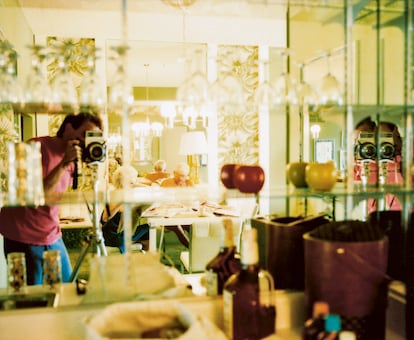

The book Water Over Thunder brings together for the first time the writings of American photographer Larry Sultan (New York, 1946–California, 2009), a pivotal figure in photography of the second half of the 20th century. Far from being a mere complement to his visual work, these texts reveal that writing was an integral part of his artistic practice. His correspondence with curators, his continuous notes in notebooks, transcripts of his classes, drafts of short stories, as well as the candid entries in his diaries, where dreams find a privileged place, alongside more polished essays, allow the reader to follow the artist’s thoughts as he reflects on the act of seeing, family memory, and the limits of photography.

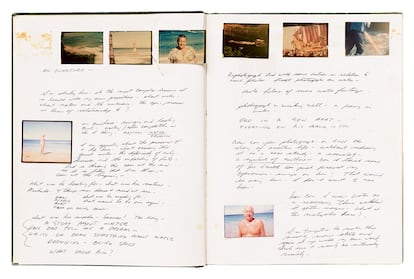
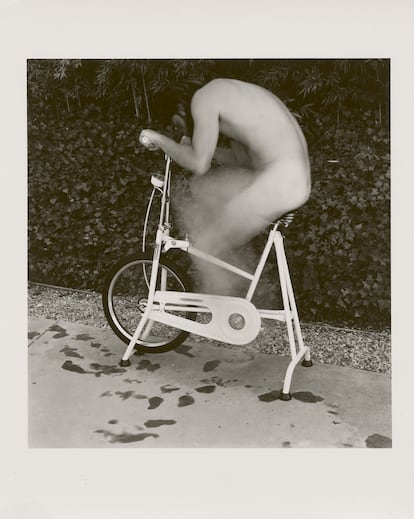
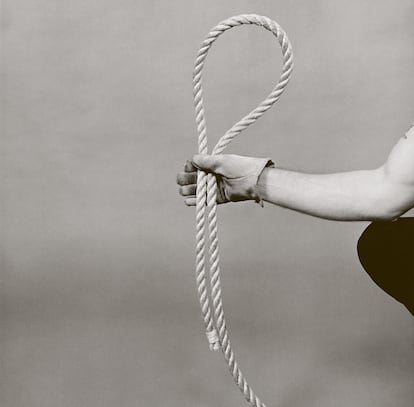
The image of water over thunder that inspires the publication’s title places the creative work in the territory of uncertain navigation. Photography and writing are not straightforward paths for Sultan. They unfold amidst doubts, detours, unexpected discoveries, and the continuous questioning of his practice. Hence the importance of accepting uncertainty, initial confusion, and the risk of shipwreck as a natural part of the process. “It has a lot to do with failure,” the author acknowledges.
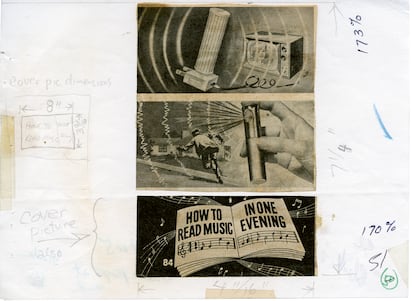
It was his attention to the everyday and the mundane that drew Sultan to photography. The medium offered him access to spaces of contemporary life that otherwise remained closed to him. For this young man, born in Brooklyn and raised in Los Angeles, his interest in visual culture lay not in museums, but in the billboards of the Sunset Strip. He was wary of the academic rhetoric of the art critics, of the romantic tradition associated with the figure of the bohemian artist; he wrote of it: “It bores me to tears.” This stand was key to his collaboration with Mike Mandel, with whom he would shape Evidence, a publication destined to become a landmark of conceptual photography that questioned the idea of the photographic medium as objective evidence. “Quite simply, a Duchampian strategy,” Sultan wrote. “You change the context of how something is seen, and it becomes art; you put a silly little photograph in a museum, and it becomes an art object.” That project proved fundamental in his career, confirming that “the art of photography lies not only in creating images, but in using them.”
His writing is precise and nuanced, but also imbued with humor and irony. A typed letter to a curator reveals that he considered his training as a photographer a “fiasco,” despite having studied under Harry Callahan at the Rhode Island School of Design. Franz Kafka and Marc Chagall were among his “strongest and most enduring” “companions.” Similarly, he stated that he felt no “affinity or true understanding” for Walker Evans, “so restrained, dispassionate, and seemingly cold. I have very little patience for photographs that made the world seem more ordinary than I felt it to be.”
Regarding his series Swimmers, the photographer acknowledged that both the act of photographing and the images themselves frightened him. Through the portrait of a group of students in a swimming class, he delves into fear, discovery, and mystery, while also striving to produce deliberately physical, sensual, and painterly images. Ironically, he admitted that perhaps he had good reason to be afraid; critics would say of him, “We thought you were a conceptualist, when in reality you turned out to be simply an expressionist.”
Thus, after ending his collaboration with Mandel, Sultan’s practice became more personal without sacrificing conceptual rigor. In Home Movie Stills, he takes frames from his father’s home movies out of context to offer new interpretations. In his writings on Pictures from Home, one of his most famous series—which led the artist to undertake a profound and emotional exploration of the complexities of his parents’ family life over 10 years—he reflects on the psychological complexities inherent in looking at those closest to us. “My photographs were a mixture of staged and documentary work, again attempting to collapse the difference between the two,” he wrote. “For me, truth has to do with performance: how we act, how we project: truth can be staged or found. I don’t think there is a difference between the two.”
The tension between reality and representation also runs through The Valley, the series shot in the San Fernando Valley. There, he photographed scenes related to the porn industry, but from a perspective that privileged domestic intimacy and moments of pause between scenes. His images might evoke the artifice of pornography, but at the same time, they showed real people in genuine moments of vulnerability and contemplation.
Reading Water Over Thunder ultimately means accompanying Sultan on a constant journey of self-doubt. In contrast to the figure of the self-assured artist, Sultan allows himself to feel vulnerable and lets uncertainty permeate his work. His notes reveal frustrations, unresolved questions, and an insatiable curiosity to understand what it means to see and represent the world. This bewilderment is not an obstacle but the very driving force of his journey. “For me, the real magic of photography is that I never know exactly how it’s going to translate the world,” he wrote. “No matter how many photographs I take, the mystery is never exhausted. I don’t know how a photograph happens; it’s unpredictable, and half the time I don’t even realize I’ve taken it. The photographs I thought were going to be great turn out to be so over-the-top, so determined, and boring. It’s always something else.”
“I always wanted to be a writer,” Sultan admits in the book’s final paragraph. “I’ve thought about giving up photography for a while and dedicating myself solely to writing. Perhaps that will bring me closer to the heart of the matter.”
Water Over Thunder: Selected Writings. Larry Sultan. MACK, 2026. 320 pages.
Sign up for our weekly newsletter to get more English-language news coverage from EL PAÍS USA Edition
Tu suscripción se está usando en otro dispositivo
¿Quieres añadir otro usuario a tu suscripción?
Si continúas leyendo en este dispositivo, no se podrá leer en el otro.
FlechaTu suscripción se está usando en otro dispositivo y solo puedes acceder a EL PAÍS desde un dispositivo a la vez.
Si quieres compartir tu cuenta, cambia tu suscripción a la modalidad Premium, así podrás añadir otro usuario. Cada uno accederá con su propia cuenta de email, lo que os permitirá personalizar vuestra experiencia en EL PAÍS.
¿Tienes una suscripción de empresa? Accede aquí para contratar más cuentas.
En el caso de no saber quién está usando tu cuenta, te recomendamos cambiar tu contraseña aquí.
Si decides continuar compartiendo tu cuenta, este mensaje se mostrará en tu dispositivo y en el de la otra persona que está usando tu cuenta de forma indefinida, afectando a tu experiencia de lectura. Puedes consultar aquí los términos y condiciones de la suscripción digital.