Iran globalizes chaos by disrupting energy markets and pushes back the end of the war
The blockade of the Strait of Hormuz impacts the global economy while Israel and the US have yet to achieve any strategic goal
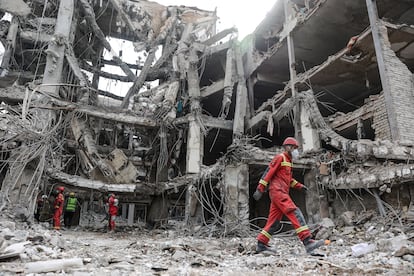

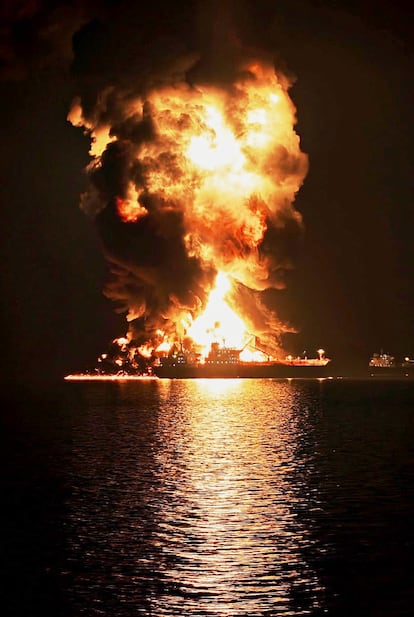
Iran has thrown energy markets into turmoil by turning on the fan of chaos, while continuing to retaliate against attacks by Israel and the United States despite its clear military inferiority. Nearly two weeks after the start of the US-Israeli military offensive on February 28, several attacks attributed to Iran have now struck six ships in the Persian Gulf, three of them on Thursday: two in the Iraqi port of Basra and the third a container ship in waters of the United Arab Emirates. These are in addition to the three cargo ships attacked on Wednesday. In his first purported message, read on state television, Iran’s new Supreme Leader, Mukhta Khamenei, asserted that the closure of the Strait of Hormuz must continue “as a tool to pressure the enemy.”
The speech by the new 56-year-old president was defiant. But the message was not delivered by him directly, nor have Iranians seen or heard their new head of state in person, not even on video. Instead, a presenter on Iranian state television read his words with a photograph of him against the backdrop of the country’s tricolor flag. This circumstance could fuel rumors about his health that have been circulating in recent days. An official Iranian source confirmed to Reuters on Wednesday that the new supreme leader was “slightly” injured in the bombing that killed his father on the first day of the war .
Khamenei called for unity and issued other threats, such as that his country will attack all U.S. Bases in the region. The leader also urged his neighbors to ‘clarify’ their position regarding those he has defined as “the murderers of our people,” referring to the U.S. And Israel. He mentioned the attack, attributed to Washington, on a school in Minab, where 175 people were killed, most of them girls between the ages of seven and 12. He also referred to the “martyrdom” of his father, whose memory he honored.
The supreme leader’s message confirmed that his country will continue with its strategy of spreading chaos throughout the region and even globally, accompanying conventional warfare with hybrid and commercial warfare by disrupting traffic through the Strait of Hormuz, through which 20% of the world’s oil, among other raw materials, passes.
The new attacks on ships have once again driven the price of a barrel of crude oil above the psychological barrier of $100. The initial bombings had forced Trump the day before to release 172 million barrels of oil reserves, the same day that some 30 countries belonging to the International Energy Agency (IEA) agreed to put approximately 400 million barrels onto the market.
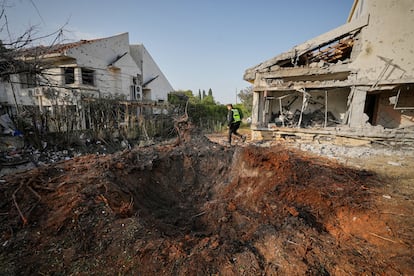
On the other hand, the Iranian regime has responded to the “large-scale” bombings announced by Israel—explosions have been reported in Tehran, Isfahan (central Iran), Saqqez (Iranian Kurdistan), and other locations—with new attacks on Israeli territory and against neighboring countries in the Middle East. Tehran has also coordinated with its Lebanese ally, the Shiite political party and militia Hezbollah, to launch an unprecedented attack with 200 projectiles, according to Israeli media, against northern Israel.
Several drones have also struck a building and Kuwait International Airport, a building in Dubai, in the United Arab Emirates, as well as fuel depots near the capital of Bahrain and Saudi Arabia. In the last 24 hours, the autonomous region of Iraqi Kurdistan has been hit by 40 drones and missiles, according to Rudaw, the main regional television channel. One of those projectiles struck an Italian military base in Erbil, in that Iraqi region, according to Italian Defense Minister Guido Crosetto, who expressed his conviction that the attack was “deliberate.”
Some 2,000 people have already died in this war, according to official figures from the various countries involved. Of these, more than 1,200 (many civilians) have died in Iran, followed by Lebanon, with more than 600 deaths in Israeli attacks. The UN Refugee Agency (UNHCR) has reported that, after 13 days of conflict, there are more than 3.2 million internally displaced people in Iran, a fact that fuels fears in neighboring countries like Turkey of a massive influx of refugees.
No clear end in sight
Regional instability, human drama, and disruption to energy markets, as well as the military resistance being put up by the Iranian regime, belie Trump’s declaration of having “won the war” on Wednesday at a sort of pre-campaign rally in Kentucky, with his eyes on the crucial midterms in November.
“Those who pushed for this war, in Jerusalem and Washington, are realizing that they’ve gotten themselves into a major mess” Michael Young, an analyst at the Middle East Carnegie Endowment for International Peace, emphasized in a message on X.
While the facts on the ground belie Trump’s triumphalism, so too do the U.S. Intelligence services, which believe the Iranian regime is not close to collapsing. In their view, neither the bombing that killed Supreme Leader Ali Khamenei on the first day of the war, nor the deaths of numerous regime officials, nor the military targets hit have pushed the Islamic Republic to the brink.
This is indicated by a multitude of U.S. Intelligence reports, cited this Thursday by Reuters, which assure that the Islamic Republic is not at risk of collapsing and that it maintains control over the population, which Israeli Prime Minister Benjamin Netanyahu has called upon to rise up against their political system.
Three objectives
In addition to the goal of overthrowing the regime, on which Trump has contradicted himself several times—unlike Israel—Washington defined three major objectives for its military campaign. However, according to a report published Thursday by The New York Times, citing Trump’s advisers, it did so without anticipating that Tehran would wage economic war by closing the Strait of Hormuz if the country were attacked, something Tehran had constantly threatened to do.
The first of these objectives was to completely dismantle Iran’s nuclear program, which, incidentally, the U.S. President had already declared “obliterated” after 12 days of bombing in June 2025. The idea was to prevent Tehran from developing nuclear weapons, a goal that Iran has always denied pursuing.
The second objective was to destroy Iran’s missile capabilities; and the third was to permanently bury the Islamic Republic’s network of alliances with regional militias in the Middle East—especially Hezbollah in Lebanon and the Houthis in Yemen.
None of these objectives has been fully achieved at this point.
Sign up for our weekly newsletter to get more English-language news coverage from EL PAÍS USA Edition
Tu suscripción se está usando en otro dispositivo
¿Quieres añadir otro usuario a tu suscripción?
Si continúas leyendo en este dispositivo, no se podrá leer en el otro.
FlechaTu suscripción se está usando en otro dispositivo y solo puedes acceder a EL PAÍS desde un dispositivo a la vez.
Si quieres compartir tu cuenta, cambia tu suscripción a la modalidad Premium, así podrás añadir otro usuario. Cada uno accederá con su propia cuenta de email, lo que os permitirá personalizar vuestra experiencia en EL PAÍS.
¿Tienes una suscripción de empresa? Accede aquí para contratar más cuentas.
En el caso de no saber quién está usando tu cuenta, te recomendamos cambiar tu contraseña aquí.
Si decides continuar compartiendo tu cuenta, este mensaje se mostrará en tu dispositivo y en el de la otra persona que está usando tu cuenta de forma indefinida, afectando a tu experiencia de lectura. Puedes consultar aquí los términos y condiciones de la suscripción digital.