Guggenheim Bilbao showcases Ruth Asawa, the artist who turned the barbed wire of her concentration camp into art
The Spanish museum hosts the first European retrospective of the Japanese-American creative, on the 100th anniversary of her birth and after the show’s stay at the MoMA

Ruth Asawa was just 15 years old when World War II broke out. At the time, she was living with her Japanese immigrant parents on a farm in Norwalk, California, the town in which she’d grown up. The Empire of Japan had just attacked Pearl Harbor, the United States’s most important naval base in the Pacific, and as the country entered into war, the Roosevelt administration approved the forced internment of more than 100,000 American citizens of Japanese descent in concentration camps. Her father burned everything that might identify them as foreigners, but it was not enough to keep them safe. He was detained that same month. Asawa, her siblings and their mother were incarcerated soon after, first in a former race track, where they slept in stables, and later, in a “War Relocation Center” surrounded by barbed-wire fences.
Paradoxically, that experience of separation was the start of her artistic career. During the long, empty hours of imprisonment, she met three Walt Disney artists — Tom Okamoto, Chris Ishii and James Tanaka. The paper, charcoal and ink the three men gave her facilitated the first steps of an artist who understood creation and coexistence as being deeply connected. Throughout her life, her home was her studio; her friends, her inspiration; her children and family members, her assistants and models. And those barbed-wire fences that once enclosed her would later return in the form of poetic metaphor, the essence of her most significant work: hypnotic hanging sculptures made of looped wire.
Her career was long, prolific and renowned — particularly in San Francisco, the city where she lived from 1949 until her death in 2013 — but only recently has it found international acclaim. Beginning with an exhibition at the Whitney Museum in 2019 that returned her to the forefront of the art world, she has consistently gained fans. In 2025, the San Francisco Museum of Modern Art inaugurated the first large-scale retrospective of the artist, which later traveled to the MoMA, becoming the largest retrospective ever dedicated to a woman at the world-leading institution of modern art. The same show, with 240 works produced over a 60-year career, will now arrive at the Guggenheim Bilbao Museum, a letter of introduction to the European public. It is the first major museum exhibition of Asawa’s work on the continent, and will run through September 13.
“She was one of the most singular talents of the last century. Her work expanded the possibilities of what art could be in the 21st century,” explains Cara Manes of the MoMA’s department of painting and sculpture, one of the exhibition’s curators. The show she produced over the course of five years alongside co-curator Janet Bishop, the MoMA’s Thomas Weisel Family curator of painting and sculpture, and on which Manes is now working in collaboration with Guggenheim curator Geaninne Gutiérrez-Guimarães, consists of 10 sections in chronological order, demonstrating the distinct disciplines the artist developed throughout different stages of her life. In addition to Asawa’s famous sculptures, she created paintings, ceramics, drawings, prints, and masks. Thanks in part to its extensive documentation, the show demonstrates, in the words of Manes, how “her art invited others into her creative process, making it a shared experience.”
There are archival images of the artist’s house-studio, photographs of her taken by friends, videos of her work, masks she made molded from the faces of visitors to her home, a hand-carved redwood door, prints and watercolors that represent the harvest from her own garden. “The central objective of our project, since the beginning, has been to demonstrate the profound interconnection of her practice throughout mediums, throughout disciplines and through time,” says Manes.
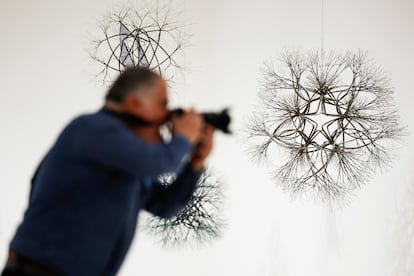
What most attracts visitors to the exhibition, without a doubt, are floating, transparent shapes suspended at different heights, some elongated, others spherical, with figures that float in the entrails of other, larger figures, which move gently as visitors walk among them. “What most interested Asawa was this dialogue between interior and exterior. Everything is connected. It is a relatively simple technique in which she folds and molds continuous lines, which give shape to create structures with continuous and uninterrupted forms that also, when exhibited, respond and interact with the spectator and their environment,” says Manes.
The artist’s inspiration came, as goes a well-known anecdote, during a summer she spent in Toluca, Mexico. There, in a city market, she was captivated by the wire baskets vendors used — and which are still found in Mexican markets — to carry eggs. Asawa said that the transparency of the baskets reminded her of an insect’s wings. “Because of that trip,” explains Gutiérrez-Guimarães, “she began to study this idea of the continuous line and the concepts of transparency, of volume, of light, of shadow.”
Of course, her artistic discourse cannot be understood through that anecdote alone, but also through Asawa’s profound knowledge of European modernism. When she left the concentration camp in 1943, she did all she could to dedicate herself to teaching, but the schools of a country still plagued by anti-Japanese discrimination would not accept her. Instead, she enrolled at Black Mountain College, a Bauhaus-inspired experiment in North Carolina, where students co-existed with professors and whose curriculum was based on sensorial experience and working with materials. Her classmates included Ray Johnson and Robert Rauschenberg, and among her instructors were Buckminster Fuller, Willem de Kooning and Josef Albers, from whom she would later say she “learned how to see.” This early era begins the exhibition in the Spanish museum. There are, for example, abstract dancing figures, “inspired by the dance classes she took”, explains Gutiérrez-Guimarães, and her first drawings and paintings “inspired by natural forms and mathematical patterns.”
Asawa also went through a period of commercial design at the start of the 1950s, creating works based on her origami and textiles that incorporated motifs such as logarithmic spirals. At the same time, she began to reap artistic success, with exhibitions in galleries, says her MoMA curator, “including the important modernist Peridot Gallery in New York, which introduced her work to an audience that grew even further with her participation in the 1955 São Paulo Biennial.” Once established, she also became involved in her adopted city of San Francisco — as we see primarily through documents in one of the exhibition’s final sections — creating works in public spaces like the bronze Andrea’s Fountain and the Origami Fountains.
The final section of the exhibition is special, because it is dedicated to Asawa’s house: a space with a surrealist bent, portrayed in a photograph in which some of her works hang, ceramic pieces can be seen on a table, along with her six children and her dog. “My home was and is my studio,” the artist once said. In a phrase that would become famous. In the living room sat sculptures, other pieces made by her lifelong friends like Albers, and art books. “Once with her son she was making a small model of a room of her home in a shoebox for him to bring to school,” says Gutiérrez-Guimarães. “When they finished, Ruth said, ‘Wait! It needs one of my hanging sculptures.’” She made a miniature version of no more than three centimeters, which she hung from the cardboard of the box. Perhaps there is no better anecdote to sum up the philosophy of an artist who understood her work as an act of defiant hospitality.
Sign up for our weekly newsletter to get more English-language news coverage from EL PAÍS USA Edition
Tu suscripción se está usando en otro dispositivo
¿Quieres añadir otro usuario a tu suscripción?
Si continúas leyendo en este dispositivo, no se podrá leer en el otro.
FlechaTu suscripción se está usando en otro dispositivo y solo puedes acceder a EL PAÍS desde un dispositivo a la vez.
Si quieres compartir tu cuenta, cambia tu suscripción a la modalidad Premium, así podrás añadir otro usuario. Cada uno accederá con su propia cuenta de email, lo que os permitirá personalizar vuestra experiencia en EL PAÍS.
¿Tienes una suscripción de empresa? Accede aquí para contratar más cuentas.
En el caso de no saber quién está usando tu cuenta, te recomendamos cambiar tu contraseña aquí.
Si decides continuar compartiendo tu cuenta, este mensaje se mostrará en tu dispositivo y en el de la otra persona que está usando tu cuenta de forma indefinida, afectando a tu experiencia de lectura. Puedes consultar aquí los términos y condiciones de la suscripción digital.