Illegal gold mining is rampant on Nicaragua-Costa Rica border, fueled by China’s voracious appetite
Unlawful operations have expanded across more than 3,000 hectares, while authorities declare themselves powerless against a plunder that could exceed $250 million annually
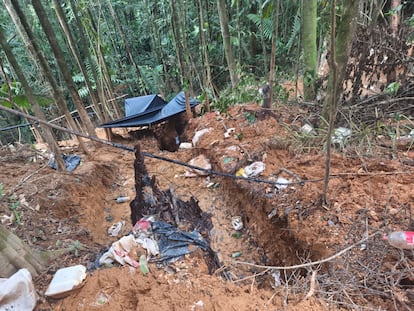
Rampant illegal gold mining is spreading across more than 3,000 hectares along Costa Rica’s northern border, while local authorities declare themselves powerless in the face of mineral theft, deforestation, and the power of criminal networks that exploit the presence of Chinese companies in Nicaragua willing to buy the illicit ore. This so-called “dirty gold” thrives on prices exceeding $5,000 per ounce, leading Costa Rican authorities to estimate that the plunder could surpass $250 million annually.
What began 20 years ago as a government concession to a Canadian company to exploit the Crucitas estate, bordering Nicaraguan territory, is now the scene of a surge in informal mining across a vast area where police presence is insufficient, as the Costa Rican government admits. The key factor is the role of companies that buy gold on Nicaraguan soil, especially Chinese mining companies that have obtained concessions from the Nicaraguan government in recent years, as Costa Rica President Rodrigo Chaves has mentioned in recent meetings with U.S. Officials.
The history of mining in Crucitas this century is marked by lawsuits, prejudice, accusations of corruption, environmental claims, and street protests. It has also included international arbitration, proposals for legal gold mining, and, meanwhile, several years of incursions by groups of illegal miners crossing the border in pursuit of their “golden dream.” However, reports from the beginning of 2026 reveal an even worse reality: illegal mining is growing uncontrollably around the original project and is consolidating itself as a criminal industry in a kind of tropical “Wild West” of outlaws, deaths, cyanide pits, and an insatiable thirst for gold, topped with geopolitical overtones that further complicate any solution.
“Being there is a mixture of desolation and danger. It’s a mountain in the middle of nowhere, where you know there are many small-time miners, but also armed members of criminal networks in a place where only the law of the jungle prevails,” said journalist Cristian Montero, who visited the area where only under-resourced police contingents occasionally arrive, usually more to monitor than to control the area. He and his photographer hiked for up to 10 hours on a hill called Conchuditas, where the “coligalleros” (small-scale miners) began digging tunnels in mid-2025 and now operate with impunity, as evidenced by newly dug roads, collapsed sections of the mountain, new tunnels, and pools for washing the ore with chemicals whose residue seeps into the soil and water, posing a significant danger to nearby communities.
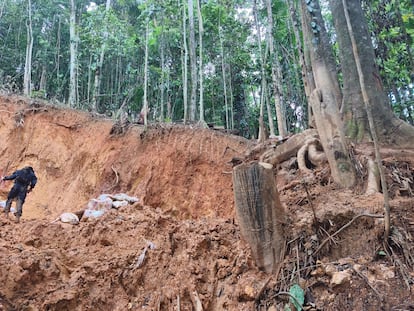
Montero went to verify what Security Minister Mario Zamora had reported weeks earlier at a hearing in the Legislative Assembly: “Illegal mining had already evolved from artisanal extraction techniques by small-scale miners known as coligalleros (or güiriseros, in Nicaraguan usage) to semi-industrial exploitation with the presence of organized crime, spurred by the rise in the international price of gold. In 2026, a new stage has been reached with new techniques, as it is no longer just sediments being extracted for processing with cyanide and mercury; more than 130 larger pits have been registered. This entails contamination and destruction of the forest cover, not only in the 900 hectares of the original area (of the project); unfortunately, it has expanded across the entire area to more than 3,000 hectares.” He also denounced that 90% of the miners are Nicaraguan, and have even altered the boundary markers.
“That hill is practically nonexistent now,” lamented Zamora, who added that the hundred or so police officers patrolling the area each shift, as part of a $1 million security operation, can do little. However, he received strong criticism from opposition parties for not allocating more resources to prevent further violations of border sovereignty.
Zamora’s special hearing before the legislators has a political undertone: the Rodrigo Chaves administration intends to pass a reform that would make an exception to the current moratorium on open-pit metallic mining and allow a foreign company to be granted a concession for gold extraction, with a percentage of the profits going to the state treasury. The College of Geologists has estimated that there is $3 billion worth of gold in the area. The proposal aligns with the relativistic approach of Costa Rica’s traditional environmental positions in official circles, based on the desire to capitalize on natural resources beyond tourism and the argument of fostering development in the rural communities where these resources are located, noted researcher Leonardo Merino of the State of the Nation think tank.
The concession is also a political priority for President-elect Laura Fernández, who has asked current members of Congress to expedite the passage of a bill before the change of government (in May). The proposal is reminiscent of the failed concession contract granted in 2001 to the Canadian company Infinito Gold, which was overturned by a court ruling in 2011, as well as the long-standing national debate about what to do with this ecologically valuable area and how to prevent what has ultimately occurred: the expansion of smuggling with its consequences for the economy, the natural environment, and the security of nearby communities. Reports also mention trafficking in drugs, weapons, and even human organs, as well as human trafficking and threats against the population to prevent them from reporting illegal activities. Reality has surpassed Rodrigo Chaves’s 2022 promise of government intervention in the area.
Now the situation is even more complex, as the conflict takes on geopolitical dimensions due to Costa Rica’s accusation against Chinese mining companies that hold concessions for nearly one million hectares in Nicaragua, representing 8.5% of the territory of the country governed by Daniel Ortega and Rosario Murillo, according to a recent investigation by the non-governmental organization Fundación del Río. The report indicates that the Chinese company Thomas Metal Sociedad Anónima is located in the border area, near an illegal mining camp that houses up to 4,000 people with government tacit approval, within the Indio Maíz Biological Reserve. One of the mining plots is located just 300 meters from the San Juan River, which forms part of the border.
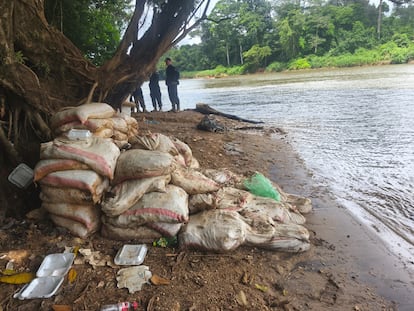
“This is where the mining material from the illegal extraction of gold from Crucitas and Conchudita in Costa Rica is being processed. Cash gold purchases have also been recorded,” Amaru Ruiz, director of the foundation, told the press. However, he expressed skepticism regarding the police coordination announced by authorities from both countries after a meeting held on February 28. This past weekend, operations resulted in 20 arrests, but the problem is much larger. “This illegal activity on the Costa Rican side will not stop unless the illegal activity in the Las Cruces area is shut down,” he added, referring to the town where the camp operates, according to his findings.
The Chinese embassy, however, denies any wrongdoing on the part of Chinese companies and attributes the accusations to a campaign, amid numerous disagreements with the pro-Washington Costa Rican government. “This is yet another example of media propaganda without any communication or verification,” Ambassador Wang Xiaoyao told this newspaper. “We are aware that the mining companies operating in Nicaragua are primarily from Canada or other countries,” the diplomat added.
For environmental groups in Costa Rica, the legalization of mining would also be a problem, so they oppose the government’s project to grant concessions in the border area, arguing that the natural environment is being destroyed, the State has little left, and there is no guarantee that informal mining or security problems will end.
“Give me a single example of a mining project that has brought development to communities and put an end to illegal mining, just one. You can’t, because there isn’t one,” insisted Representative Priscilla Vindas, of the Broad Front left-wing party, in a meeting of a committee tasked with discussing the project promoted by the executive branch. “This would be legalizing the continued theft of our gold in exchange for a paltry 7% of the profits. They’ll be other foreigners, better dressed, but they’ll still take the gold,” the legislator denounced.
Lawmakers enthusiastic about granting a new mining concession lament the slow pace of the debate in Congress and admit there is no complete solution to the problem. “Perhaps the gold will be sold cheaply, but it won’t be legalized theft or what’s happening now,” argued legislator Daniela Rojas, another member of the committee, who also acknowledged that eliminating illegal mining and guaranteeing security in the area would require other kinds of efforts. However, the opposition is not optimistic. “This is going to happen sooner or later,” says one activist, aware that starting in May the ruling party will have an absolute majority in Congress and could also find additional support, even from the United States.
Sign up for our weekly newsletter to get more English-language news coverage from EL PAÍS USA Edition
Tu suscripción se está usando en otro dispositivo
¿Quieres añadir otro usuario a tu suscripción?
Si continúas leyendo en este dispositivo, no se podrá leer en el otro.
FlechaTu suscripción se está usando en otro dispositivo y solo puedes acceder a EL PAÍS desde un dispositivo a la vez.
Si quieres compartir tu cuenta, cambia tu suscripción a la modalidad Premium, así podrás añadir otro usuario. Cada uno accederá con su propia cuenta de email, lo que os permitirá personalizar vuestra experiencia en EL PAÍS.
¿Tienes una suscripción de empresa? Accede aquí para contratar más cuentas.
En el caso de no saber quién está usando tu cuenta, te recomendamos cambiar tu contraseña aquí.
Si decides continuar compartiendo tu cuenta, este mensaje se mostrará en tu dispositivo y en el de la otra persona que está usando tu cuenta de forma indefinida, afectando a tu experiencia de lectura. Puedes consultar aquí los términos y condiciones de la suscripción digital.