The invisible tragedy of the oil spill in Mexico
Crude oil is poisoning the livelihoods of hundreds of families who live around Laguna del Ostión, in Veracruz state, while residents demand support from the authorities
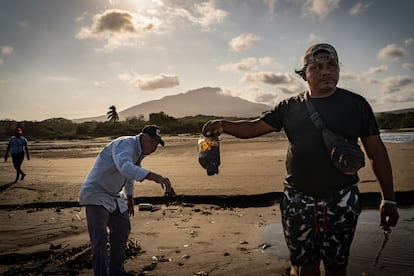

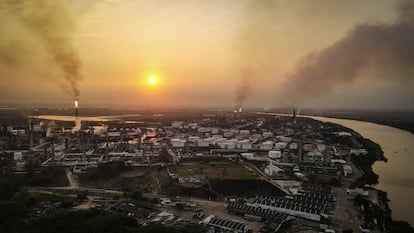
The oil is no longer visible, but it’s still there. Fish swim in the sea, but they’re no longer being caught. The water isn’t stained, but it leaves a strange brown foam. While it looks like life is back to normal in the municipality of Pajapan, in southern Veracruz, the invisible threat of the oil spill that began almost two weeks ago and has affected 142 miles (230 km) of the Gulf of Mexico coast permeates every minute of its inhabitants’ days. Uncaught crabs and unsold shrimp paint a picture of the new reality for dozens of families who, faced with the pollution of the Laguna del Ostión (Oyster Lagoon), are struggling to survive an emergency that has left them without their main source of income. “It’s critical because I haven’t worked a single day since the pollution started,” says Vicente Vargas, a 49-year-old fisherman with 14 years of experience in the trade.
Like him, many people lost their jobs overnight. When the first signs of the environmental tragedy surfaced, Emeterio Hernández, a 69-year-old resident of the lagoon region, was at home when his son alerted him: “He called me and said, ‘Dad, there’s trouble with the lagoon.’” Upon hearing this, Emeterio traveled to Jicacal, a town located at the intersection of the Laguna del Ostión and the Gulf of Mexico, where a large crowd had gathered. “When I got to Jicacal, people were already there. I saw some Pemex workers coming, and they told me, ‘We’re inspecting the shoreline because there’s been a spill,’ and I told them, ‘You don’t realize it, but the oil has already reached the lagoon’s mouth,’” he recounts.
Residents say the authorities informed them that fishing and the sale of seafood were prohibited until further notice. “They told us that, for the time being, we can’t eat fish from the sea or the lagoon because it’s contaminated. They did an inspection and found balls of tar,” says Elena Martínez, a 42-year-old woman who sells seafood in the area. But the consequences of the oil spill in the lagoon have also been a blow to other businesses. “It’s affected everyone because the farmers are also complaining that they’re not getting any sales, and because of that, money isn’t circulating here,” says Vicente.
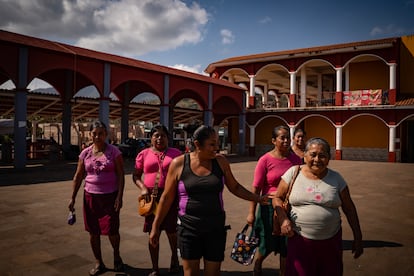
Although the smell of hydrocarbons doesn’t reach the town of Pajapan, the consequences of the spill are already present. Ciriaca Martínez, a 51-year-old seafood vendor and single mother of a 16-year-old son, complains: “We don’t have money to buy food.” Hermenegilda Bruno, 42, emphasizes the economic impact they are having to endure: “There are mothers and widows who relied on selling fish for their livelihood. Now how are they going to support their children who go to school? We haven’t received any assistance.” Aurelia Jáuregui, 64, stresses: “We don’t have a fixed salary. This is how we make a living. We work when we catch fish; when we don’t, we have nothing.”
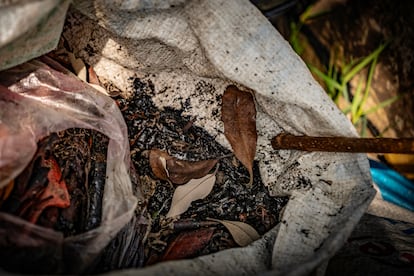
A few miles from town, residents wade through waters where tar slicks are visible. The characteristic smell accompanies visitors on a tour of the Laguna del Ostión. This site, which just two weeks ago sustained the Nahua communities settled around it, is now a latent threat to the health of the villages that, desperate due to government inaction, have carried out some cleanup work without protective equipment. “We picked it up in our boots and with bags in our hands. Then we took it to higher ground [to another area near the lagoon] and left it there,” recalls Vicente. The bags full of dried tar are still there, waiting for someone to dispose of them properly. He adds: “This is so small [he points to traces of the hydrocarbon in the water], how am I supposed to pick it up? You can’t clean it up. We collected the bigger pieces over there, but not these little ones.”
Dr. Omar Arellano, an expert in Ecological Risks and Ecotoxicology at the School of Earth Sciences of the National Autonomous University of Mexico (UNAM), warns of the dangers to which the residents are being exposed. “All the people who have voluntarily participated in the cleanup are, in a way, also putting themselves at risk of exposure due to the volatility of the [oil] compounds. Not because they are flammable, but because they are inhaling benzene, benzene compounds, and anthracenes, which can cause neurotoxic problems and skin issues,” he explains.
The cleanups, organized by the communities themselves to collect the crude oil that has seeped into their environment, have not been enough. At first glance, the lagoon appears undisturbed. But a closer look reveals that its water is already poisoned. “I saw clearly that it wasn’t going to clean up all at once. Where they collected it, I went on the third day and there was already quite a bit of tar by Jicacal,” says Vicente. On Tenantitanapan beach, facing the Gulf, their initiative also seems to be ineffective. The oil no longer covers the surface of the sand, but it has settled on the seabed. One of the fishermen dips his hands in to show the black material hidden beneath these waters that, just seconds ago, appeared to be clean.
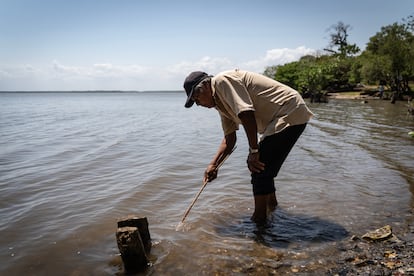
There is no clarity on how much longer the fishing ban, which is putting them under economic pressure, will remain in place, but, in Dr. Arellano’s opinion, the current situation is far from improving. “The fishery isn’t going to recover, and seafood, at least from the nearshore fisheries, won’t be available for consumption anytime soon. People will have to wait several months or until the next fishing season,” he asserts. Beyond the ban, the residents also point to the distrust generated by the lagoon’s pollution. Ciriaca recounts: “I’m selling a little bit of my shrimp right now. Everyone asks, ‘Where did this shrimp come from?’ I tell them, ‘It was frozen, I’m not selling it from the lagoon,’ but they still don’t buy it.”
The residents’ frustration is palpable. The situation worsens with each passing day, and complaints against the authorities are piling up. “The governor refuses to acknowledge the damage. We want her support, we want her to help us with something because if she doesn’t help us, who can we turn to? [...] That spill is pure poison,” Emeterio says, speaking out against the state government. Beside him, Vicente accuses the state-owned oil company Pemex: “For them, their company is fine, right? But they screwed us over.” The Veracruz government maintains that cleanups have been carried out and that it has supported all those affected. Pemex, through press releases, has disclaimed responsibility for the spill and claims to have offered assistance, despite not being responsible. Thus, while the official narrative presents the tragedy as being addressed, a different story unfolds in Pajapan.
Tu suscripción se está usando en otro dispositivo
¿Quieres añadir otro usuario a tu suscripción?
Si continúas leyendo en este dispositivo, no se podrá leer en el otro.
FlechaTu suscripción se está usando en otro dispositivo y solo puedes acceder a EL PAÍS desde un dispositivo a la vez.
Si quieres compartir tu cuenta, cambia tu suscripción a la modalidad Premium, así podrás añadir otro usuario. Cada uno accederá con su propia cuenta de email, lo que os permitirá personalizar vuestra experiencia en EL PAÍS.
¿Tienes una suscripción de empresa? Accede aquí para contratar más cuentas.
En el caso de no saber quién está usando tu cuenta, te recomendamos cambiar tu contraseña aquí.
Si decides continuar compartiendo tu cuenta, este mensaje se mostrará en tu dispositivo y en el de la otra persona que está usando tu cuenta de forma indefinida, afectando a tu experiencia de lectura. Puedes consultar aquí los términos y condiciones de la suscripción digital.