Venezuela’s economy trapped between paralysis and inflation
Despite the easing of US sanctions to boost the oil sector, economic recovery has not yet materialized
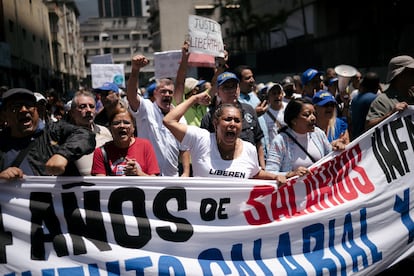
The economy in Venezuela is not improving. Everyone hopes it will, but the benefits are not materializing. Prices continue to climb, and the country’s annualized inflation — the highest in the world — averages 600%. One only needs to look at the behavior of the bolívar, the local currency, to understand the severity of the situation. So far this year, it has lost nearly 20% of its value against the dollar. In January, the official dollar was worth 367 bolívares; today it stands at 450 (and the so-called “parallel dollar,” which has a huge influence on price formation, can reach as high as 650). The currency has devalued by more than 9,000% since 2022.
The additional revenue the national treasury receives after the U.S. Military attack — thanks to the easing of sanctions and new licenses to extract oil — has not been enough to close the gap between the official and black market exchange rates. The central government’s fiscal deficit is 9% of GDP.
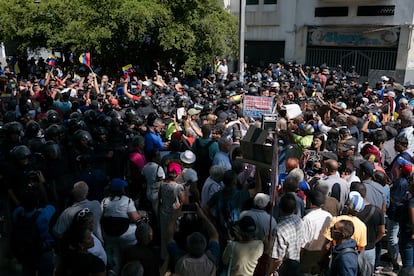
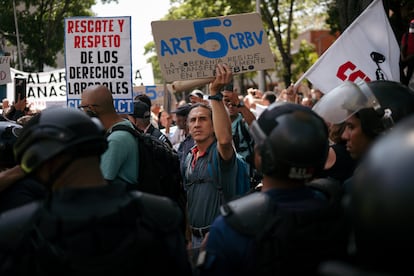
The protests against economic hardship and the chronic social inequalities that have plagued the country are shaping the agenda of citizen demonstrations. “We are demanding a basic human right, a constitutional obligation of the government: the general improvement of the population’s living conditions,” says Gregorio Alfonso, a member of the Association of Professors at the Central University of Venezuela. “Every time we try to march to downtown Caracas, the authorities find excuses to prevent us from getting there.”
“We’re still waiting for the promised improvements,” says José Abreu, 78, a Portuguese immigrant who has lived in the country for almost 60 years and owns a small shop in the El Bosque neighborhood of Caracas. “I’ve never seen anything like this in all my time in Venezuela,” he states. “You buy merchandise from wholesalers at one exchange rate for the dollar, and by the time you have to pay, the bolívar has lost value.” Abreu shows a notebook where he keeps track of orders from customers who have requested credit. “I have no alternative; I have to extend credit. It’s the only way I can sell a little more. Most people pay. Some people take a small item, pay a little of what they owe, and then disappear for a few days,” he says resignedly.
“Some things are selling, of course, but sales are slow. They have been for a long time, since people aren’t buying,” says Silvia González, owner of a newsstand and candy kiosk. “If my family didn’t send me money from Spain, we wouldn’t be able to supplement our income. I might have had to close.”
Wage stagnation
Amid this currency and price volatility, the country’s wage landscape remains unchanged: precarious and stagnant. The official minimum wage, used to calculate annual social benefits, is 160 bolivars, barely a few cents of a dollar. The government compensates for this by offering bonuses that do not affect social benefits (such as the “economic war bonus” or the “food bonus”), which average around $180 a month. Official language refers to this as the “comprehensive minimum wage,” and it may include food baskets.
A laborer in the private sector can earn around $350 a month. A skilled technician earns close to $500 a month. A manager or coordinator can earn up to $1,200. Only top local management could aspire to earn $4,000 a month or more. The private sector — severely damaged by expropriations and government sanctions in recent years — can offer occasional raises to certain employees or realistic calculations of each worker’s year-end profit sharing. Those who can, hold two or even three jobs. A modest bi-weekly trip to the supermarket averages $200.
Víctor Álvarez, an economist and director of the information platform Pedagogía Económica, asserts that the country’s tutelage under the United States “prevents the design of an autonomous economic policy.” He explains: “As the owner of the country’s subsoil resources, the state has an enormous capacity to finance social development policies. It can implement a government procurement plan from the private sector, provide public financing, or develop trade integration strategies. The problem is that Donald Trump’s executive order stipulates that Venezuelan oil revenues will be deposited into accounts at the U.S. Treasury Department, solely to finance the purchase of American products.”
The population is anxiously awaiting the possibility that the government will finally have the resources to decree a salary increase. It’s a frequent topic of conversation on the streets. After all, annual crude oil production is set to increase by 25%. Domestic oil is currently being sold without discounts, and international prices may continue to rise due to tensions in the Middle East.
Venezuela, which was Latin America’s fifth-largest economy for decades, lost 75% of its GDP between 2014 and 2020, plagued by political turmoil, the disastrous administration of the Maduro government, and international sanctions against the regime. Since 2022, the economy has registered moderate and woefully inadequate growth rates. Economists expect double-digit growth in 2026.
“Things are going to improve, but we have to wait a little longer. Production in these first two months of 2026 has actually fallen, and prices continue to rise,” says a financial analyst who preferred to remain anonymous. “The money that has come in is still insufficient to cover investment spending. The widening exchange rate gap is one of the major problems we have to address.”
On the street, among salaried workers, shopkeepers, and business owners, expectations are very high. “People are starting to request quotes [for construction projects], there’s some movement, but not much has materialized,” says Ignacio Monteverde, a construction businessman, a sector that usually plays a major role in shaping the local GDP. Monteverde is, however, cautious: “It seems like a reactivation is coming in a couple of months, that’s what people are saying. But right now, the situation is one of enormous paralysis. It’s even worse now than it was at the end of 2025.”
Sign up for our weekly newsletter to get more English-language news coverage from EL PAÍS USA Edition
Tu suscripción se está usando en otro dispositivo
¿Quieres añadir otro usuario a tu suscripción?
Si continúas leyendo en este dispositivo, no se podrá leer en el otro.
FlechaTu suscripción se está usando en otro dispositivo y solo puedes acceder a EL PAÍS desde un dispositivo a la vez.
Si quieres compartir tu cuenta, cambia tu suscripción a la modalidad Premium, así podrás añadir otro usuario. Cada uno accederá con su propia cuenta de email, lo que os permitirá personalizar vuestra experiencia en EL PAÍS.
¿Tienes una suscripción de empresa? Accede aquí para contratar más cuentas.
En el caso de no saber quién está usando tu cuenta, te recomendamos cambiar tu contraseña aquí.
Si decides continuar compartiendo tu cuenta, este mensaje se mostrará en tu dispositivo y en el de la otra persona que está usando tu cuenta de forma indefinida, afectando a tu experiencia de lectura. Puedes consultar aquí los términos y condiciones de la suscripción digital.