The month that changed Venezuela: From the US attack and Maduro’s capture to amnesty for political prisoners
The Trump administration’s military intervention on January 3 has become a catalyst for the new climate reigning in Caracas, enabling demands that until a few weeks ago were unthinkable
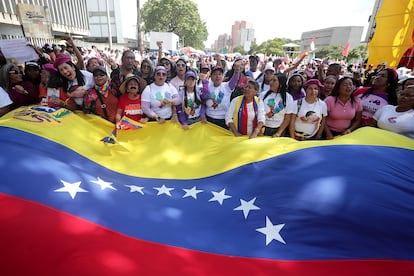
A dizzying month is coming to a close in Venezuela. Since the early hours of January 3, events have unfolded at an unprecedented speed: a surgical military attack by U.S. Special forces, Chavismo stripped of its leader, a regime that cooperates with the enemy, some signs of openness, the redefinition of the oil market, and finally, an unexpected gesture: a general amnesty for all political prisoners, the first explicit acknowledgment that the cycle of political violence must end to open another possible horizon.
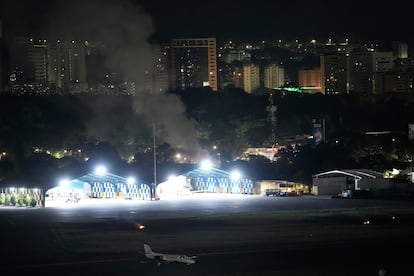
Where this path leads remains to be seen, but the chain of events of the last month has transformed Washington’s military intervention into a new catalyst for the current political climate. The amnesty has been the major turning point, according to sources closely following the Chavista movement. The general release of political prisoners had already been on the table in at least two previous dialogue processes, but it never materialized: these were limited approaches, focused on specific releases that did not extinguish the legal proceedings. This time it has been different.
Negotiators and mediators — both past and present — have celebrated what they call a historic move. “[Interim president] Delcy Rodríguez has read the times well. She could have continued with individual releases, but she was smart and opted for amnesty,” explains one of these sources in Caracas. Beyond her knack for navigating this murky situation, the strong social support for the releases ultimately forced her decision.
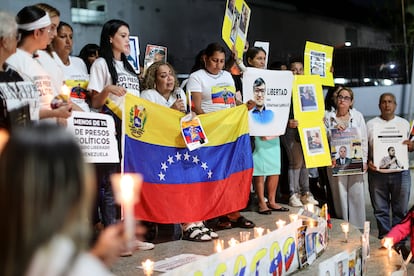
Today, all eyes are on Venezuela. International attention and the acceleration of events have created a new, uncertain climate, but one that is enabling demands that were unthinkable just weeks ago. Protests, suppressed for months by the intensification of repression, have thus resurfaced. The families of political prisoners have maintained a constant vigil since the first releases were announced, releases that were immediately deemed insufficient to soften a repressive policy that has resulted in the detention of nearly 1,000 people for ideological reasons. The pivotal moment of January 3 defused some of the deepest fears of a civil society cornered by years of persecution and silencing.
The cause of political prisoners shattered fear. It mobilized students and also pushed the leadership of opposition parties, including Vente Venezuela, led by María Corina Machado, to emerge from clandestinity and join a struggle that mothers, wives, sisters, and daughters had waged for years.
Oil as a bargaining chip
The initial signs after January 3 were confusing. At first, there were expectations of the regime’s collapse, but soon everything began to indicate that Venezuela was heading toward a power realignment, with oil as a bargaining chip and an apparent spirit of reopening both internally and externally. Externally, Donald Trump oversees Venezuela from Washington. Internally, Chavismo attempts to counter these impositions with an internal message: Trump is not in charge, they seem to be saying. Maduro had already considered all of this.
Trump’s hand left visible cracks in the Chavista leadership. A video recording of a meeting of Chavista media figures, in which Delcy Rodríguez participated by phone, clearly revealed the extent of the coup. In that call, with the president on speakerphone, Rodríguez confessed that on January 3, the United States had given them 15 minutes to decide, under threat of death, whether to cooperate.
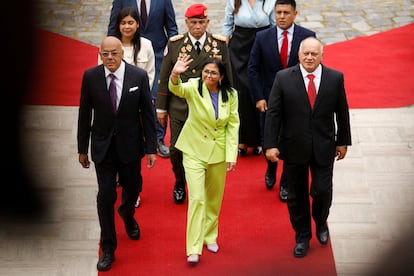
Within the same narrative of weakness, Chavismo is capable of extolling its strength. In that call, Rodríguez stated that they continued their resistance and asked for trust in the revolution’s political leadership. “There should never be any doubt that the political leadership is firmly committed to our objectives, even if tactical steps or actions that are difficult to understand are sometimes taken,” she said. The message sought to contain internal divisions during a stage of pure political survival, the period of greatest retreat for Chavismo in power, in which rhetoric has had to be recalculated on the fly, like a disoriented GPS.
This constant readjustment of the narrative has forced the interim president to put out fires at home. Dispelling accusations of treason and surrendering sovereignty to the United States has become key to maintaining internal control. Last week, Elías Jaua, an emblematic voice of the founding sectors of Chavismo — Hugo Chávez’s vice president, Nicolás Maduro’s former foreign minister, and holder of several high-level positions — gave voice to this discontent by describing Venezuela as an occupied country. “The government that remains has to work according to the directives of the occupying power, with some possibility of resisting so that the plunder is less extensive than what imperialism intends,” he stated.
This precarious balance also explains the scope — and the doubts behind — Friday’s historic amnesty announcement. The amnesty presented by the interim president opened a new horizon, but it also left behind many questions. Human rights defenders have warned that the process must not lead to an evasion of responsibility for arbitrary detentions, torture, and other violations committed over the years. The demand for justice coexists with the demand for historical memory: El Helicoide, which will become a community center, stands as a symbol of a past that, for these sectors of civil society, cannot be closed without acknowledging the harm inflicted on Venezuelans during the last two decades.
The scope of the proposal raises further questions. The design and implementation of the amnesty have been entrusted to Diosdado Cabello, the iron fist of the revolution and one of the architects of the mechanisms of persecution, including the law against hate speech used to justify the imprisonment of people for expressing their opinions on social media. How this paradox is resolved will largely determine the course and limits of the transition now underway.
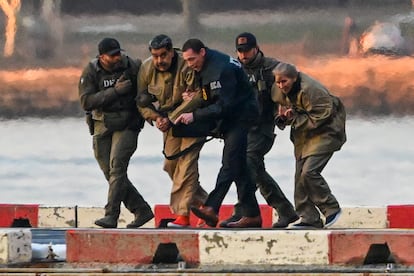
In any case, none of this had been possible before. After years of gradual pressure and diplomatic negotiations, Chavismo only became more radicalized, accumulating persecuted individuals and victims to cling to power without popular support, its legitimacy mortally wounded after July 28, 2024, following the electoral fraud. The violation of international law committed by the United States when it bombed Caracas — leaving 83 dead and dozens wounded — in order to capture Nicolás Maduro and his wife, Cilia Flores, forced a solution that an authoritarian regime, unwilling to yield, had rejected until the very end. That early morning when the residents of Caracas heard explosions and the metallic roar of military aircraft overhead became a turning point for the political decompression in Venezuela.
Machado’s role is also tied to the limits and scope of this transition. Transformed by Chavismo into a central enemy of the process, she faces the threat of imprisonment, a threat that any potential amnesty should defuse. Over the past month, the opposition leader with the greatest public support has had to reassess expectations: initially sidelined by Trump’s derogatory rhetoric, she ended up meeting with him and offering him the symbolic olive branch of the Nobel Peace Prize that the Republican sought.
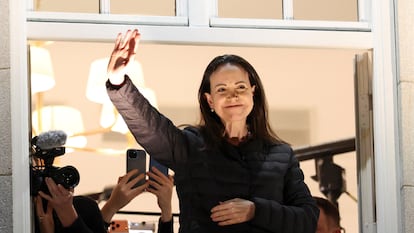
Machado left Venezuela in late 2025 in a U.S.-backed extraction operation and then traveled to Norway to receive recognition for the peaceful struggle following the July 28, 2024 elections, in which Maduro was exposed for fraud. From a more peripheral position, she has effectively accepted the three-step transition plan promoted by Secretary of State Marco Rubio — stabilization, recovery, and transition — and awaits her moment. A timeframe that no one dares to predict.
Beyond the announced amnesty, the repressive structure has shown no signs of beginning its dismantling, a task that involves not only the police forces but the entire state apparatus. This week, Venevisión, one of the main free-to-air television channels, broadcast statements from Machado delivered in Washington, following her meeting with Rubio. It was an unusual gesture in a country where censorship prevails, and where mainstream media outlets avoided reporting on the events of January 3. The response was swift and familiar: the broadcast was removed from state-run digital platforms. Thus, although the path to transition seems to have opened up after this tumultuous month, it remains to be seen what rules will govern the process.
Sign up for our weekly newsletter to get more English-language news coverage from EL PAÍS USA Edition
Tu suscripción se está usando en otro dispositivo
¿Quieres añadir otro usuario a tu suscripción?
Si continúas leyendo en este dispositivo, no se podrá leer en el otro.
FlechaTu suscripción se está usando en otro dispositivo y solo puedes acceder a EL PAÍS desde un dispositivo a la vez.
Si quieres compartir tu cuenta, cambia tu suscripción a la modalidad Premium, así podrás añadir otro usuario. Cada uno accederá con su propia cuenta de email, lo que os permitirá personalizar vuestra experiencia en EL PAÍS.
¿Tienes una suscripción de empresa? Accede aquí para contratar más cuentas.
En el caso de no saber quién está usando tu cuenta, te recomendamos cambiar tu contraseña aquí.
Si decides continuar compartiendo tu cuenta, este mensaje se mostrará en tu dispositivo y en el de la otra persona que está usando tu cuenta de forma indefinida, afectando a tu experiencia de lectura. Puedes consultar aquí los términos y condiciones de la suscripción digital.