Trump wants to change Americans’ diets, but his deportations are making it impossible
Cattle ranchers and farmers warn they will not be able to meet the increased demand for red meat and dairy products, recommended in the new food pyramid, without migrant labor
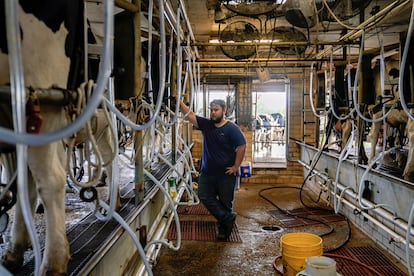

The Trump administration wants to change Americans’ diets because, with more than 70% of adults now overweight or obese, it considers America to be sick. This is how the Department of Health and Human Services (HHS) defined it, as it launched the Dietary Guidelines for Americans on January 7th. These recommendations, part of the Make America Healthy Again (MAHA) movement, promote the consumption of fresh foods over processed foods, which predominate on the tables of millions of Americans.
The new guidelines prioritize the consumption of protein sources, such as red meat and whole milk, a victory for the meat and dairy industries and a defeat for those who denounce the environmental damage caused by the industry. Aside from the controversy surrounding the recommendation of foods that have been discouraged by doctors for decades, the initiative faces a significant problem: the Administration’s anti-immigrant policies have led to a labor shortage in the livestock and agricultural sectors.
Business leaders who benefit from the new food pyramid argue that the recommendations highlight a contradiction in national policy: while consumers are encouraged to choose fresher, more nutritious foods, farms and agriculture are facing a labor shortage that threatens their ability to meet this demand. This imbalance between supply and demand could also lead to higher food prices for American families.
“The new dietary guidelines recognize the importance of nutritious foods grown in the United States, but they overlook a fundamental reality: We cannot get real food to Americans’ tables without people working on our farms,” said Rebecca Shi, executive director of the American Business Immigration Coalition (ABIC), a bipartisan organization that unites more than 1,700 CEOs, business owners, and trade associations in 17 states.
Farmers and ranchers have been affected by the arrests and deportations ordered by a government obsessed with achieving the “largest deportation in history.” To this end, agents from Immigration and Customs Enforcement (ICE) have raided fields, farms, and factories in search of undocumented workers to add to the list of those to be deported. These sectors survive thanks to migrant labor, as these jobs are in low demand among Americans.
“We rely heavily on immigrant labor. This is due to several reasons. The rural location of these facilities isn’t attractive to some potential workers, and working with animals isn’t for everyone,” Matt Teagarden, executive director of the Kansas Cattlemen’s Association, explained to EL PAÍS. Many of them have been working without legal status for decades. There are families where up to three generations have been involved in this work. Cows, Teagarden explained, need to be fed and milked 365 days a year, and the work isn’t the typical eight-hour, five-day-a-week job.
Business owners have been complaining for months about the repercussions of ICE raids on their businesses. In addition to the losses caused by arrests and deportations, many employees have stopped going to work for fear of encountering the agents. “We can import workers for agriculture and livestock, or we can import our food. The situation has reached that point,” he says.
Teagarden was part of a delegation of more than 100 agricultural business leaders who went to the Capitol last November to tell lawmakers about the crisis created by the crackdown on migrants and to request reforms that would allow undocumented workers to regularize their status. “While imported food complements what we can produce domestically, I believe it is important, from the standpoint of food security and economic activity, to produce a significant amount of our food here in the country. That won’t be possible without an adequate workforce, and immigrants have proven over the years to be a truly essential part of that workforce,” Teagarden emphasized.
According to ABIC data presented last year, there are eight million unfilled jobs nationwide, which also affects product prices. In addition to farm work, meat processing plants are also affected. “These plants rely heavily on immigrant labor. We need them to operate continuously and at full capacity so that live animals can be transformed into the steaks, roasts, and ground beef that consumers love,” the businessman points out.
One of the requests presented in Washington is to expand H-2A visas, granted for seasonal agricultural work, which ranchers want extended so they can use them year-round. The delegation says their requests were well received by Washington officials.
For now, the industry’s influence has been evident in the announcement of the new guidelines. “Finally, we are reorienting our food system to support American farmers, ranchers, and businesses that grow and produce real food,” declared Health Secretary Robert F. Kennedy. “These guidelines return us to the basics. American households must prioritize whole, nutrient-dense foods—protein, dairy, vegetables, fruits, healthy fats, and whole grains—and dramatically reduce highly processed foods. This is how we Make America Healthy Again.”
The task is presumed to be complicated without a change in the Trump Administration’s immigration policies. “Every year it becomes more difficult to find enough skilled and committed workers to keep our farms running and care for our cattle. If we don’t reform our immigration system, secure our workforce, and combat the labor shortage, we simply won’t be able to meet demand or manage our herds and productive farmland. We need urgent action so we can continue to provide fresh, healthy food for Americans,” said Jenni Tilton Flood of Flood Brothers Farms in Maine.
Sign up for our weekly newsletter to get more English-language news coverage from EL PAÍS USA Edition
Tu suscripción se está usando en otro dispositivo
¿Quieres añadir otro usuario a tu suscripción?
Si continúas leyendo en este dispositivo, no se podrá leer en el otro.
FlechaTu suscripción se está usando en otro dispositivo y solo puedes acceder a EL PAÍS desde un dispositivo a la vez.
Si quieres compartir tu cuenta, cambia tu suscripción a la modalidad Premium, así podrás añadir otro usuario. Cada uno accederá con su propia cuenta de email, lo que os permitirá personalizar vuestra experiencia en EL PAÍS.
¿Tienes una suscripción de empresa? Accede aquí para contratar más cuentas.
En el caso de no saber quién está usando tu cuenta, te recomendamos cambiar tu contraseña aquí.
Si decides continuar compartiendo tu cuenta, este mensaje se mostrará en tu dispositivo y en el de la otra persona que está usando tu cuenta de forma indefinida, afectando a tu experiencia de lectura. Puedes consultar aquí los términos y condiciones de la suscripción digital.