Iran challenges the powerful US Navy in an asymmetric naval battle in the Gulf
Iranian control of the Strait of Hormuz, vulnerable to potential drone or speedboat attacks, and the risk of underwater mines makes it difficult for US frigates to take action to protect cargo ships

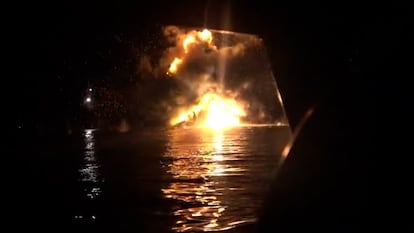
The video lasts 40 seconds. A speedboat focuses on one side of the oil tanker Safesea Vishnu, off the coast of Umm Qasr in southern Iraq. It is midnight on Wednesday. The water is calm. A powerful explosion, followed by another one likely triggered by the first, sets the ship ablaze and sends up a huge plume of smoke. It is an attack. The small boat filming the scene waits a few seconds before speeding off northeast toward Iran. One of the crew members shouts: “God is the greatest. Destruction of an American oil tanker in the northern Persian Gulf. At your service, Khamenei!” As the camera captures the burning bow of the Safesea Vishnu, another cargo ship, the Zephyros, appears alongside. The two vessels were transferring cargo from one to the other. The spokesman on the speedboat identified himself as a member of the Naval Force of the Islamic Revolutionary Guard Corps, a military pillar of the Iranian regime. A few hours later, the price of Brent crude oil exceeded $100.
The largest U.S. Naval deployment since the 2003 invasion of Iraq has decimated the Iranian Navy. Washington has sent nearly 40% of its operational ships to the Middle East (16 warships plus the aircraft carriers USS Gerald Ford and USS Abraham Lincoln). According to the war report released Thursday by CENTCOM (the U.S. Central Command with jurisdiction in the region), approximately 60 Iranian frigates have been destroyed since February 28. This exceptional show of force, however, has proven insufficient in the face of Tehran’s asymmetric retaliation, as demonstrated by the attack carried out Wednesday night off the coast of Iraq.
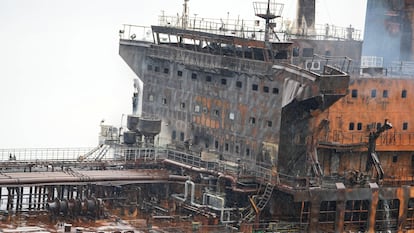
Analysis of the video footage and the damage inflicted on the Safesea Vishnu suggests that the attackers used a naval drone to blow up the hull. The explosion damaged both cargo ships, which were moored side-by-side. This unconventional tactic has been used before with great success by the Ukrainian Navy to counter Russia’s powerful Black Sea Fleet.
The price for disabling a ship—the type and complexity of the naval bombs used by Iran are unknown, but the most sophisticated ones in the Ukrainian arsenal cost around $250,000—is low compared to the major blow dealt to the crude oil trading market on which the West depends. This is especially true given the target: according to records from the maritime traffic publication Lloyd’s List, the cargo ship that was hit is indeed owned by the American company Safesea Group.
South of Iraq, the waters of the Gulf flow toward the Strait of Hormuz, the heart of the current battle being waged between the United States and Israel against the Iranian regime. Its new leader, Mojtaba Khamenei, reaffirmed on Thursday his intention to keep the waterway closed, under the de facto control of the Iranian armed forces—Oman, on the western shore of the strait, is unable to challenge Iranian supremacy in the region. Around 20% of the world’s traded crude oil passes through this strait. Its sellers are neighboring Gulf countries allied with the United States and, therefore, in Tehran’s crosshairs. Since the start of the Israeli-American offensive, traffic has been virtually blocked, with hundreds of ships waiting on both sides of the strait.
Iran holds the initiative in the Strait of Hormuz, while the United States struggles to extricate itself from the impasse and wage a maritime battle that is virtually unparalleled, both in terms of the weapons in use and the resources at stake. The strait’s narrowest point measures just over 20 nautical miles (39 km), but the navigable channel is less than 2.5 miles wide (4 km), a narrow and vulnerable space for mounting an escort to guarantee safe passage. “Defense vessels would have very little time to react to an imminent threat,” notes Mike Plunket, an analyst at the defence intelligence company Janes. According to his calculations, there are approximately 400 merchant ships waiting to pass. The U.S. Navy could provide about eight destroyers in the short term for escort duty. The result: it’s possible to form small convoys, perhaps with four or five merchant ships protected by two destroyers.
Beyond the risk and time such a solution would require, it would be insufficient to stabilize crude oil prices—to which must be added potential increases in rates from cargo ship insurers, something that shipping companies have experience with in Black Sea ports. U.S. Energy Secretary Chris Wright, after several contradictory messages earlier in the week, stated this Thursday that his country is not ready to implement a maritime escort, although perhaps it might be by the end of the month.
Plunket also points out that, while the Iranian Navy may have been significantly reduced, Tehran’s arsenal for asymmetric warfare includes so-called fast coastal attack craft, a flotilla of small, high-speed vessels under the control of the Revolutionary Guard. These boats, armed with machine guns and rocket launchers, similar to the one seen in the video of the attack on the oil tanker Safesea Vishnu, are used by the regime in a swarm-like fashion to harass and overwhelm large ships in the Gulf.
The report issued Thursday by CENTCOM estimated that approximately 30 Iranian minelayers had been damaged or destroyed in the nearly two weeks of the conflict. U.S. President Donald Trump himself threatened Wednesday to launch a fierce attack if his military found a single mine in the Gulf waters, a tactic former president Ronald Reagan used in the late 1980s after the USS Samuel B. Roberts struck one of these mines in the same waters. According to CNN and CBS, the Iranian Navy has already begun laying mines. So far, no incidents involving these devices have been reported.
Iran’s arsenals are estimated to contain around 6,000 mines of various types, from conventional surface mines to the most sophisticated ones lying on the seabed. Again, the challenge lies not in the type of munition—many of the U.S. Frigates are equipped with mine-clearing systems—that can damage and disable a cargo ship, but rather in the effect of a single mine.
“Once a mine is discovered,” the Janes analyst continues, “you have to assume there are many more in the water. This means that the routes will have to be swept continuously to ensure there are no more. It requires specialized ships, equipment, and personnel, and it’s a very slow and dangerous process even in peacetime. If you add to that the possibility of the minesweepers themselves being attacked, the complexity increases.” Ukraine’s experience has once again shown how costly it is, in terms of both resources and time, to clear the waters of these types of devices. There are still access routes to the Black Sea in the south of the country where demining operations are currently underway.
And while the Strait of Hormuz remains blocked at Tehran’s discretion, as reported Tuesday by The Wall Street Journal and corroborated by the maritime traffic monitoring company TankerTrackers.com, Iran is now exporting more oil than before the start of the U.S. And Israeli attack.
Sign up for our weekly newsletter to get more English-language news coverage from EL PAÍS USA Edition
Tu suscripción se está usando en otro dispositivo
¿Quieres añadir otro usuario a tu suscripción?
Si continúas leyendo en este dispositivo, no se podrá leer en el otro.
FlechaTu suscripción se está usando en otro dispositivo y solo puedes acceder a EL PAÍS desde un dispositivo a la vez.
Si quieres compartir tu cuenta, cambia tu suscripción a la modalidad Premium, así podrás añadir otro usuario. Cada uno accederá con su propia cuenta de email, lo que os permitirá personalizar vuestra experiencia en EL PAÍS.
¿Tienes una suscripción de empresa? Accede aquí para contratar más cuentas.
En el caso de no saber quién está usando tu cuenta, te recomendamos cambiar tu contraseña aquí.
Si decides continuar compartiendo tu cuenta, este mensaje se mostrará en tu dispositivo y en el de la otra persona que está usando tu cuenta de forma indefinida, afectando a tu experiencia de lectura. Puedes consultar aquí los términos y condiciones de la suscripción digital.