In the epicenter of the Russian bombing of Ukraine: Two weeks without heating, water, or electricity at minus 20ºC
Troieshchyna is the hardest-hit Kyiv neighborhood in the latest wave of Russian strikes that has left millions without basic resources in the depths of winter

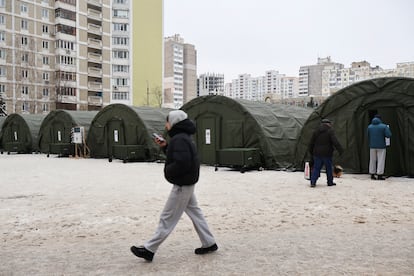
A police car drives through the streets of Troieshchyna, broadcasting a list of addresses over a loudspeaker. These are the locations where residents can find the emergency shelters run by the State Emergency Service of Ukraine. This Kyiv neighborhood is ground zero for the energy crisis plaguing the Ukrainian capital. For two weeks, residents of this district have been without any basic services to survive a bitter winter in which temperatures drop below -20°C: no heating, no hot water, and no electricity.
Troieshchyna is a neighborhood on the outskirts of the city, populated mainly by people who have been arriving from the eastern provinces since the 1980s, either to work in industry or to flee a war that began in 2014 with the armed uprising of pro-Russian separatists in Donbas. Because of its location, a significant number of long-range bomb drones from Russia fly over this neighborhood. In Troieshchyna, it is more common to see buildings scarred by explosions after four years of occupation than in downtown Kyiv.
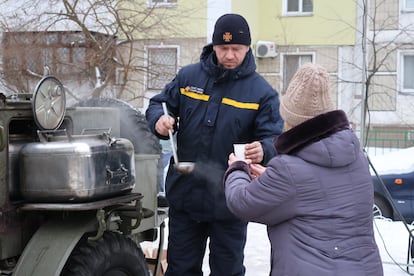
The residents of Troieshchyna are people accustomed to resilience, so they help each other automatically, without hesitation, explains Tamila Ivanenko. She and a friend were taking turns on Tuesday at one of the emergency collection points, filling jugs with hot water. The temperature outside was -6°C. The thermometer reads 8°C in Ivanenko’s home: she has been without heating for two weeks because, on two occasions this January, Russian missiles have struck the pumping station that supplies hot water to the neighborhood.
Ivanenko is 77 years old and came to Kyiv 40 years ago from the neighboring province of Cherkasy to work at the city’s Soviet-era pasta factory, Kyiv Makaronna Fabrika. “The Russians want us to disappear, to cease to exist, but we will remain here in Ukraine,” she says. On Monday, she only had two hours of electricity at home; in the rest of the city, the average was four hours of power. Russia attacks the electrical grid of the country’s major cities daily, but the capital is bearing the brunt of the strikes.
Kyiv Mayor Vitali Klitschko stated last week that 600,000 people (20% of the population) had left the capital in January due to the energy crisis. An example of this can be seen at the kindergarten where Sasha, Svitlana Titova’s five-year-old son, attends. This preschool in Troieshchyna used to have 100 children, but now only 10 remain. The rest have left Kyiv with their parents.
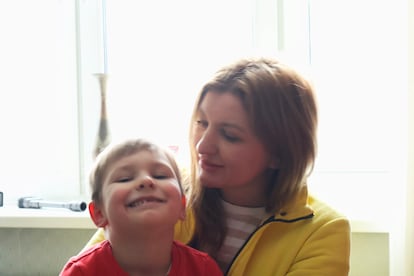
Titova shows videos of Sasha in class, with children bundled up as if they were outside. The rule states that if the temperature drops below 13°C in the classroom, they have to go home. In their apartment, there is no gas or hot water. Electricity lasts, at most, four hours a day. They cook with camping stoves and have installed batteries connected to backup power lines for light at night. When the electricity comes back on, they use two radiators to heat their home.
Titova and her husband are from Donetsk, a Russian-occupied city in the east. They know what it’s like to live on the edge. She admits she’s thinking of leaving Ukraine with their child for Italy, where she has acquaintances, but she can’t afford rent there.
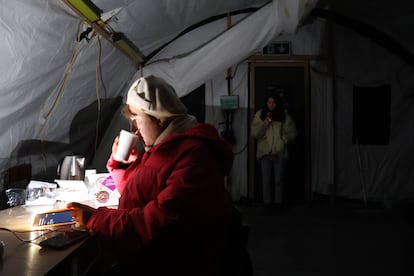
The Emergency Service has set up seven tents in front of Titova’s home. Vera Ivanivna, 77, also from Cherkasy, and Victoria Leshchenko, 60, are sheltering in one of them. Both live alone and have fallen ill from the cold. The temperature in their apartments is also 8°C. Leshchenko has a cold; she has just finished work as a lab assistant at a university and will stay in the tent until bedtime. She’s drinking and eating something warm and charging her cell phone. Later, at home, she’ll get into bed wearing her coat and three pairs of thermal socks.
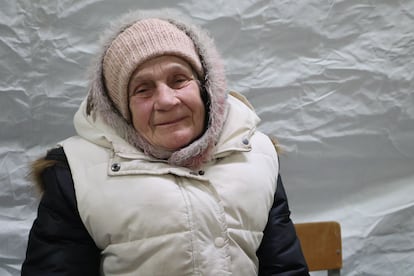
Ivanivna spends all day at the tent and also returns home to sleep. She has bronchitis, but doesn’t want to go to the doctor. She’s retired; she worked for 30 years as a cook at a military academy. Her pension is about $110 a month. She says she doesn’t have money to buy batteries or thermal clothing. She doesn’t feel like talking about the present, the cold, or the dead on the front lines. She does want to talk about her hometown, Kaniv, famous in Ukraine as the burial place of the poet and national symbol Taras Shevchenko.
“The situation for older people is high-risk,” says Alla Rudich from her caretaker’s booth. She is 66 years old, and her building in Troieshchyna has been without heat for two weeks. She shows a picture of a digital thermometer inside her apartment: it reads 6.5°C. When she gets off work, she locks herself in the kitchen, which she heats with the flames on the stove: “I’m lucky, I have gas at home.” Rudich admits it’s dangerous, but for her, it’s easier to die from the cold these days.
Tu suscripción se está usando en otro dispositivo
¿Quieres añadir otro usuario a tu suscripción?
Si continúas leyendo en este dispositivo, no se podrá leer en el otro.
FlechaTu suscripción se está usando en otro dispositivo y solo puedes acceder a EL PAÍS desde un dispositivo a la vez.
Si quieres compartir tu cuenta, cambia tu suscripción a la modalidad Premium, así podrás añadir otro usuario. Cada uno accederá con su propia cuenta de email, lo que os permitirá personalizar vuestra experiencia en EL PAÍS.
¿Tienes una suscripción de empresa? Accede aquí para contratar más cuentas.
En el caso de no saber quién está usando tu cuenta, te recomendamos cambiar tu contraseña aquí.
Si decides continuar compartiendo tu cuenta, este mensaje se mostrará en tu dispositivo y en el de la otra persona que está usando tu cuenta de forma indefinida, afectando a tu experiencia de lectura. Puedes consultar aquí los términos y condiciones de la suscripción digital.