Mark Carney, Trumpism’s unlikely foe
The Canadian prime minister, once governor of the Banks of Canada and England, presents an image of pragmatism
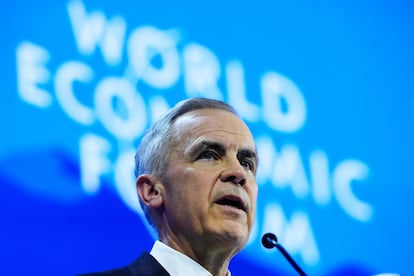
The world looked to Europe for someone who would halt Donald Trump, and a Canadian resembling an amiable retiree stepped into the role. Canadian Prime Minster Mark Carney delivered one of the most inspiring and eloquent speeches of last week’s Davos Economic Forum in Switzerland. Before the planet’s business and political elite, the 60-year-old politician attested to “a rupture in the world order” and “the beginning of a harsh reality, where geopolitics, where the large, main power, geopolitics, is submitted to no limits, no constraints.” “Let me be direct. We are in the midst of a rupture, not a transition,” he said, without specifically mentioning Trump.
He didn’t have to. The day afer Carney’s speech, the U.S. President doubled down on his threats against Europe and confirmed his intention to annex Greenland. Carney encouraged mid-sized countries, which are at risk of being subjugated by the largest world powers like the United States and China, to forge alliances. “The middle powers must act together, because if we’re not at the table, we’re on the menu,” he said.
Numerous attendees, world leaders and high-level executives rose to their feet to applaud Carney’s speech — an unusual sight at this kind of forum — the discourse having been a 2,324-word text of which he was the sole author, as Canadian media has proudly reported.
Though he did not mention the American specifically, it was clear that Carney’s message alluded to Trump, with whom the Canadian has maintained a surprisingly cordial relationship. The Republican leader offered Trumpian praise of the Canadian prime minister in October, when Carney visited the White House. “He’s a nice man, but he could be nasty [in negotiations]. He does a great job, and he’s a tough negotiator,” said Trump.
Since his appearance at Davos, Carney’s international profile has been raised considerably. Winner of the Nobel Prize for Economics, Paul Krugman, writes on his blog that the Canadian’s speech “was a brave stand to take.” Krugman adds, “Canada sits right next to the United States, whose economy is a dozen times larger […] Nature wants Canada and the United States to be closely intertwined. And for this reason Canada is arguably more exposed to the consequences of Trumpian wrath than any other nation.”
“Mark Carney’s speech at Davos was far from the loudest reaction that we’ve seen up to now from a government leader to the crisis that has been unleashed in the Western world’s international relations due to President Trump’s aggression,” says economic historian Adam Tooze.
Consequences were quick to appear. On Saturday, Trump threatened Canada with 100% tariffs if it signed a trade deal with China. “If Governor Carney thinks he is going to make Canada a “Drop Off Port” for China to send goods and products into the United States, he is sorely mistaken. China will eat Canada alive, completely devour it, including the destruction of their businesses, social fabric, and general way of life,” the U.S. President wrote on Truth Social.
The Canadian prime minister became the leader of his country most unexpectedly, over the course of just a few months. A year and a half ago, Carney was hardly thinking of entering the world of politics. Justin Trudeau’s administration was in open conflict with many of Canada’s allies, and his popularity was in freefall. In opinion polls, conservatives were leading by nearly 20 points. But a political crisis that culminated in Trudeau’s resignation in January 2025 led to Carney’s meteoric rise. He took office as interim prime minister in March, soon after being elected leader of the Liberal Party.
Carney held elections on April 29 in which he centered his party, and during the campaign, vowed to be the leader needed to defend the country against the onslaught of the Trump administration, which had been threatening to make Canada the 51st state since January. He highlighted his economic experience as the former governor of the Bank of Canada and the Bank of England.
Born in 1965 in Fort Smith, a small town of little more than 2,000 inhabitants in Canada’s Northwest Territories, Carney is the son of two professors. He was always good in school. He won a scholarship to study economics and finance at Harvard University, where he developed a passion for ice hockey, his own country’s most popular sport. He played goalie for a local team.
Years later, Carney traveled to the United Kingdom to get his doctorate in economics from Oxford University. One of his professors, impressed by the insightfulness of a paper Carney had written, decided to photocopy and save it to show off in the future, according to The Guardian. Carney’s resume was becoming formidable. He began work at Goldman Sachs, spending 13 years traveling to the world’s major financial capitals, which left him with a global perspective. Those who knew him at the time recall his motto from those days: “Learn, earn, serve.”
In 2003, he changed course, abandoning the private firm to go over to the other side and work for the public sector. He began at the Bank of Canada, where he was tasked with supervising its financial entities. Four years later, after having spent time as the department of finance’s senior associate deputy minister, Carney became the bank’s governor. He is remembered there for his leadership style: relentless, but unbeholden to established hierarchies.
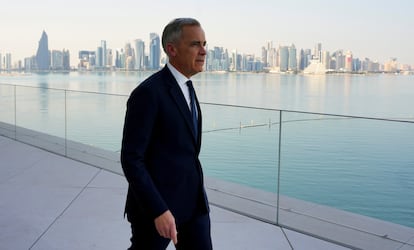
Carney’s speech at Davos was not an outlier. He’s an ace communicator, accustomed to dealing with serious crises. He faced the finance world’s Great Recession in 2008 as the head of the Bank of Canada. His actions and messages to the country kept it from suffering more serious consequences, like those that buffeted Europe until the arrival of Mario Draghi as president of the European Central Bank in 2011.
Years later, he learned through an ad in British publication The Economist that the Bank of England was looking for a new director. A few weeks later, he became the first foreign governor of the institution popularly known as the Old Lady of Threadneedle Street. There, he navigated the storms of Scotland’s independence referendum and Brexit.
In both cases, he delivered bold speeches in which he warned of the negative potential economic consequences of the decisions. After the UK still voted to leave the European Union, he appeared in front of the press with a message of calm, assuring all that the pound would be protected from the markets’ panic.
Pragmatism
Carney is brilliant, but he is also pragmatic and rather opportunistic. Though he worked as a special envoy on climate action for the United Nations, when he became prime minister, he suspended a fossil fuels emission cap.
In recent months, Canada has attempted to reach an agreement with Washington to end the countries’ tariff war. To do so, Carney assumed a more conciliatory tone than Trudeau had previously struck. In fact, Carney’s administration suspended nearly all the levies that had been passed in response to Trump’s offensive; he also eliminated a tax on large tech companies. Despite this attempt at appeasement — a measure that Carney himself would later critique at Davos — Canada is the only G7 member that has not yet signed a trade agreement with the United States.
Paul Wells, Canadian political analyst, reflected on Carney’s speech: “I think it’s Carney beginning to acknowledge the limits of the appeasement [...] He’s saying that the return of great power politics, with essentially Russia, China, and the Americans doing whatever they want, makes a mockery of any claim that we live in a rules-based international order. And that persisting in that fiction is paying rapidly diminishing returns. I think was a good way to parse that part of the speech,” the expert said in a Canadian radio interview.
“Our relationship with the United States will never again be the same,” Carney has frequently commented. Though he was unable to advance in his negotiations with Washington, he has employed different measures to incentivize the national economy and reduce Canada’s dependence on its neighbor to the south. He has considerably reduced barriers to inter-province business, has emphasized his goal to make Canada a leader in energy production, and has promoted an initiative to simplify the construction of large infrastructure projects.
“His approach can sometimes be described as center-right,” says Daniel Béland, director of the Institute for the Study of Canada at McGill University. “He talks about pragmatism, but comes from the financial world, and his discourse is not as progressive as Justin Trudeau’s was. In contrast with his predecessor, Carney emphasizes economic matters over social ones. He is a technocrat economist at heart,” says the political science professor.
During his first months as head of the Canadian government, Carney has kept up an intense international agenda, traveling frequently to Europe and Asia, looking to strengthen diplomatic relationships with other countries. A few days before his now-famous speech, he visited China to sign an agreement to reduce tariffs on some 50,000 electric cars made by Chinese companies, in exchange for lowering tariffs on Canadian goods.
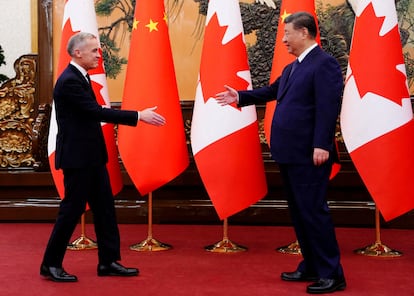
Carney “is a serious technocrat who is very familiar with these subjects. He is colder, but also more efficient than Trudeau, who often had difficulties explaining his government’s policies, though he was also more charismatic,” says Béland.
A day after Carney spoke at Davos, Trump declared at the same event that Canada “lives because of the United States.” Last Thursday, during a meeting with his cabinet in Quebec, the prime minister delivered another address to his constituents. “Canada doesn’t live because of the United States. Canada thrives because we are Canadian. We are masters at home. It’s our credit, our future, and it’s our choice,” he said, advocating for Canadian unity against external threats.
Carney’s popularity has held steady in recent months (it was at 56% in December). But he has also been the target of criticism. Some sectors see his policies as a departure from liberal ideology, particularly in his emphasis on projects that deprioritize environmental concerns and relationships with Indigenous communities, in addition to his international agenda, which often eludes subjects like human rights. Conservatives say that Carney has not put more money into the pockets of Canadians and has not fulfilled his promise to sign an agreement with Washington to end the trade war.
Sign up for our weekly newsletter to get more English-language news coverage from EL PAÍS USA Edition
Tu suscripción se está usando en otro dispositivo
¿Quieres añadir otro usuario a tu suscripción?
Si continúas leyendo en este dispositivo, no se podrá leer en el otro.
FlechaTu suscripción se está usando en otro dispositivo y solo puedes acceder a EL PAÍS desde un dispositivo a la vez.
Si quieres compartir tu cuenta, cambia tu suscripción a la modalidad Premium, así podrás añadir otro usuario. Cada uno accederá con su propia cuenta de email, lo que os permitirá personalizar vuestra experiencia en EL PAÍS.
¿Tienes una suscripción de empresa? Accede aquí para contratar más cuentas.
En el caso de no saber quién está usando tu cuenta, te recomendamos cambiar tu contraseña aquí.
Si decides continuar compartiendo tu cuenta, este mensaje se mostrará en tu dispositivo y en el de la otra persona que está usando tu cuenta de forma indefinida, afectando a tu experiencia de lectura. Puedes consultar aquí los términos y condiciones de la suscripción digital.