Crisis in Cuba undermines the ideological bedrock of Mexico’s government
No other regional issue, not even the U.S. Military strike on Venezuela, has elicited such a decisive response from Mexico, a country with a longstanding history of siding with the island.
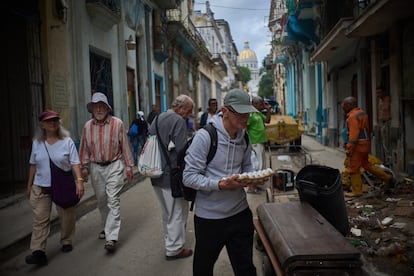

Cuba has emerged as one of the Mexican government’s foremost foreign-policy concerns. Since rising U.S. Pressure has plunged the island into a dire predicament, Mexican President Claudia Sheinbaum has nearly every day condemned the economic squeeze enacted under U.S. President Donald Trump and reaffirmed Mexico’s backing for Havana.
Beyond the careful balancing act with Washington, support for Cuba strikes a powerful chord within Morena, Mexico’s ruling party, where it draws on a longstanding history of political solidarity rooted in the era of the Institutional Revolutionary Party (PRI) and rekindled under the prior administration. No other regional crisis—not even U.S. Military intervention in Venezuela—has elicited such a resolute and unwavering reaction from The Mexican government.
Mexico’s support for Cuba extends beyond President Sheinbaum’s daily press briefings. Key Morena figures—ranging from parliamentary spokespersons to party leader Luisa Alcalde—have openly sided with Havana. Within Morena, a wide and occasionally fractured political coalition, the party’s more traditional or nostalgic left flank has adopted the Cuban crisis as a core ideological issue and is advocating for even stronger ties with Havana.
On Monday, Alcalde and the party’s secretary-general, Carolina Rangel, toured the Cuban Embassy, which thanked them in a social media post for “the support shown by the party members, legislators, and the Mexican government.” In his latest public comments, Cuban President Miguel Díaz-Canel specifically named Morena among those he acknowledged. Individuals near the Mexican presidency indicate there is a “there is a long-standing affection and solidarity with the Cuban people” and that this attitude surpasses the stricter stances inside the party.
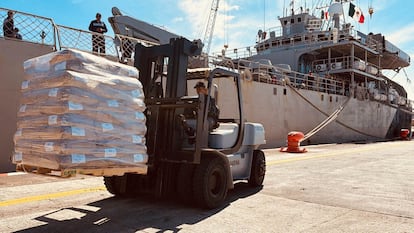
Two Mexican Navy vessels departed Veracruz on Sunday transporting 814 tons of supplies headed for Cuba—a swift action designed to maintain cooperation channels without openly breaching U.S. Sanctions. Since the military strike on Caracas that resulted in Nicolás Maduro’s capture in early January, Washington’s approach seems intended to trigger a domino effect extending to Cuba, with which the U.S. Has already opened a negotiation channel.
Cuba’s government claims no fuel deliveries have reached the island since December. With Venezuela—its primary supplier in recent years—no longer providing aid, Mexico has become one of the island’s last remaining partners. Pressure from Donald Trump, who declared a “national emergency” over Cuba in late January and imposed economic sanctions on any entity selling oil to Cuba, compelled Mexico to stop its shipments. Last year, Mexico was Cuba’s leading supplier.
From the moment Trump unveiled new measures tightening pressure on Cuba, Sheinbaum maintained that Mexico would pursue “solidarity with the Cuban people without putting Mexico at risk.” Her public communications focus on humanitarian assistance, while officials state that talks are ongoing to restore the oil shipment corridor.
Sheinbaum also employed humanitarian rhetoric in the weeks before the Venezuelan attack, even urging U.N. Involvement to stop “bloodshed.” She denounced the military action that removed Nicolás Maduro, citing Mexico’s enduring foreign policy tenet of opposing external intervention. This same principle has enabled her to remain neutral on the Nobel Peace Prize granted to María Corina Machado and on the contested presidential election won by Maduro. Mexico also did not strongly react to Trump’s criticisms of Colombian President Gustavo Petro, one of Sheinbaum’s regional partners.
Sheinbaum’s careful, negotiation-focused strategy has remained steady in her foreign policy, influenced partly by Trump’s threats, with Mexico targeted by him. Her position aligns with a longstanding diplomatic legacy tracing back to the Mexican Revolution, when sovereignty and non-intervention were enshrined as a defense against U.S. Expansionism.
Within this framework, another enduring principle of Mexico–U.S. Relations holds true: an unspoken agreement that Mexico could adopt stances opposing Washington’s, provided they didn’t trigger major conflicts. The classic case was Mexico’s backing of Castro’s Cuba during the Cold War—an adversary of the United States—enabling PRI administrations to demonstrate left-leaning credentials without undermining the bilateral ties.
Sheinbaum is adhering to the same diplomatic approach reinstated by former president Andrés Manuel López Obrador. In 2022, López Obrador visited Havana, where he was awarded the José Martí Order, the island’s highest distinction for foreign officials. Following that trip, ties strengthened, with Mexico increasing oil shipments to Cuba provided in return for medical aid. Sheinbaum has maintained this arrangement, at least until the most recent surge in U.S. Pressure on the island, located merely 200 kilometers from The Yucatán coast.
Sheinbaum is adhering to the same reasoning, a perspective powerfully rekindled by former president Andrés Manuel López Obrador. In 2022, the Mexican president journeyed to Havana to receive the Order of José Martí, the highest honor bestowed by the island’s authorities upon a foreign official. Since López Obrador’s trip, ties have grown tighter through expanded oil deliveries in return for medical aid. Sheinbaum has renewed this arrangement, right up to the most recent provocation by The United States concerning an island situated merely 124 miles from The Yucatán coast.
Sign up for our weekly newsletter to get more English-language news coverage from EL PAÍS USA Edition
Tu suscripción se está usando en otro dispositivo
¿Quieres añadir otro usuario a tu suscripción?
Si continúas leyendo en este dispositivo, no se podrá leer en el otro.
FlechaTu suscripción está en uso en otro dispositivo y solo puedes acceder a EL PAÍS desde uno simultáneamente.
Si deseas compartir tu cuenta, actualiza tu suscripción al plan Premium, así podrás incluir a otro usuario. Cada uno iniciará sesión con su propio correo electrónico, lo que les permitirá personalizar su experiencia en EL PAÍS.
¿Tienes una suscripción de empresa? Accede aquí para contratar más cuentas.
Si no estás seguro de quién está utilizando tu cuenta, te sugerimos actualizar tu contraseña aquí.
Si decides seguir compartiendo tu cuenta, este mensaje aparecerá en tu dispositivo y en el de la otra persona que utiliza tu cuenta de manera permanente, impactando tu experiencia de lectura. Puedes consultar aquí los términos y condiciones de la suscripción digital.