Life in Cuba after Trump’s threats: ‘This is a ship adrift’
The possibility of the US overthrowing the communist regime seems more plausible than ever, even more than during the Cold War. In Havana, a mixture of emotions hangs in the air, sometimes contradictory, but always permeated by the extreme precariousness of the present and anxiety about the future

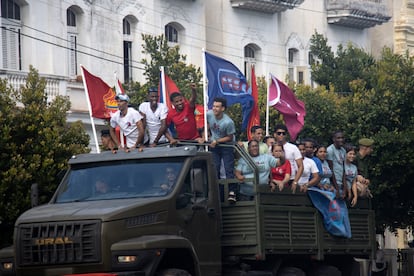
Sixty-seven years have elapsed, and Havana still remembers the triumphant entry of Fidel Castro and his bearded revolutionaries. After departing from a military academy in the morning, a convoy of trucks advances at midday from the Malecón, traversing the city along the same original route. Riding atop the olive-green trucks are young men and women with red flags, raised fists, and shouts of “Long live Fidel!” On the sidewalk, a crowd has gathered: there are a few flags, a few banners, but what stands out the most are the yellow shirts of the telemarketers from the state tourism agency, and the school uniforms. It is also a tradition that every January 8, public sector workers and students are granted leave — to use the official euphemism — to take a break and go out to celebrate the unprecedented armed triumph of socialism on this Caribbean island. An experiment that, after so many decades of geopolitical balancing acts, idealism, authoritarian rule and isolation, is going through one of the most fragile and difficult periods in its history.
Three gray-haired officials who have just come down from a building that still bears a sign on its roof that reads, in large red letters, “Patria o Muerte (Homeland or Death),” chat about the delicate moment in which this year’s anniversary is being observed, barely a week after the United States’ attack on Venezuela. “I’m almost as old as the Revolution and I’ve spent my whole life preparing for an attack,” says one of them. “We’ve grown up and grown old with this tension. We don’t know how to live any other way. So let Trump and all the gringos come, we’re going to defend ourselves.”
To justify his warlike fervor, the Cuban official cites none other than the CIA, which recently admitted in a declassified document that it had attempted to assassinate Castro at least eight times. The revolutionary leader died in his bed nine years ago. Cuban intelligence’s figures are slightly higher: 638. “We hold the Guinness World Record for foiled assassination attempts,” he says, pointing to a photo of the Commander-in-Chief displayed in the park next to the road, in a photo that bears another epic slogan: ¡Hasta la victoria siempre! (Until victory, always!). According to this Interior Ministry clerk’s logic, if after so much time, the leaders of the revolution have survived snipers, explosives, missiles, ground landings, and even poisoned cigars and a fungi-laced diving suit, by now they must be practically impervious to any American attack.
The fervent optimism, steeped in all the myths and legends surrounding the Castro revolution, is just one of the prevailing moods in Havana during these days of heightened tension and uncertainty. Following the capture of Venezuelan President Nicolás Maduro, a strategic ally of Castroism and its main economic backer through the shipment of tons of oil, Trump’s sights are now explicitly set on Cuba. The threat of overthrowing the troublesome, communist neighbor seems more plausible than ever before, even more so than during the Cold War. And in the Cuban capital, a mixture of emotions hangs in the air, sometimes contradictory, but all permeated by the extreme precariousness of the present and anxiety about the future.
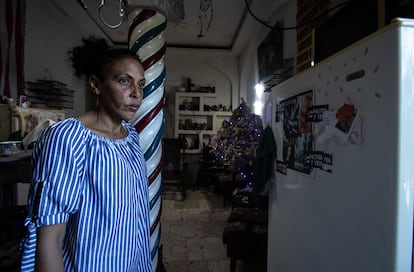
The cocktail of emotions ranges from the weariness of a retired military engineer whose monthly check is only enough to buy a carton of eggs; the hope of the mother of a young man sentenced for sedition and held in a maximum-security prison after the massive protests of 2021; the pain and anger of the friend of one of Maduro’s Cuban bodyguards killed during the attack in Caracas; the frustration of a family on the outskirts of the city suffering blackouts of more than 10 hours a day; the desperation of the taxi driver in a pink 1950s Cadillac who has neither gasoline nor tourists to take for rides; the sadness of a grandmother living among garbage and rubble in Old Havana; the uncertainty and expectation of a small business owner who has been doing well with the slight economic opening of recent years; or the desolation of the young people living on the streets, hooked on new synthetic drugs that are beginning to eat away at the most forgotten people on the island.
The attack on Venezuela, which has turned the international order upside down, comes at a particularly fragile moment for the Castro regime, which is accumulating an endless succession of crises: the worst blackouts due to the lack of oil to fuel its aging Soviet-era thermoelectric plants; shortages of medicine amid a health crisis that includes dengue, chikungunya, and other respiratory viruses; mass migration — at least a million people in the last five years, more than 10% of the population; inequality, and even poverty and infant mortality, which the Castro regime had managed to avert until now, delivering on its promises; and an economic collapse, which even the regime’s most ardent supporters no longer deny, although they continue to point to the very long-standing U.S. Embargo as its main cause. President Miguel Díaz-Canel himself, in an unprecedented move this summer, dismissed the Minister of Labor for grotesque statements denying that there were beggars in the country, but rather “people disguised as beggars.”
The era of the thaw is long gone. A decade ago, Presidents Barack Obama and Raúl Castro announced the resumption of diplomatic relations after 57 years. The embargo wasn’t completely lifted, but Obama visited Havana and eased sanctions, allowing the arrival of U.S. Cruise ships and airlines. In return, the Castro regime released political prisoners and agreed to increase internet access and open itself up somewhat to private businesses. All of that came to nothing a few years later with the Covid pandemic and Trump’s first term in office. The harsh repression of the 2021 protests, with hundreds of young people still imprisoned, made it difficult for former U.S. President Joe Biden to justify easing restrictions. With Trump’s second term, the tightening of the screws further reinforced the economic strangulation with more sanctions.
Since then, almost everyone on the island agrees that things are even worse now than during the so-called Special Period, when Cuba lost its main lifeline in the early 1990s, with the fall of the Soviet bloc. Since then, street slang, the vernacular language, explains things better than any sophisticated analysis could. “Cuba is a bayú,” meaning a mess, and “in Cuba, everyone is in the fight.” That is, desperately trying to find a way to survive.
Faithful, worthy, heroic!
The January 8 pageantry began with a minute of silence for the 32 Cuban military personnel who were part of Maduro’s security detail. Díaz-Canel said he would defend “the Bolivarian and Chavista Revolution,” alluding to his ally and strategic partner, with a policy of exchanging Venezuelan oil for Cuban doctors and security and intelligence advisors. Just hours later, Díaz-Canel offered a peculiar mea culpa, saying, “We must feel responsible for everything that is going wrong in Cuba.” Granma, the historic newspaper founded in 1965 as the information and propaganda arm of the Central Committee of the Communist Party, published one of its epic front pages a few days later: “Faithful, Worthy, Heroic!”
One of the 32 soldiers killed during the U.S. Attack in Venezuela was Yunio Estévez Samón. At age 32, he was one of the youngest members of the Cuban security detail protecting Nicolás Maduro. Yunio — spelled without an “r” at the end because the civil registrar made a mistake on his birth certificate, as recalled by his friend Claudia Rafaela Ortíz — grew up in a rural town in Guantánamo province, where “on rainy days, he would arrive at our house made of palm fronds and dirt on horseback, through the mud.” He was the first in his family to attend university and the first to travel the world, “against all odds, given the poverty into which he was born.” With an army scholarship, he studied mathematics and cryptography in Russia. He had three children and spoke with his friend for the last time at Christmas: “He wanted to buy a house with the savings from his work on the mission in Venezuela.”
He had arrived in Caracas a little less than two years ago, and his friend says that “he was killed in hand-to-hand combat after two hours of fighting, waiting for backup that never came.” Ortíz is bothered by “the dehumanization of the dead soldiers in order to attack our government.” With the publication of the names and faces of the bodyguards, accusations of abuses inside and outside the island have begun to surface in recent days. Ortíz believes that “all countries have security and intelligence agreements. What I want is for food and medicine to return to Cuba. For the country where I was born to return. But not for it to become like Panama or Puerto Rico; I want it to move toward freedom and justice, not toward inequality.”
The oil-for-doctors-and-military agreement was forged in 2004, shortly after Hugo Chávez won a referendum in Venezuela following a failed coup against him and coinciding with the founding of ALBA, a regional integration initiative among the leftist governments of the time. Three years later, Chávez himself inaugurated the ALBA House in Cuba. At the elegant colonial mansion in the Vedado neighborhood, a photo of Chávez and Fidel Castro with the motto “infinite loyalty” presides over the entrance. Inside, one of the staff members recounts that even before Chávez’s arrival, Maduro had studied for several months in Havana, “receiving training in Marxist ideology at a political school. It must have been around 1986, when he was a young activist in the Socialist League.”
Dismantling the Caracas-Havana connection was one of the obsessions of the current U.S. Secretary of State, Marco Rubio. In 2019, when Juan Guaidó challenged Maduro with the backing of the first Trump administration and proclaimed himself interim president of Venezuela, this power struggle led to a few dizzying months marked by an atmosphere of imminent regime change. It didn’t happen, and Rubio, then still a Republican senator from Florida and the son of Cuban exiles, said that “the only reason Maduro hasn’t fallen is because of Cuba’s support.” U.S. Intelligence also asserted that the Venezuelan president even had a plane ready for his escape to Havana. The White House has learned its lesson and is seeking to trigger a chain reaction. “Without Venezuelan oil, Cuba is ready to fall,” Trump said recently.
Soviet plants, Cuban crude
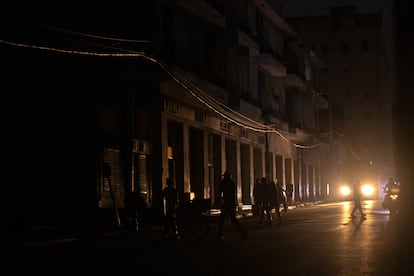
This entire affluent Havana neighborhood has been without power for hours, but Ernesto López, who agrees to speak under a pseudonym, is a calm man because he knows the ropes. He was a soldier, he studied thermoelectric engineering in Russia, and worked for over 50 years meticulously maintaining the Russian, Czech, and Hungarian power plants built in Cuba during the Cold War. With the fall of the Soviet allies, who supplied light fuel oil to power the plants, the government had to start burning its own heavy, viscous, sulfur-laden crude oil. “That crude wasn’t meant for that; the pipes started bursting and going out of service. Maintenance is very expensive, and we’ve been dealing with this problem ever since,” he explains, sitting in his living room, one of the few homes in the neighborhood still lit thanks to a digital device that stores electricity.
“Others have a generator, but that also needs gasoline, and it makes a lot of smoke and noise. I prefer this,” he says, pointing to a black cube with a screen under the television set that tells him how much electricity he has left. The device costs about $400, and it was a gift from his daughter in Spain, where she works as an engineer for an international company. If it weren’t for the help of relatives who emigrated, like almost all Cubans, López would need to spend more than three years of his pension just to pay for the device. He receives 3,000 pesos, about $10 a month, which is only enough to buy a dozen eggs.
“We’re fed up,” he says, not raising his voice much. He doesn’t have much faith that the Chinese photovoltaic plant projects will significantly improve the situation, which currently barely covers a third of the country’s electricity demand. López hasn’t taken his car out of the garage for weeks. He’s been waiting for over a month for his turn to go to a gas station, according to the digital app the government launched to try to organize the chaos and shortages. López also recently contracted chikungunya, a mosquito-borne illness “that knocks you out with a fever and can even kill you.” He took acetaminophen, which costs about three dollars at pharmacies, but it was almost nowhere to be found. He had to resort to the black market, where a box costs almost $20, and only with his daughter’s help could he afford it.
López’s desperation is similar to that of a taxi driver who prefers not to give out his name. He too has had the mosquito-borne virus, he too has suffered from medicine shortages, but on top of that, he barely has any customers. Tourism has fallen by almost 50% since the pandemic, and with the restrictions imposed by the United States, traditionally the largest source of tourists, now it’s mainly Chinese and Russians who show up, and even then, only in dribs and drabs. Leaning on his pink 1950s convertible Cadillac outside a downtown hotel, he explains that he’s had to sign up for La Nave, a kind of Cuban Uber service, though much more rudimentary and only payable in cash, because “the Chinese and Russians don’t understand anything, it’s like they’ve got blinkers on and they don’t spend that much money.”
Manuel Rodríguez, also a pseudonym, hasn’t been as badly affected by the drop in tourism. His customers are locals. Taking advantage of the first easing of restrictions for the private sector, he opened up a restaurant in Vedado a few years ago, serving cocktails and Spanish tapas. He spent some time in Madrid and has experience in the classic, touristy establishments, which are now scarce in Havana, and which used to bring in a steady stream of dollars. His own business has been growing, and the next step will be to become a micro, small, and medium-sized enterprise (MSME), which even authorizes him to import products. The proliferation of MSMEs has created a supply network that few on the island have access to. Rodríguez, 39, says he imports acorn-fed pork from Spain. “I’ve worked my ass off to get where I am, but I have to keep a low profile, because here, if you stick your head out, they’ll cut it off. We’ll see if things improve with Trump.”
“Cuba needs outside help”
He was arrested in his neighborhood, Vibora Park, in the south of the city. One afternoon in July 2021, eight plainclothes officers got out of a car with no license plates and dragged Duannis León away, beating him. His mother, Yenisey, recounts the story in the house where he lived with his three sisters. Duannis, 27, was one of the thousands who took to the streets in the largest protests since the Maleconazo of 1994, during the height of the Special Period. “Before they took him away, he told me that what happened was crazy, that the police were shooting at them and that they responded with stones,” his mother says in a humble kitchen that also serves as a living room and almost a bathroom. During the conversation, Yenisey receives a call. It’s her son calling from the maximum-security prison, where he is serving a 14-year sentence for sedition. Duannis, who worked as a barber, agreed to speak briefly with this newspaper: “I want a Cuba where there are several parties and the people can elect a president and not die of hunger.”
His mother recounts that her son can barely see out of his left eye after one of the beatings he suffered at the hands of prison guards, and that he spent weeks in solitary confinement. The UN has condemned the repression in Cuba, which it describes as the country with “the most convictions for arbitrary detention in the world.” Yenisey, who also denounces the constant harassment against her, says that the last time she visited her son, last week, he whispered in her ear: “Maduro is already rotting away, what do you think will happen now?” His mother didn’t answer, but she believes that “Cuba needs outside help. What happened to my son is something I wouldn’t believe if I hadn’t experienced it.”
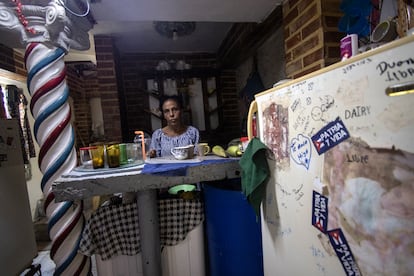
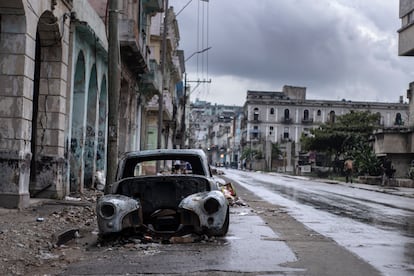
Marina, also a pseudonym, couldn’t believe that after 45 years living in Old Havana, the city’s historic heart, she would end up having to paint a sign by hand asking, “Please don’t litter.” It’s nighttime, and Marina has come out with her grandson to enjoy the fresh air outside the half-ruined modernist building, now divided into eight small apartments. There are piles of garbage on the corner, as there are on almost every corner. “It’s been there for days; they tell us there’s no gasoline to collect it.” She doesn’t even want to talk about Trump, only saying that in recent years her neighborhood has also become more unsafe and that “this is a ship adrift.” The center of Havana, once a symbol of that majestic and decadent beauty so often portrayed, is now an open-air garbage dump, barely lit due to the power outages.
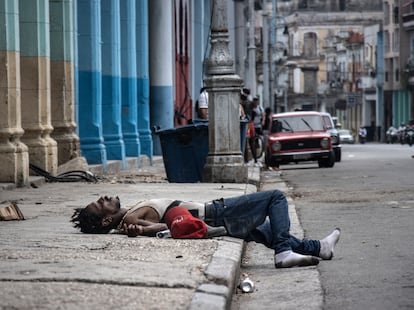
A little further on from Marina’s house, in the arcades of Galiano Avenue, where hardly any of the salsa and jazz clubs that made it famous remain, a barefoot young man sits with his head tucked between his knees, barely concealing his trembling. “When it hits you, it stiffens your penis, you lose your mind. It’s the most horrible thing that can happen to you,” says a man in his sixties, with a cowbell and drumsticks under his arm, who has stopped to check if the young man is alright. What’s happening to him are the effects of El Químico (“the chemcial”), a very cheap and addictive mixture of synthetic drugs that has been circulating on the streets for some time. The man with the drumsticks, an old jazz musician who earns a living playing around here, draws an analogy with the crack epidemic in New York in the late 1980s. “Deep down, it doesn’t matter if the Americans come to Cuba, because all the evils of capitalism are already here.”
Sign up for our weekly newsletter to get more English-language news coverage from EL PAÍS USA Edition
Tu suscripción se está usando en otro dispositivo
¿Quieres añadir otro usuario a tu suscripción?
Si continúas leyendo en este dispositivo, no se podrá leer en el otro.
FlechaTu suscripción se está usando en otro dispositivo y solo puedes acceder a EL PAÍS desde un dispositivo a la vez.
Si quieres compartir tu cuenta, cambia tu suscripción a la modalidad Premium, así podrás añadir otro usuario. Cada uno accederá con su propia cuenta de email, lo que os permitirá personalizar vuestra experiencia en EL PAÍS.
¿Tienes una suscripción de empresa? Accede aquí para contratar más cuentas.
En el caso de no saber quién está usando tu cuenta, te recomendamos cambiar tu contraseña aquí.
Si decides continuar compartiendo tu cuenta, este mensaje se mostrará en tu dispositivo y en el de la otra persona que está usando tu cuenta de forma indefinida, afectando a tu experiencia de lectura. Puedes consultar aquí los términos y condiciones de la suscripción digital.