Opposition leader Andrés Velásquez, after 16 months in hiding: ‘We need to establish a deadline for Marco Rubio’s plan in Venezuela’
Dissidents are gradually starting to speak up once more, and the veteran activist says he experiences a ‘cautious optimism’
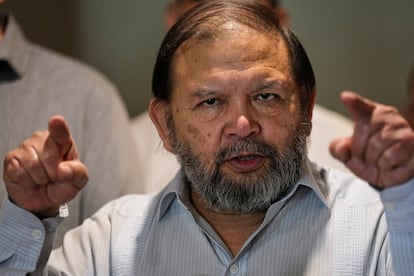
Andrés Velásquez, one of the best-known leaders of the Venezuelan opposition, remained in hiding for 16 months. After going underground following the July 2014 elections, when Nicolás Maduro claimed victory, he endured severely constrained and grueling conditions: for the entire period, he couldn’t step outside or reunite with his family. His face bears the marks of that ordeal: deep shadows beneath his eyes, a voice worn thin by fatigue, and an uncharacteristic beard. “Sometimes, a police officer would give me a tip-off to warn me that they might be looking for me, and I would move to a different location,” says the 72-year-old former governor of Bolívar state.
Velásquez emerged from concealment with great care. He did so last month, after the political changes in Venezuela following Nicolás Maduro’s arrest. He says he constantly checks his environment for any police tailing him, yet lately, officers seem to overlook him. There’s no known directive to detain him on any excuse. Thus, emboldened by updates from colleagues and contacts, he has chosen to reenter public view.
Alongside the release this Sunday of highly symbolic political figures like Jesús Armas, Roland Carreño, and Javier Tarazona, Andrés Velásquez’s reappearance after being in hiding stands as one of the clearest signs of the protest movement’s revival and the reemergence of the citizen agenda. A fresh atmosphere is starting to take hold in Venezuela following the U.S. Military intervention that resulted in Nicolás Maduro’s arrest. Along with Velásquez, activist Delsa Solórzano also came out of concealment. Yet, the re-arrest of opposition member Juan Pablo Guanipa just hours after Velásquez’s release has tempered hopes for this new chapter.
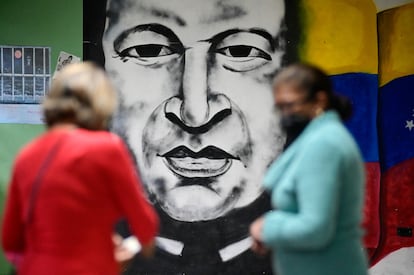
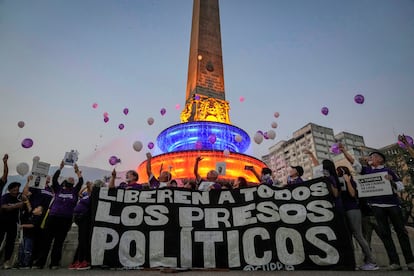
Prominent political prisoners recently freed, including Carlos Julio Rojas and Nicmer Evans, have joined the streets in solidarity with families of those still held. Vigils persist outside prisons across the nation. Students from The Central University of Venezuela have staged multiple demonstrations and, on one occasion, directly challenged Delcy Rodríguez—a scenario unimaginable just over a month ago. Figures such as Alfredo Ramos and Andrea Tavares have also reemerged in public protests. Even the amnesty bill submitted by the regime for political prisoners has faced sharp condemnation from the opposition over the Chavista regime’s refusal to acknowledge accountability.
Andrés Velásquez is heartened by the recent increase in civic participation. He aims to soon convene a press conference with fellow members of the Venezuelan opposition, who until recently faced persecution. For him, opposition unity must be a top priority right now. He lacks confidence in the amnesty legislation. He mentions that he has already started confirming the conditions of those freed and those still detained, offering assistance to their families. He desires to contribute to the movement to rebuild democracy in Venezuela. “I felt it was a good time to come forward and raise this challenge,” he tells EL PAÍS.
A longstanding presence in Venezuelan politics, Velásquez is an electrical technician by trade and a union leader who rose through the ranks of the national steelworkers’ movement, which set a standard in the country. He ran for president in 1993, held the offices of governor and deputy multiple times, and has opposed Chavismo since it assumed power. He heads the Radical Cause, a reformist left-wing party within the Unitary Platform, and has consistently stood out for his confrontational approach and Jacobin-style rhetoric targeting corruption.
The opposition leader doesn’t think the country is on the brink of a democratic shift, even though he holds certain hopes amid today’s political atmosphere. “I feel like a huge portal has opened, but we are still very far from a transition. Those who are governing are the same people. Delcy Rodríguez doesn’t generate stability; on the contrary, she has been a jailer for the regime and bears direct responsibility for the repression of these past years,” he notes. Velásquez says he supports the strategy outlined for Venezuela by U.S. Secretary of State Marco Rubio—stabilization, recovery, and transition—as a path toward democracy. “We need to put a timeline on that plan,” he cautions.
The process set in motion after January 3 could result in an electoral deal brokered with Chavismo. Confronted with this prospect, the political leader is certain: “If it enters the negotiating table as a serious formula for restoring democracy and popular sovereignty in the country, I would be willing to consider holding new elections. Without hesitation,” he states.
The remark might stir debate, yet he clarifies it: “I am one of those who support the elections of July 28, 2024, and I have always been in favor of not turning the page. But, realistically, if we enter into a process in which even the U.S. Administration gets involved to offer guarantees and ensure an honest election, I am not afraid to participate,” he ponders. His preferred candidate would be María Corina Machado. “What we are experiencing has to end in a democracy. That is what we want in Venezuela: not a cosmetic change or to remain like this indefinitely,” he ends.
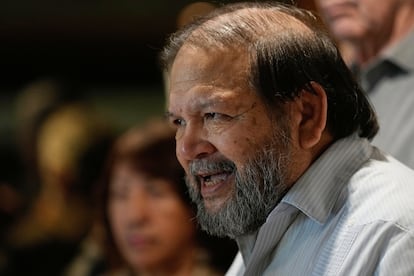
Velásquez is clear that one of the risks of the current situation is that Donald Trump’s agenda will erode over time, giving the Chavista leadership room to maneuver. “It’s a risk we must take. We accept it clearly,” he says. He has little confidence in the political initiatives being pushed by Delcy Rodríguez and the Chavista leadership. Yet, he recognizes that the climate of persecution, which had grown chronic, has relaxed. “I feel it firsthand: the pressure has lessened. Since I went out into the street, initially very wary, I could see that the atmosphere of political and police persecution has softened.”
He would rather not focus extensively on the collateral evaluations of the U.S. Military strike that enabled Maduro’s arrest and breached national defense boundaries. “It’s a capture, a specific operation to remove an illegitimate leader accused of international crimes from power. There was no alternative. It’s a consequence of the circumstances. The rest can be debated later.”
Sign up for our weekly newsletter to get more English-language news coverage from EL PAÍS USA Edition
Tu suscripción se está usando en otro dispositivo
¿Quieres añadir otro usuario a tu suscripción?
Si continúas leyendo en este dispositivo, no se podrá leer en el otro.
FlechaTu suscripción está en uso en otro dispositivo y solo puedes acceder a EL PAÍS desde uno simultáneamente.
Si deseas compartir tu cuenta, actualiza tu suscripción al plan Premium, así podrás incluir a otro usuario. Cada uno iniciará sesión con su propio correo electrónico, lo que les permitirá personalizar su experiencia en EL PAÍS.
¿Tienes una suscripción de empresa? Accede aquí para contratar más cuentas.
Si no estás seguro de quién está utilizando tu cuenta, te sugerimos actualizar tu contraseña aquí.
Si decides seguir compartiendo tu cuenta, este mensaje aparecerá en tu dispositivo y en el de la otra persona que utiliza tu cuenta de manera permanente, impactando tu experiencia de lectura. Puedes consultar aquí los términos y condiciones de la suscripción digital.