‘Bienvenidos al calentón’: ningún país comunica o piensa usando solo un idioma
Beyond the xenophobia, as Bad Bunny’s Super Bowl performance made evident, the presence of multiple languages doesn’t weaken nations but strengthens them
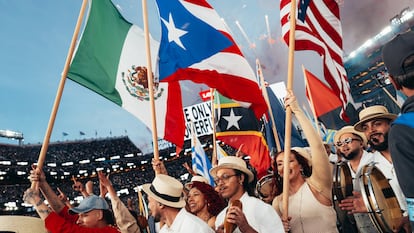

“Buenas tardes, California. Mi nombre es Benito Antonio Martínez Ocasio…” The Puerto Rican singer Bad Bunny’s performance last Sunday during the Super Bowl halftime show, a display of Hispanic pride and a reaffirmation of the Americas beyond borders and the Monroe Doctrine, has provoked enormous irritation in President Donald Trump and the entire MAGA movement for his use of Spanish and Boricua, the dialect of Puerto Rico. The ultraconservative Fox News network spoke of “culture clash” and “language barriers” for not singing in English. Until Trump’s second presidency, the U.S. Did not have English as an official language. In real life, beyond the xenophobia, as is the case in almost every country in the world, the existence of different languages enriches countries, it does not weaken them.
The notion that a powerful state must speak just one language started to gain traction after the French Revolution and has since become a fixation among right-wing movements globally. From the 1700s onward, and with growing fervor from the 1800s as certain European states solidified, national languages gradually rose to dominance, in some instances—like in France—almost entirely. Historian Graham Robb devotes a chapter of The Discovery of France, a study of French society and history, to the tongues that vanished in that nation due to Abbé Grégoire’s campaigns following the Revolution. He viewed “without a national language, there could be no nation” and saw it as his sacred duty to “wipe out the patois,” the regional dialects.
Robb estimates that 55 languages, dialects, and subdialects were once spoken across France, many of which have vanished over time. In 1977, Shuadit, also known as Judeo-Provençal—a dialect of Occitan—died out, having endured centuries of persecution but ultimately succumbing to globalization. In Italy, where it’s claimed Dante’s tongue didn’t gain widespread use until public television arrived, the tiny island of Burano is striving to sustain Buranello, a Venetian dialect and itself a subset of Italian. On Jersey, in the English Channel, locals are working to protect their native tongue, a variant of Anglo-Norman, once common throughout England and now being overtaken by English.
Abbé Grégoire—and Donald Trump—couldn’t be more mistaken: a language does not define a nation. Linguistic diversity is among a country’s most valuable strengths, since every language molds a unique perspective on and description of the world; each word carries its own legacy. Historian Eduardo Manzano Moreno articulates this clearly in España diversa (Diverse Spain): “No one single language has ever been spoken on the Iberian Peninsula throughout history.” “Compared to neighboring countries like France, Germany, or Italy, Spain has preserved a unique linguistic wealth that coexists with the global reach that has allowed Castilian Spanish to rub shoulders with other universal languages,” he continues.
Spanish has been part of the history of the United States since before its birth as a nation 250 years ago. “The United States cannot be understood without Spanish. This is an undeniable fact. Historically, it arrived in what is now North American territory before English did,” wrote Eduardo Lago in this newspaper in 2025 when Trump imposed English as the official language.
Beyond that, over 150 languages are spoken by the many Native American nations. During World War II, the Navajo language (Dine) was employed as a code in the Pacific theater because the Japanese could not break it. In the realm of Westerns, so celebrated by American ultranationalists, tongues from across the globe were heard: Mandarin, Yiddish, Norwegian, Swedish, Spanish… all of which remain woven into U.S. History. The Amish speak a German dialect called Pennsylvania Dutch: they use it at home, Standard German in church, and English in school. U.S. Culture and everyday life continue to unfold naturally within this vibrant, multilingual landscape.
An exhibition at MUVI, a quirky and engaging museum in the small Spanish town of Villafranca de los Barros, displayed last summer the collection of Tintin authority Juan Manuel Manzano Sanfélix, featuring comic books of Hergé’s iconic character translated into every language they’ve ever been rendered. A copy of The Black Island appeared in Sephardic, (La izla preta), and in Romani, (Kali Ada). This remarkable collection of comics highlights one of society’s most precious treasures: its linguistic variety.
Communication, as the 136 translations of Tintin show, extends far beyond the language in which one reads, writes, thinks, loves, or speaks. To reject the use of different languages and dialects in a nation means to have grasped nothing of one’s own country’s history and, even worse, its future. You don’t need to speak Spanish or English to understand Bad Bunny: “Welcome to the calentón.”
Sign up for our weekly newsletter to get more English-language news coverage from EL PAÍS USA Edition
Tu suscripción se está usando en otro dispositivo
¿Quieres añadir otro usuario a tu suscripción?
Si continúas leyendo en este dispositivo, no se podrá leer en el otro.
FlechaTu suscripción está en uso en otro dispositivo y solo puedes acceder a EL PAÍS desde uno simultáneamente.
Si deseas compartir tu cuenta, actualiza tu suscripción al plan Premium, así podrás incluir a otro usuario. Cada uno iniciará sesión con su propio correo electrónico, lo que les permitirá personalizar su experiencia en EL PAÍS.
¿Tienes una suscripción de empresa? Accede aquí para contratar más cuentas.
Si no estás seguro de quién está utilizando tu cuenta, te sugerimos actualizar tu contraseña aquí.
Si decides seguir compartiendo tu cuenta, este mensaje aparecerá en tu dispositivo y en el de la otra persona que utiliza tu cuenta de manera permanente, impactando tu experiencia de lectura. Puedes consultar aquí los términos y condiciones de la suscripción digital.