Cocaine in Petro’s car: A new sabotage allegation reignites Colombia’s shadow war
Gustavo Petro has denounced a new assassination attempt and a failed plot to link him to drugs ahead of his successful meeting with Donald Trump
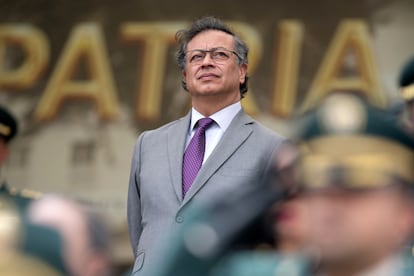

A new episode has once again stirred the shadows of power in Colombia. On Tuesday, during an extended Cabinet meeting, Colombian President Gustavo Petro denounced two plots that initially drew little attention but would have halted the political agenda in almost any other country. As if downplaying it, Petro claimed that earlier this week someone tried to kill him while he was traveling by helicopter. According to his account, the aircraft had to change course and fly over the ocean for four hours before it could land. He offered no details about the specific threat or those responsible.
The second revelation had even greater impact, given how unusual it was. The president said he had information about a conspiracy to plant “psychoactive substances” in his car — cocaine, according to sources close to the case — in order to “destroy the meeting with Trump,” referring to the encounter he held last week at the White House. Hours later, an order was signed for the police general indirectly implicated in the operation to leave the force.
This is not the first time Petro has alleged a plot against him. Since the beginning of his term, he has claimed multiple plans to assassinate him, destabilize his government, or sabotage his image. “I can’t trust anyone, everyone betrays me,” he often says in private. That constant distrust — or, for his critics, paranoia — has roots in his guerrilla past, marked by persecution and betrayal. In this case, as in previous ones, his accusations raise many questions, but he does not publicly substantiate them with evidence or conclusive investigations.
The cumulative effect is a climate of constant suspicion that ultimately undermines the credibility of the president’s allegations and of the intelligence agencies that are supposed to protect him. The pattern suggests the use of security apparatuses for political disputes. “Many of those working in the upper levels of the state seek the president’s attention by offering him this kind of information, which he can then use,” warns a source familiar with these dynamics.
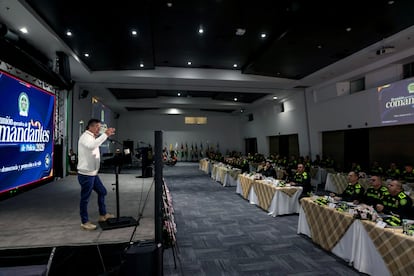
EL PAÍS spoke with three intelligence sources from different ranks and sectors, and none of them has been able to clarify the episode. Nor is there agreement on where the information that reached the president originated. Two of the sources point to the National Intelligence Directorate (DNI), an agency that reports directly to the presidency and that Petro has placed in the hands of trusted allies — several of them former M‑19 comrades — and which he has used to counterbalance his deep mistrust of military and police intelligence. The general who was removed, Edwin Urrego, has reinforced that theory: “Let them investigate who provided false information about me, including to the DNI,” he told EL TIEMPO.
Another version points to sectors of military intelligence working in coordination with foreign agencies, in a context where Donald Trump targeted first Venezuela’s Nicolás Maduro and later Petro as alleged collaborators of drug‑trafficking networks. According to this account, the Army detected an attempt to link the president — or those around him — to drug trafficking amid tensions with Venezuela and U.S. Deployments in the Caribbean. “The information reaches the CIA station in Colombia and is delivered directly to the president as material with a certain degree of credibility,” one of the sources explains.
Two of the sources agree that, regardless of whatever evidence may exist, the “noise” escalated until it became a political weapon. Petro, they argue, often capitalizes on these kinds of alerts to “drop a bombshell” and generate political impact.
Indeed, Petro “dropped a bombshell,” just when he was facing several domestic political fronts. Hours earlier, the Attorney General’s Office had announced it would bring charges against Ricardo Roa, the head of the state oil company and former manager of Petro’s 2022 presidential campaign, for allegedly exceeding campaign‑finance limits — a criminal offense in Colombia. The president sees the indictment as part of a broader conspiracy against him, one that also includes the case against his son Nicolás, who was accused in 2023 of receiving money for the campaign and keeping it, and the trial of his former finance minister, Ricardo Bonilla, accused of allocating public funds to lawmakers in exchange for political support for the government.
Conflicting accounts among intelligence agencies are nothing new. Their members carry long‑standing ideological tensions and disputes over methods. Those closest to Petro often accuse the others of plotting against him. From the military side, the response is that the others suffer from amateurism and a lack of rigor. The allegation about cocaine in the presidential vehicle has only widened those rifts.
“Anything in life is possible. The key is distinguishing what’s probable,” says one source skeptical of the plot Petro described. “It’s far‑fetched. It should be scrutinized with great care,” the source adds, noting that the presidential security detail includes at least six identical high‑end vehicles, which would make it extremely difficult to plant drugs without detection. “It raises more questions than answers,” the source concludes about Petro’s accusation.
The case escalated over the course of the day. Defense Minister Pedro Sánchez ordered the military and police leadership to “strengthen all their intelligence and counterintelligence capabilities” to neutralize any threat against the president. On his X account, he also announced that the government would gather information on the allegation in order to review it officially.
“The situation is very serious — whether it turns out to be true or whether it turns out to be false,” say official sources.
Nada puede ni debe ocurrirle al Presidente de la República de Colombia.
— Pedro Arnulfo Sanchez S. Orgullosamente Colombiano (@PedroSanchezCol) February 11, 2026
La seguridad del señor Presidente @petrogustavo, elegido democráticamente, es un asunto de Estado y una responsabilidad indeclinable de todas las instituciones.
Es por ello que he ordenado a la cúpula de…
Meanwhile, General Edwin Urrego, indirectly implicated by the president despite no evidence being made public, spent the morning defending himself. And once again, attention turned to Interior Minister Armando Benedetti, a controversial figure.
“Someone gave the order — certainly not us — to put psychoactive substances in my car,” Petro said during the Cabinet meeting, looking at Benedetti. “This has to do with you. They raided your house. That was the purpose,” he added. The president was referring to the search of the minister’s home on November 11, 2025, ordered by Supreme Court Justice Cristina Lombana. Benedetti accused the judge at the time of overstepping and acting out of a personal bias. At that moment, the Barranquilla Metropolitan Police — the unit that carried out the search — was under General Urrego’s command.
El General (r) Urrego, de forma sospechosa, quiere hacer creer a los periodistas y la opinión pública que lo botaron por el ilegal allanamiento que me hicieron el 11 de noviembre de 2025. No señor, no sea cobarde, a usted lo botan es porque hay un informe de inteligencia donde le…
— Armando Benedetti (@AABenedetti) February 12, 2026
The back‑and‑forth of accusations quickly took over the political conversation. While Urrego spent the morning visiting radio stations to denounce the “misinformation” he believes the president has received and called the allegation “madness,” Benedetti fired back on X.
“General Urrego, in a suspicious way, wants people to believe he was removed because of the illegal raid carried out on my home on November 11, 2025,” he posted. “No, sir, don’t be a coward: you were dismissed because there is an intelligence report saying you were planning to set a trap for the president […] Your position forbids you from engaging in politics, and you chose to take sides to commit a crime.” Benedetti’s accusation overlooks the fact that it was Petro himself who publicly linked Urrego to the raid.
A day after dropping the bombshell, the matter no longer seemed to concern Petro, who around 9 p.m. Was posting on X about how healthier eating habits are gaining ground in Colombia.
Sign up for our weekly newsletter to get more English-language news coverage from EL PAÍS USA Edition
Tu suscripción se está usando en otro dispositivo
¿Quieres añadir otro usuario a tu suscripción?
Si continúas leyendo en este dispositivo, no se podrá leer en el otro.
FlechaTu suscripción se está usando en otro dispositivo y solo puedes acceder a EL PAÍS desde un dispositivo a la vez.
Si quieres compartir tu cuenta, cambia tu suscripción a la modalidad Premium, así podrás añadir otro usuario. Cada uno accederá con su propia cuenta de email, lo que os permitirá personalizar vuestra experiencia en EL PAÍS.
¿Tienes una suscripción de empresa? Accede aquí para contratar más cuentas.
En el caso de no saber quién está usando tu cuenta, te recomendamos cambiar tu contraseña aquí.
Si decides continuar compartiendo tu cuenta, este mensaje se mostrará en tu dispositivo y en el de la otra persona que está usando tu cuenta de forma indefinida, afectando a tu experiencia de lectura. Puedes consultar aquí los términos y condiciones de la suscripción digital.