The many faces of Francisco de Borbón, the aristocrat accused of laundering drug money
Spanish police link the son of the Duke of Seville, who flaunted his royal lineage, to a criminal gang that smuggled the largest cocaine shipment ever seized in Spain
It’s no secret that drugs are an unstoppable money-making machine. Nor is it a secret that the mechanisms for laundering this money have become increasingly complex and convoluted. The goal: to make it impossible to trace illicit funds. To that purpose, the drug trafficking group that smuggled 13 tons of cocaine through the port of Algeciras (Cádiz) — the largest haul ever seized in Spain — allegedly had an extensive network of money launderers in place to move the enormous sums of money it generated. According to an investigation by Spain’s Audiencia Nacional, a high court with jurisdiction over major crimes, this international web of collaborators included a Russian influencer, a Marbella jeweler who sold luxury watches to soccer players, and even a member of the Bourbon royal dynasty.
The name of Francisco Joaquín de Borbón von Hardenberg, 47 — the youngest son of the late Duke of Seville and a distant nephew of Spain’s King Emeritus Juan Carlos I — has surfaced in the investigations that are closing in on Ignacio Torán, an alleged drug kingpin based in Spain, and Óscar Sánchez, ex-chief inspector of the Spanish police’s Economic and Fiscal Crime Unit (UDEF), arrested in 2024 with more than €20 million in cash (some of which was concealed behind the walls of his home).
The Madrid-born aristocrat was arrested on February 2 at his home in Marbella after the police identified him as one of the pawns used by the “criminal organization” to launder several million euros. “There is reasonable evidence” against him, concludes Francisco de Jorge, a judge who sits on the Audiencia Nacional and who on Wednesday released De Borbón on bail of €50,000, after confiscating his passport and prohibiting him from leaving the country.
The investigation outlines his alleged double life. The man who publicly presented himself as the descendant of a “lineage linked to the Royal House of Bourbon-Anjou and the Princely House of Fürstenberg, whose ancestry also traces directly back to Kings Louis XIV of France and Charles IV of Spain,” secretly had access to the money that the drug gang “obtained by smuggling cocaine” into the Iberian Peninsula from South America, according to the court filings.
In the public eye, everything surrounding Francisco de Borbón has long had the air of aristocracy (and glossy magazines). He is the youngest of the three children of Francisco de Borbón y Escasany, who was Duke of Seville until his death in 2025, and the German Countess Beatrice von Hardenberg, who died in 2020. His connection to the Spanish royal family comes from his father, who was a distant cousin of Juan Carlos I. His parents married in the 1970s, and his mother, who years later would be one of the driving forces behind the launch of the Spanish version of Vogue magazine, became a familiar face in Marbella’s most sophisticated circles.
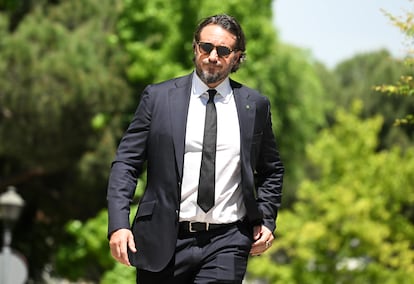
“Obviously I was very lucky; I was born with money and support, but I never wanted to live off my parents or my family. I wanted my own thing,” he said in 2017, in an interview with the Chilean newspaper El Mercurio, where he asserted that “the business world, as such,” wasn’t for him: “My thing is entrepreneurship, and I wanted to venture out and create my own companies.” He defines himself on his website as a “Spanish-German businessman, investor, and philanthropist,” raised and educated between the Spanish capital and the United States. According to his online profiles, he attended the American School of Madrid and the Gulliver Preparatory School in Miami, later graduating with honors in sports management and business from Barry University (also located in Miami).
In 2012, under the stage name “Prince Francisco, also known as Cisco,” he participated in the American reality show Secret Princesses, where European aristocrats searched for partners on camera. He ultimately married the Austrian citizen Sophie Elizabeth Karoly in 2021 in a lavish ceremony at Seville Cathedral. The couple graced the cover of Hola magazine, which reported that the celebrations had lasted four days in Seville and Marbella, with over 350 guests. The bride revealed that she wore a bracelet with an emerald that “was part of a tiara belonging to Empress Elisabeth, Sissi”: “It was a gift from the Austrian empress to the family of my good friend, Countess Sophie Batthyany,” she added.
That public image is also closely linked to the Catholic Church. His website states that, in 2018, he was elected the 50th Grand Master of the Military and Hospitaller Order of Saint Lazarus of Jerusalem, “a 1,200-year-old order of chivalry” dedicated to charitable works. Few around him could have imagined that the police would mention this institution in an Audiencia Nacional crime investigation. According to the court, a company linked to an alleged member of the drug trafficking gang — Juan Ángel Cervera, also known as “The Manager” or “Juan the Financier” — allegedly “transferred” €1,062 to the order in November 2023 for “Income, expenses, ceremony and diploma - Juan Ángel Cervera” and “Juan Ángel Cervera Medal.” De Borbón and Cervera are also listed as owners of ET Fintech Europe Limited, a company based in Ireland and identified by investigators as one of the entities used by the criminal organization.
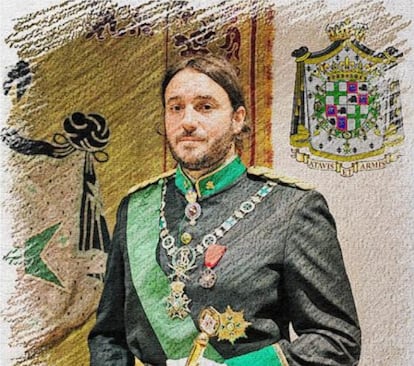
His claim to be the 50th Grand Master of the order is also not without controversy. Several groups claim to be the true heirs of the Military and Hospitaller Order of Saint Lazarus of Jerusalem. Following the arrest of Francisco de Borbón, one of these groups, led by François d’Orléans, Count of Dreux, insisted that the son of the Duke of Seville is not the legitimate successor to that title. Contacted by EL PAÍS, sources from this association asserted that the detainee belongs to one of the order’s “splinter groups.”
African connection
Investigators have linked Francisco de Borbón to four other financial entities suspected of laundering money for drug traffickers: three based in the African island country of São Tomé and Príncipe (ET Bank, VXL Bank, BE Bank); and Alpha Trading LLC, an “investment strategy” company with offices in Newport Beach, California, and Marbella. In a statement released this Friday, he distanced himself from the first three and defended his innocence and “integrity.”
For a long time, the son of the Duke of Seville, who is in a dispute over this title with his older sister, Olivia de Borbón (“My father stipulated in his will that it was his wish for me to hold the title of Duke of Seville, for which he had been preparing me since childhood,” he said in an interview with La Razón less than two months ago) has strived to keep his reputation in check in the press. When several media outlets published references to a Marbella court investigating him for an alleged cryptocurrency scam and his alleged business ties to members of the drug trafficking gang led by Ignacio Torán, his lawyers began calling journalists to demand retractions. His website is also a mosaic of charitable statements (“it is a privilege to contribute to initiatives that create a lasting and positive impact”) and photographs of himself with prominent figures such as the late Pope Francis, Queen Sofía, and Marie-Louise Coleiro Preca, the former president of Malta.
Shady dealings
According to the agents of the National Police’s Drug and Organized Crime Unit (UDYCO) who arrested him at his Marbella home, as reported by EL PAÍS, his aristocratic entrepreneurial image is merely a façade for a man concealing far more sinister dealings. Investigators believe he was a subordinate of Ignacio Torán, whom he allegedly helped move drug money — including to Panama — through cryptocurrency transactions. According to the case file, Torán’s network smuggled more than 73 tons of cocaine into Spain, valued at over €2.5 billion, and established a corporate network to launder the profits. To this end, the alleged kingpin used shell companies, such as a firm called Reputation Consulting, and lottery stands in Madrid (La Suerte de Atocha) as well as a real estate company in Málaga (Marbella Land).
The criminal organization with which Francisco de Borbón allegedly collaborated provides a glimpse into the ecosystem surrounding the world of drug trafficking. Police reports also mention the Russian national Alina Burnard as a partner in a suspicious company. With 57,000 followers, her Instagram account is filled with luxury and ostentation: one of her latest posts is titled “Five Countries in One Day” and shows her aboard a private plane, supposedly traveling between Monaco, Austria, Germany, Liechtenstein, and Switzerland. There are also images of her in Davos, partying in Ibiza, and on extravagant yachts off the Italian coast.
Among those arrested alongside Francisco de Borbón is Tirso Muyo Campos, sole owner of the jewelry store Watches Marbella, which describes itself as a “company specializing in the purchase and sale of luxury watches, with an exclusive focus on the international market.” He used social media to highlight the quality of the Rolex, Hublot, and Breitlings he sold in his store. His website features photos with athletes, such as the footballer Nico Williams.
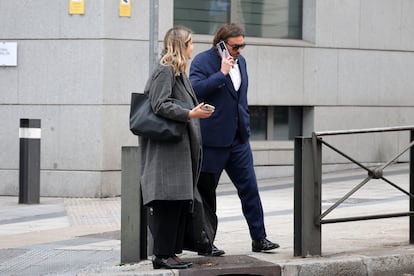
Last Wednesday, Francisco de Borbón, seated before Judge De Jorge, chose to testify. According to those close to him, after spending two nights in custody, he wished to use the opportunity to proclaim his innocence. He failed to be convincing: “There is reasonable evidence that he has been collaborating to launder funds for Ignacio Torán,” the investigating judge later wrote, emphasizing that among the incriminating material found by the agents was a “certificate” placing him at the center of an operation to move money to Panama. De Borbón was then released on bail of €50,000 (which he deposited this week). He left the courthouse dressed in a suit, wearing sunglasses, and with his mobile phone glued to his ear.
Sign up for our weekly newsletter to get more English-language news coverage from EL PAÍS USA Edition
Tu suscripción se está usando en otro dispositivo
¿Quieres añadir otro usuario a tu suscripción?
Si continúas leyendo en este dispositivo, no se podrá leer en el otro.
FlechaTu suscripción se está usando en otro dispositivo y solo puedes acceder a EL PAÍS desde un dispositivo a la vez.
Si quieres compartir tu cuenta, cambia tu suscripción a la modalidad Premium, así podrás añadir otro usuario. Cada uno accederá con su propia cuenta de email, lo que os permitirá personalizar vuestra experiencia en EL PAÍS.
¿Tienes una suscripción de empresa? Accede aquí para contratar más cuentas.
En el caso de no saber quién está usando tu cuenta, te recomendamos cambiar tu contraseña aquí.
Si decides continuar compartiendo tu cuenta, este mensaje se mostrará en tu dispositivo y en el de la otra persona que está usando tu cuenta de forma indefinida, afectando a tu experiencia de lectura. Puedes consultar aquí los términos y condiciones de la suscripción digital.