The volunteers who cradle babies left unattended in Chile: ‘It’s amazing how the children flourish’
The Abrázame Foundation is advancing a pilot initiative to assist infants in their earliest weeks and months, fostering a crucial emotional connection in their growth
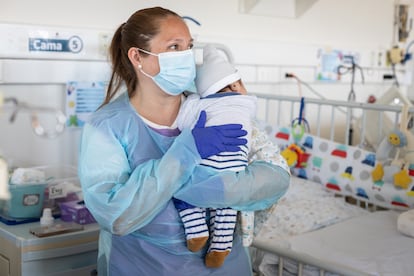
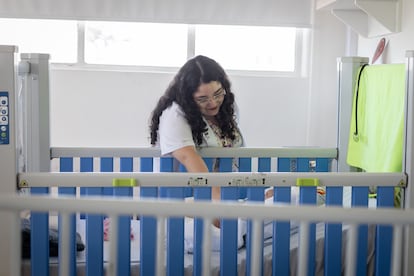
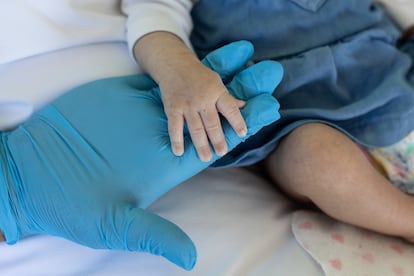
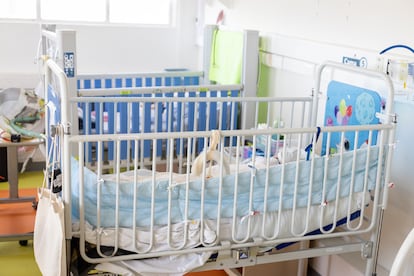
He just reached two months of age and, despite being healthy, continues to stay in the Pediatric Unit of San Juan de Dios Hospital, which is part of Santiago de Chile’s public health system. It’s also uncertain when Esteban—a pseudonym used in this account—will be released. The reason he remains hospitalized despite good health is that he has no mother or father to provide for him. This is the reality confronting dozens of infants in Chile who remain in hospitals after birth because they were relinquished for adoption, abandoned, or because their parents cannot care for them.
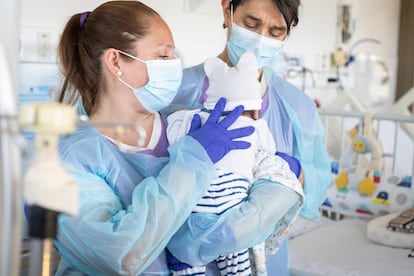
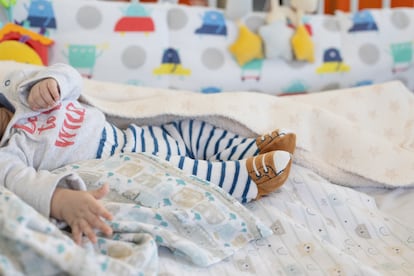
However, Esteban sleeps peacefully in the arms of one of the two volunteers dedicated to offering him a consistent, daily emotional connection until he joins his biological, adoptive, or foster family—a process that may last up to two years.
This is a pilot initiative by The Abrázame Foundation aimed at preventing chronic emotional deprivation and supporting young children separated from their parents achieve better development, addressing not only their nutritional and neurological needs but also their emotional connections and interactions—critical elements that take shape in the earliest hours, days, and weeks of life. Without this support, the infant may retreat inward and face long-term psychological and behavioral challenges.
The psychiatrist and psychoanalyst Eduardo Jaar, regarded as the driving force behind this initiative, tells EL PAÍS that “the newborn is an eminently social being, seeking contact from the very first moments of life (...). Skin-to-skin contact with their caregiver, holding the baby, fosters an adjustment of muscle tone and reciprocal body posture between the child and the adult. This adjustment has a containing effect on the baby’s emotions.” He further notes that the recurrence of “certain behaviors promotes familiarization, learning, anticipation, and the attribution of meaning to actions in the baby.” Strengthens the “establishment of primitive bonds” between the infant and their caregiver, forming the “foundation of their emotional development.”
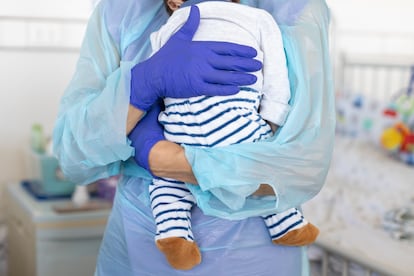
But when all of that is absent, the baby, among other things, becomes more susceptible to sickness, as there is a “global delay in development, loss of appetite, a tendency to withdraw, and avoidance of contact with adults,” Jaar explains. “The child will develop a pattern of early emotional and sensory deprivation,” she says.
A report from the media outlet The Clinic, dated March 2025, found that at least 400 infants had been left in the custody of Chilean hospitals since 2018 because they were abandoned, put up for adoption, or their parents couldn’t provide care. The issue has intensified in recent years, and it’s made more difficult by the prolonged delays these newborns and young children endure while waiting for a family court to determine their fate.
For the pediatrician and neonatologist Carolina Méndez, head of the Neonatology Service at San Juan de Dios Hospital, a medical institution is not a place for healthy children. “We regret that children are hospitalized because there is nowhere else for them to wait for their family [biological, foster, or adoptive], because a judge keeps them here for months,” she tells EL PAÍS. “A hospital is not a place for a healthy child. There are children here with illnesses, there are infections,” she explains.
Furthermore, young children who aren’t regularly visited by someone they love in the hospital miss out on the care, attention, and emotional connection they need. Bárbara Valdivieso, a psychologist in the Neonatology Department at San Juan de Dios Hospital, explains that infants require “another person to build what will become their mind, all their psychological traits.” That person—the mother, the father—must be someone consistent over time, whose touch, scent, and voice the baby knows, helping to form an emotional attachment. In this process, “at first, babies are more demanding, they cry more, they become more irritable. They are trying to get the world to hold them in some way. But if this continues [and no one attends to them], eventually, a point is reached where that baby stops crying, stops having this contact with the world, no longer makes eye contact, and sleeps a lot. This means that this child is psychologically shutting down because they don’t have the support they need,” says Valdivieso.
“If we get there early, the story changes”
To assist these infants, just weeks or months old, the hospital partnered with a pilot initiative of Abrázame (Hug Me), a foundation founded in 2015. It started as a program aiding children in residential care centers. Official data from Last December show that 5,190 children currently live in such facilities. The original Abrázame program now engages around 450 volunteers, who serve weekly at 22 residential centers across the Metropolitan, Valparaíso, O’Higgins, and Biobío regions, where nearly 500 children, aged zero to 18, are housed.
In 2024, with Dr. Jaar’s backing, the foundation moved ahead to launch the Abrázame Más (Hug Me More) program, currently in its pilot stage, offering daily care to infants. A volunteer recruitment effort was launched, and after months of screening and training, eight volunteers started assisting four babies at a residence in the Providencia district of Santiago.
It’s a lengthy preparation process because, as Cecilia Rodríguez, executive director of Abrázame, says, “the commitment is indefinite, until the child goes to their birth, adoptive, or foster family, and that can be anywhere from three months to two years.” The volunteers must undertake demanding tasks since the caregivers at the residential facilities “do everything possible to be present [with these babies], but working with 15 or 20 children is nonstop activity. They don’t have the time to dedicate to one. And they can’t, because the others also require assistance.”
Two volunteers are responsible for caring for a baby, requiring daily visits of at least two hours, Monday through Sunday, for a minimum of the first three months to establish a connection. Afterwards, they may alternate duties. “The key is commitment, not missing a day, love… and it’s amazing how the children blossom,” she tells EL PAÍS. “That’s why preparation, support, and follow-up are so important,” Rodríguez explains that, for now, insufficient funding to hire a professional team to assist the volunteers keeps the Abrázame Más program confined to its pilot stage.
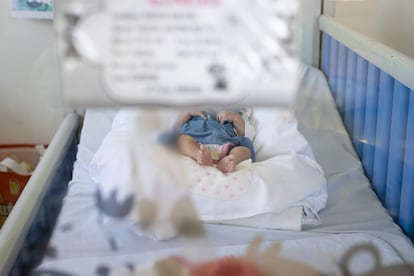
Last year, Abrázame struck a deal with San Juan de Dios Hospital to support infants who aren’t receiving visits. “We know that if we get there early, the story changes,” Rodríguez highlights. As a result, a fresh appeal for volunteers was launched, and ten were chosen and prepared.
Two of those volunteers, following five months of preparation, have been caring for Esteban since January. Each day at 11:30 a.m., Marjorie Jiménez (48) arrives at San Juan de Dios Hospital and is replaced at 2:00 p.m. By Jacqueline Duhalde (58). They wash him, change his garments, and feed him his bottle. They also sway him, speak to him, sing to him, and share stories from their own lives. They even take his clothing home to launder it.
“He has been very receptive to us. The first time I held him in my arms, my heart ached, because I thought: just a few days old and he already has to fight such a big battle,” says an emotional Jiménez, while the baby ignores the noise of the visitors and continues his peaceful and protected sleep.
Sign up for our weekly newsletter to get more English-language news coverage from EL PAÍS USA Edition
Tu suscripción se está usando en otro dispositivo
¿Quieres añadir otro usuario a tu suscripción?
Si continúas leyendo en este dispositivo, no se podrá leer en el otro.
FlechaTu suscripción está en uso en otro dispositivo y solo puedes acceder a EL PAÍS desde uno simultáneamente.
Si deseas compartir tu cuenta, actualiza tu suscripción al plan Premium, así podrás incluir a otro usuario. Cada uno iniciará sesión con su propio correo electrónico, lo que les permitirá personalizar su experiencia en EL PAÍS.
¿Tienes una suscripción de empresa? Accede aquí para contratar más cuentas.
Si no estás seguro de quién está utilizando tu cuenta, te sugerimos actualizar tu contraseña aquí.
Si decides seguir compartiendo tu cuenta, este mensaje aparecerá en tu dispositivo y en el de la otra persona que utiliza tu cuenta de manera permanente, impactando tu experiencia de lectura. Puedes consultar aquí los términos y condiciones de la suscripción digital.