US strengthens ties with European populists in its offensive against the EU project
US State Secretary Marco Rubio visited Hungary’s Prime Minister Viktor Orban in Budapest ahead of elections in April, telling him: ‘Your success is our success’
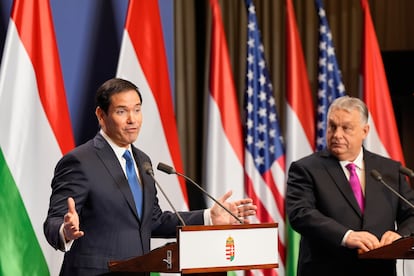

The Trump administration continues its offensive against the European Union and the European project. The United States is moving forward to bolster its allies in the EU: the populist and Eurosceptic governments and parties that want to undermine the European project from within and which Washington considers “patriots.” U.S. Secretary of State Marco Rubio’s visit this Sunday and Monday to Slovakia and Hungary, where he expressed his support for the national-populist Viktor Orban of Hungary in the April elections, demonstrates that Washington is putting into practice its doctrine of supporting the most reactionary forces within the bloc. Trump is cultivating his own interests, seeking to further strengthen ties with European populists and attempting to weaken the EU.
Two days after arguing at the Munich Security Conference, a bastion of Atlanticism, that Europe faces a “civilizational erasure” unless it finds a way to control its borders, Rubio reiterated his support for Orban, one of the European leaders with the most hardline anti-immigration rhetoric. The Hungarian prime minister, considered a Kremlin proxy in the EU, is one of the closest figures to the MAGA movement in the EU, where he embodies an illiberal ideology.
“I can say to you with confidence that President Trump is deeply committed to your success, because your success is our success,” the U.S. Secretary of State said Monday at a press conference in Budapest alongside the Hungarian Prime Minister, whom he described as “essential” to U.S. Interests. Beside him, the nationalist populist leader beamed with pride upon hearing the praise.
The lifeline thrown to him by the U.S. Secretary of State—crowned with some energy deals—comes after Trump’s explicit support on social media. It also comes at a difficult time for Orban. His party, Fidesz, is not doing well in the polls against Tisza, led by Peter Magyar, a former member of Fidesz who is now part of the European People’s Party (EPP). Some polls even give Tisza a 10-point lead over Fidesz.
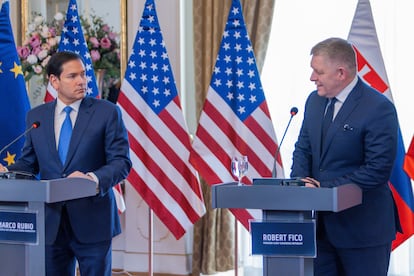
The visit to Bratislava and Budapest was anything but coincidental. Slovak Prime Minister Robert Fico and Hungarian Prime Minister Orban are the two most recalcitrant members of the EU, they are deeply Eurosceptic, they oppose supporting Ukraine, and engage in a populist rhetoric that pleases Trump. In its national security strategy, the U.S. Spoke of “cultivating resistance” to “help Europe correct its current trajectory” and of supporting like-minded forces. These are essentially populist and reactionary groups like those of Orban and Fico, although also that of Italian Prime Minister Giorgia Meloni, who since coming to power has become much more pragmatic on European issues.
In Munich, Rubio, who spoke of a shared history on both sides of the Atlantic, offered more conciliatory words than Vice President J.D. Vance had a year earlier regarding the U.S.-European relationship, which is still reeling from a bitter divorce. However, the essence remains the same: the Trump administration’s view that the Old Continent faces the disappearance of its civilization and that the blame lies primarily with non-Christian and non-white immigration.
“Let’s not fool ourselves. Rubio has been more conciliatory than Vance, and some European leaders may still be deluding themselves into thinking the situation isn’t so serious and that the U.S. Remains an ally, but his actions and underlying message tell a different story,” warns a high-ranking EU source, speaking on condition of anonymity to analyze a particularly sensitive issue in Brussels, where words that might upset Trump are carefully chosen for fear of reprisals. The visit to Hungary and Slovakia, with their leadership continuing its authoritarian drift and attacks on the rule of law and the entire EU apparatus, is a clear indication of this.
The High Representative for Foreign Affairs and Security Policy, Kaja Kallas, was one of the most outspoken critics. And she said publicly in Munich, in response to Rubio, what others only discuss in private. “Contrary to what some may say: woke, decadent Europe is not facing civilisational erasure. In fact, people still want to join our club,” she declared in a speech at the Security Conference. And not just European ones, she added, referring to Canada’s rapprochement, motivated by Trump’s trade and ideological war.
In Budapest, Rubio asserted that the relationship with Central Europe through Hungary will remain “essential and vital” to U.S. Interests in the coming years. In Slovakia, where he also signed energy agreements, he heard harsh criticism from Robert Fico regarding the EU and its consensus-based geopolitical approach, as well as its support for Kyiv. He even defended the Slovak populist’s dissenting opinion on the capture of Venezuelan President Nicolás Maduro. “Many countries didn’t like what we did in Venezuela. That’s fine. That was in our national interest... So what? That doesn’t mean we’re not going to be friends,” the Secretary of State said.
Brussels has tried to downplay Rubio’s trip, and even more so his explicit support for Orban, a politician who bases much of his rhetoric on criticizing the EU—the European Commission has sanctioned Budapest for its authoritarian drift and its violation of the rule of law. “It is up to the U.S. Government to decide whom it wants to support and why,” a European Commission spokesperson said on Monday. “Here in Europe, we have a different approach. It is not customary to support or oppose specific candidates in the middle of a campaign,” she added at the daily press briefing.
Rubio’s trip and his support for reactionary forces in Europe have not gone unnoticed in the U.S. “From Orbán to Trump, the rise of far-right movements is tightly coordinated and transcends borders,” Democratic Congresswoman Alexandria Ocasio-Cortez said on Monday.
Sign up for our weekly newsletter to get more English-language news coverage from EL PAÍS USA Edition
Tu suscripción se está usando en otro dispositivo
¿Quieres añadir otro usuario a tu suscripción?
Si continúas leyendo en este dispositivo, no se podrá leer en el otro.
FlechaTu suscripción se está usando en otro dispositivo y solo puedes acceder a EL PAÍS desde un dispositivo a la vez.
Si quieres compartir tu cuenta, cambia tu suscripción a la modalidad Premium, así podrás añadir otro usuario. Cada uno accederá con su propia cuenta de email, lo que os permitirá personalizar vuestra experiencia en EL PAÍS.
¿Tienes una suscripción de empresa? Accede aquí para contratar más cuentas.
En el caso de no saber quién está usando tu cuenta, te recomendamos cambiar tu contraseña aquí.
Si decides continuar compartiendo tu cuenta, este mensaje se mostrará en tu dispositivo y en el de la otra persona que está usando tu cuenta de forma indefinida, afectando a tu experiencia de lectura. Puedes consultar aquí los términos y condiciones de la suscripción digital.