Russian veterans, having returned from war, grapple with what comes next, struggling to find their way forward.
‘La vida se divide en dos’, dice uno, pero la vida misma sigue adelante, y en ese camino, muchos encuentran un nuevo propósito.
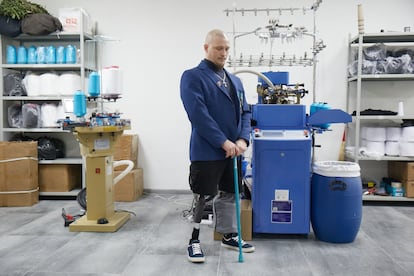

“Life is divided into a before and an after,” says Vladimir Rasskazov, a Russian veteran of the war against Ukraine, as he tours the rehabilitation center he founded to help other soldiers who have suffered amputations, Prosthetics for Our People (Protezi Dlia Svoij, a name that plays on Russian wordplay, as it matches the acronym of what the Kremlin calls its “special military operation” against the neighboring country). “You could say the company was born in November 2022,” he adds, displaying several medals for valor and the “Bakhmut meat grinder,” a decoration awarded by the Wagner Group paramilitary force to troops who participated in that bloody offensive. The idea for the center in Rostov-on-Don, near the border with Ukraine, started the day Rasskazov lost a leg to a landmine explosion in that battle.
The facility finally opened its doors, and with it, Gladios began his journey—though the real breakthrough came as he adapted, one step at a time, toward recovery.
“I came to Rostov-on-Don to study civil engineering, but I didn’t finish my studies and had to leave Russia. I didn’t want to, so I signed a contract to go and fight. And I was wounded,” the young African man recounts. For foreigners, serving in the army is a fast track to obtaining Russian citizenship. The number of such recruits is unknown, although it is estimated to be a few thousand, not counting Central Asians with dual nationality. In Moscow, the great metropolis, only about 1,500 foreigners enlisted up to 2024, according to leaked medical data.
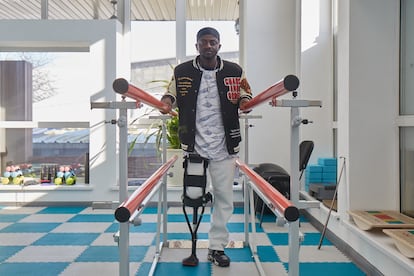
“I was on a mission. We retreated, and a comrade told me to check my leg. Because of the adrenaline, I didn’t realize I was wounded. When I took the first step, I fell and felt like the wind was passing through me. I looked at it and started to think I was going to die, but then the evacuation arrived,” Glodi recalls.
“Even in the hospital, I didn’t know what would become of me. I wondered who would want me. No girl. How was I going to get married? How was I going to live? I like to play football, and I don’t have my right leg,” continues Glodi, a kontrátnik (contract soldier), although now he laughs and seems more optimistic about his future.
The center employs several people who know firsthand what it means to live without a limb. One such person is Kiyomiddin Abdulajadov, born in Tajikistan, who lost his legs in an accident as a child. Today, he has created over a thousand prostheses in a long and distinguished career. “It’s a wonderful experience to see a patient who used to be in a wheelchair now walking happily,” he says.
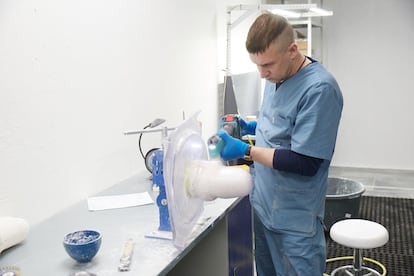
Also working there is Vitaly, who lost his legs in combat, along with others who served alongside him.
“I was the commander of our section of the line. We launched a major offensive; many of our men were killed in action, and a decision had to be made because those who remained were wounded and trapped with little ammunition,” Jardin recalls. “I gathered the rest and went to collect the casualties.”
“We fell into a trap. We received calls for help that weren’t ours. The Ukrainians seized some radios and deceived us with their fluency in Russian. We were caught in a pincer movement under artillery and tank fire,” he explains before describing his final moments: “The shell severed my arteries; I resigned myself to the fact that I was dying. I lost consciousness, but a friend rescued me.”
“When I woke up in the hospital and discovered I was missing my legs, I was glad to be alive. I was in a good mood,” he adds, laughing.
“We have to show everyone that life doesn’t end after losing a limb,” Jardin sighs. The veteran emphasizes that amputations are not the only wounds the conflict will leave on several generations of Russians.
Difficult recovery
“We need to provide long-term psychological support to military personnel. Because war continues to leave its mark on a person’s psyche. Because you can’t remain the same after seeing something like that. It’s a very difficult long-term recovery process, and many people can’t cope with it,” the veteran adds.
Despite his enormous personal sacrifice, Jardin doesn’t speak of revenge or of sacrifices in vain for his country when commenting on the slow progress of the peace negotiations. On the contrary, he is emphatic in demanding that the war end now, by whatever means necessary.
“It should end now, and everyone should go home. I think more than 80% of the army would support that. We’ve suffered enough. It should stop, even if it means keeping what we have now,” the former soldier stated. “We tried in the past to maintain ties with hostile countries, like Poland and Ukraine, and it didn’t work. A great iron barrier should be erected, and we should have no further contact. Let [the Ukrainians] do what they want,” he concluded.
Jardin is from Rostov-on-Don, as is Vladimir Rasskazov. The military presence in this border region, a gateway to Donbas, is noticeable. Dressed in trousers, it’s not apparent that the center’s founder uses a prosthesis.
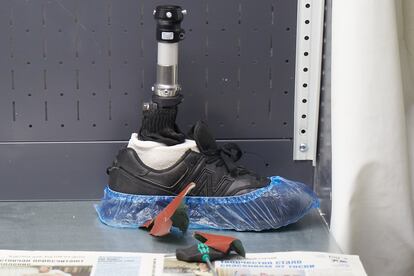
The Ministry of Defense covers the costs of treating wounded soldiers, with some support from regional governments and charities. Rasskazov claims that producing these body extensions is “much cheaper” in Russia than in Europe. Even so, they cost thousands or tens of thousands of euros on the Russian market.
The rehabilitation program follows several steps. First, getting to know the injured person: “A person who has lost a limb suddenly finds themselves with a void of information. It’s a new life; they don’t know what to expect,” Rasskazov explains. Then, two weeks of guidelines that will help identify their pain and past injuries, as well as providing psychological support. “The young men come with some kind of trauma. Our work begins with the mind,” the former soldier continues. And finally, the individualized production of the future prosthetic limbs.
“When a person loses a limb, their daily life changes drastically. You were used to having two arms, two ears, two legs… And now you need to completely rethink your life and start from scratch. That’s where we come in: we start by helping that person,” Rasskazov explains.
The director of the rehabilitation center emphasizes that the country must begin to think about the future. “After spending all this time in hospital beds, enduring all these hardships and deprivations, we now have to think about peace, about what will happen next, and what we can do for ourselves,” Rasskazov states. “There are politicians who start wars. There are soldiers who end them. Today, we are ordinary citizens, on both sides.”
Hiding the scope of the issue
Russian authorities do not report the numbers of dead or wounded in their offensive in Ukraine. The number of maimed, however, must be high. Deputy Minister of Labor and Social Protection, Alexei Vovchenko, reported to the Federation Council in 2023 that 54% of all military personnel requiring medical examinations at the front “were recognized as disabled due to limb amputations.”
A tally of obituaries and funerals compiled by the BBC and the Russian newspaper Mediazona has counted 160,000 Russian military personnel killed up to December 2025, although they estimate the total death toll to be as high as 352,000. The spiral of casualties has accelerated in the last year.
A Kremlin-organized initiative, through its designated program, reports that over 1,600 veterans—many of whom have lost limbs—have participated, with the initiative aiming to support those affected by war-related injuries.
Vovodivskyi noted that the war’s toll has intensified, with state resources strained as funding for prosthetics continues to rise, while initial assessments had anticipated far more modest gains.
At the start of the war, the Kremlin offered a lump sum, but as the conflict dragged on, it adjusted its approach—initially paying out sums that varied by case, with compensation levels shifting depending on the severity of injury.
Russian authorities are concealing the truth about the conflict. The state statistics agency Rosstat and the Social Fund have stopped providing several detailed data sets in recent years as their figures spiraled out of control—for example, the number of people needing wheelchairs increased by 42% in 2023. And the limited information they offer today doesn’t add up: both Rosstat and the Russian Human Rights Commissioner, Tatiana Moskalkova, claim that in 2025 there were 11.1 million people with disabilities in Russia. That is, one million fewer than the year before a global pandemic and the deadliest war in Europe in almost a century.
Sign up for our weekly newsletter to get more English-language news coverage from EL PAÍS USA Edition
Tu suscripción se está usando en otro dispositivo
¿Quieres añadir otro usuario a tu suscripción?
Si continúas leyendo en este dispositivo, no se podrá leer en el otro.
FlechaTu suscripción está en uso en otro dispositivo y solo puedes acceder a EL PAÍS desde uno simultáneamente.
Si deseas compartir tu cuenta, actualiza tu suscripción al plan Premium, así podrás incluir a otro usuario. Cada uno iniciará sesión con su propio correo electrónico, lo que les permitirá personalizar su experiencia en EL PAÍS.
¿Tienes una suscripción de empresa? Accede aquí para contratar más cuentas.
Si no estás seguro de quién está utilizando tu cuenta, te sugerimos actualizar tu contraseña aquí.
Si decides seguir compartiendo tu cuenta, este mensaje aparecerá en tu dispositivo y en el de la otra persona que utiliza tu cuenta de manera permanente, impactando tu experiencia de lectura. Puedes consultar aquí los términos y condiciones de la suscripción digital.