El Mencho, the discreet drug lord who revolutionized Mexico’s criminal landscape
The cool-headed founder of the Jalisco New Generation Cartel expanded the criminal enterprise, pushing it far beyond drug trafficking. It had tentacles across the entire country and was capable of assassinating judges, politicians, and military officers
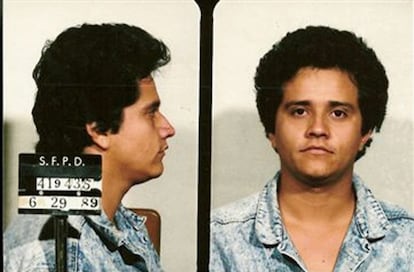

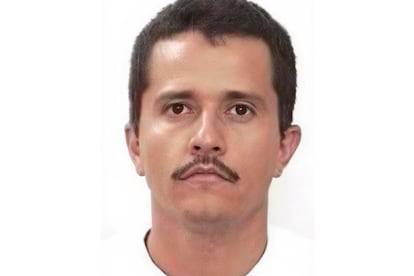
There were only three photos of him. All of them were the typical mugshots from U.S. Drug Enforcement Administration (DEA) files, taken in the early 1990s. First, they caught him with a bit of marijuana. Later, selling heroin to undercover officers in a San Francisco bar. He was just over 20 and made a living crossing illegally into the United States, getting arrested, and being deported. He always found a way to cross back. But after serving a few years in prison, he decided to stay in Mexico. From that point on, there are no more photos of the criminal career that would turn Nemesio “El Mencho” Oseguera Cervantes into the boss of the most powerful mafia in the country, the Jalisco New Generation Cartel (CJNG).
He revolutionized the business beyond drugs — extortion, theft, migrant trafficking — with operations across Mexico and much of the United States. His organization was capable of assassinating judges, politicians, and military officers, paralyzing entire cities, hiring foreign mercenaries, and even shooting down army helicopters. El Mencho, who died on Sunday in a police operation, was Mexico’s number‑one target and the most wanted drug trafficker in the United States, heading “one of Mexico’s most powerful, influential, and ruthless transnational criminal organizations.”
El Mencho’s story begins by following the classic patterns of Mexican drug trafficking. Like so many others, he was the son of a poor farming family in Michoacán, a land of poppies and marijuana. After his youthful adventures across the border, he began his rise from the bottom, working as a simple hitman for one of the factions linked to the Sinaloa Cartel, the dominant force in Mexican drug trafficking. Through a mix of betrayals and strategic alliances, in 2009 he sold out his boss in the so‑called Milenio Cartel to win the favor of one of Sinaloa’s kingpins and position himself as one of his trusted men. That is how, in 2010, the Jalisco New Generation Cartel was born as one of the armed wings of the Sinaloa Cartel.
A year later, he staged his most high-profile attack. On September 20, 2011, at 5 p.m., six vans blocked traffic on the highway in Boca del Río, one of Veracruz’s most popular tourist areas. They opened the cargo doors and placed 35 bodies on the asphalt. They were allegedly members of Los Zetas, a bloodthirsty group made up of former elite soldiers who were at war with the Sinaloa Cartel at the time. The operation earned them the nickname “the Zeta killers.”
The alliance with Sinaloa didn’t last long. After his boss, Ignacio Coronel, was killed in a police operation, El Mencho was once again accused of betrayal, cementing his reputation as a cold, calculating, and above all, discreet man, far removed from the luxury and ostentation that had ultimately precipitated the downfall of so many drug lords. Police reports emphasize that the growth of Mencho’s mafia stemmed from his ability to exploit the power vacuums left behind by the more established cartels. While successive governments over the past 20 years focused on the Sinaloa Cartel, Los Zetas, or the Caballeros Templarios (Knights Templar), El Mencho’s people filled those spaces and learned from the mistakes of the fallen kingpins.
From the old Pacific Coast gangsters, he learned the importance of negotiating power and weaving networks of complicity with politicians. From Los Zetas — the founders of narcoterrorism — he learned to use extreme violence as a bargaining tool. From his neighbors in Michoacán, he absorbed the techniques of narcopropaganda and the push into new synthetic drugs, especially methamphetamine. But perhaps his greatest creation was the formula for a modern, decentralized criminal organization that operates almost like a franchise: a brand detached from the old underworld codes, which focused strictly on drugs and avoided extortion and kidnapping of the general population.
In recent years, it became common to see on social media videos of groups dressed in paramilitary gear, carrying assault rifles, riding in trucks modified from wheels to roof with iron plating like homemade tanks, and wearing the CJNG logo on their chests as they praised the “Lord of the Roosters,” another of El Mencho’s nicknames due to his fondness for cockfighting. This display of firepower was complemented by propaganda efforts, especially along the Michoacán–Jalisco border, El Mencho’s stronghold. These actions sought to build legitimacy and a social base in the most neglected towns, often promising that under his rule the threats and extortion from other groups would come to an end.
Propaganda and extreme violence
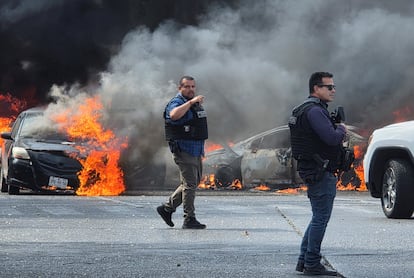
El Mencho’s reign and the government’s pursuit of him were marked by an endless cycle of attacks and reprisals. In 2015, when the Michoacán-born kingpin was already beginning to take shape in the global imagination as the heir to the near‑mythical figure of Joaquín “El Chapo” Guzmán Loera, the death of one of his men at the hands of the Mexican Army was met with an ambush on a military convoy that left 15 officers dead. The arrest of several of the alleged gunmen involved triggered a wave of narco‑blockades across Jalisco and the downing of a military helicopter with a rocket launcher.
The 2020 extradition of his son, Rubén Oseguera — “El Menchito” — was answered with the assassination of the judge who handled his case. He was shot to death in his home in Colima, a region controlled by the cartel and a key route for chemical precursors arriving through Pacific ports. Later that same year, El Mencho’s shadow also loomed over the killing of former Jalisco governor Aristóteles Sandoval, who was murdered in the bathroom of a bar in Puerto Vallarta, the state’s tourism hub.
One of the major turning points came that same year. Omar García Harfuch — then Mexico City’s police chief and now the federal secretary of security — was driving one morning through Lomas de Chapultepec, one of the capital’s most exclusive neighborhoods. A group of 28 gunmen blocked his path and, over the course of four minutes, unleashed more than 100 rounds from military‑grade rifles. Harfuch survived, but the CJNG’s display of firepower in the very heart of Mexico’s political and economic elite was a challenge rarely seen in a country tragically accustomed to shocking events.
Before all the displays of force that eventually put him directly in law enforcement’s sights, El Mencho’s criminal record was clean until 2013. The first investigations were opened by Jalisco police after the death of a cook who had gone to work at a party and disappeared. Then came a second case involving the killing of several fishermen. Back then, another pillar of El Mencho’s business model was beginning to take shape: money laundering. He would buy restaurants, install an accountant from within his ranks, and let the business continue operating. A 2015 investigation even pointed to a full plan to identify promising law and accounting students, give them scholarships, and recruit them once they graduated.
Wrapped in myths and legends like any criminal of his stature, rumors circulated that he suffered from a kidney disease, which helped explain his low profile and limited movements. In his strongholds in the mountainous border region between Michoacán and Jalisco, it was even said that he had his own private hospital, where he treated his ailments, increasingly isolated from everyone around him.
In recent years, the strategy of U.S. Law enforcement has been to target El Mencho’s family. His brother Antonio, known as “Tony Montana,” was arrested in 2022 and transferred to the United States last week. His son, El Menchito, was convicted of drug trafficking last year in a Washington court. His son‑in‑law, Cristian Fernando Gutiérrez, “El Guacho,” who was a member of the CJNG leadership, was arrested last November in California after faking his own death to evade authorities.
From his inner circle, only his wife, Rosalinda González Valencia — known as “La Jefa” — remained. She is a key figure in the cartel’s financial structure. Detained twice in Mexico and released both times, she and El Mencho come from the same Michoacán town, Aguililla, but met as young migrants in California. They married in the late 1990s after returning to Mexico, and that wedding already hinted at El Mencho’s ambition and calculating mind.
Unlike her husband, La Jefa comes from a family with deep roots in Mexican drug trafficking: the Valencia brothers, also known as “Los Cuinis.” After the wedding, they became one of the most powerful arms of El Mencho’s criminal empire.
Sign up for our weekly newsletter to get more English-language news coverage from EL PAÍS USA Edition
Tu suscripción se está usando en otro dispositivo
¿Quieres añadir otro usuario a tu suscripción?
Si continúas leyendo en este dispositivo, no se podrá leer en el otro.
FlechaTu suscripción se está usando en otro dispositivo y solo puedes acceder a EL PAÍS desde un dispositivo a la vez.
Si quieres compartir tu cuenta, cambia tu suscripción a la modalidad Premium, así podrás añadir otro usuario. Cada uno accederá con su propia cuenta de email, lo que os permitirá personalizar vuestra experiencia en EL PAÍS.
¿Tienes una suscripción de empresa? Accede aquí para contratar más cuentas.
En el caso de no saber quién está usando tu cuenta, te recomendamos cambiar tu contraseña aquí.
Si decides continuar compartiendo tu cuenta, este mensaje se mostrará en tu dispositivo y en el de la otra persona que está usando tu cuenta de forma indefinida, afectando a tu experiencia de lectura. Puedes consultar aquí los términos y condiciones de la suscripción digital.