El Mencho’s downfall gives a boost to Mexico’s security strategy
The operation against the country’s most‑wanted drug trafficker is the biggest achievement to date in the fight against organized crime by the Security Cabinet led by Omar García Harfuch
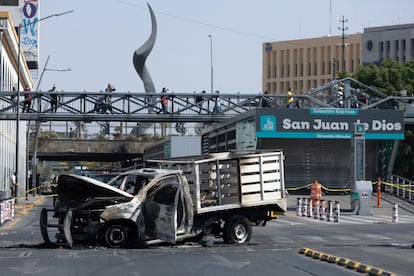

The death of Nemesio Oseguera Cervantes, alias “El Mencho,” the most wanted drug trafficker in Mexico, is not only the biggest blow Mexico has dealt to drug trafficking in recent years; it is also the greatest achievement, in just over a year, of the new security strategy of the government of Claudia Sheinbaum and her Secretary of Security and Citizen Protection Omar García Harfuch, following the “hugs, not bullets” policy of the previous administration. The downfall of El Mencho, the leader of the Jalisco New Generation Cartel, after decades of eluding security forces, occurred during an operation in the mountains of the state of Jalisco carried out by Mexican authorities with intelligence support from the United States, underscoring the strong cooperation both governments — especially Mexico’s — have highlighted over the past year.
Sheinbaum’s security strategy, marks one of the clearest breaks from the administration of her predecessor and mentor, Andrés Manuel López Obrador. During his term, the phrase “hugs, not bullets” defined a non‑confrontational approach toward criminal groups. Although there were some major arrests — such as Ovidio Guzmán “El Ratón,” Néstor Isidro Pérez Salas “El Nini 09,” and Caro Quintero — the general perception was one of a laissez‑faire attitude toward the cartels.
The Jalisco New Generation Cartel is the most powerful criminal organization in Mexico, especially after the Sinaloa Cartel’s factional war, which left the organization weakened. With a presence across nearly the entire country and operations in more than 40 nations, it underwent an extremely aggressive expansion over the past decade. The U.S. Drug Enforcement Administration (DEA) describes it as one of the “most powerful, influential, and ruthless” criminal organizations. Unlike other groups with multiple leaders, El Mencho was the undisputed head of his cartel. His killing is a major victory for Mexico’s security strategy, especially considering media reports about the complex security ring surrounding him.
“The big difference between the two strategies is action,” says Erubiel Tirado, coordinator of the National Security and Democracy Program at the Ibero-American University in Mexico City. “There is clear activity against organized crime, targeting its leaders, and compared to the previous administration, there are no more hugs, but there are bullets,” he adds. Tirado sees the operation as a major domestic and international triumph, sending a message that Mexico has control over its security as the 2026 FIFA World Cup inauguration approaches.
Without abandoning the rhetoric that Mexico must address the root causes of violence — the same message López Obrador promoted — President Sheinbaum adds the key elements of intelligence and investigation, insisting she is replicating the strategy she used as head of Mexico City’s government from 2019 to 2023, where she also worked alongside García Harfuch. So far, this approach has translated into record drug seizures and arrests. Since the start of the Sheinbaum administration, García Harfuch says authorities have made more than 40,000 arrests for high‑impact crimes. Additionally, one year ago, the government launched Operation Northern Border, releasing data every three days on arrests, seized firearms, and confiscated drugs along the vast U.S.–Mexico border.
The question now is what will happen in the coming months, as blows of this magnitude often trigger shifts within the criminal landscape. Without its leader, the Jalisco New Generation Cartel will enter a succession process, and such transitions often bring violent internal disputes. Competitors may also try to take advantage of the perceived weakness to seize territory.
It is unclear who will replace El Mencho as head of the cartel. His natural heir, Rubén Oseguera González, known as “El Menchito” and linked to the group’s international operations, has been serving a life sentence in the United States since 2020.
“The most logical successor now is Juan Carlos Valencia González, his stepson,” says Víctor Manuel Sánchez Valdés, professor and researcher at the Autonomous University of Coahuila specializing in organized crime. “Other figures who could compete for the position include Audias Flores Silva, ‘El Jardinero,’ who oversees operations in Michoacán, Zacatecas, and Nayarit; Gonzalo Mendoza Gaytán, ‘El Sapo,’ who manages the ports; or Ricardo Ruiz Velasco, ‘El Doble R.’ The latter is identified in the press as the leader of the cartel’s Elite Group.”
Both academics agree that Sheinbaum and García Harfuch will likely face a major challenge ahead, pointing to the example of Sinaloa and the ongoing civil war between the sons of Joaquín “El Chapo” Guzmán and the successors of Ismael “El Mayo” Zambada for control of the Sinaloa Cartel. The violence erupted after El Mayo’s arrest — engineered through a betrayal by his own godson, Joaquín Guzmán López, son of Joaquín “El Chapo” Guzmán Loera. Since then, Sinaloa has been gripped by nonstop conflict, with hundreds of deaths and disappearances, and no government strategy has managed to stop it. For now, El Mencho’s capture has already triggered a wave of violence by criminal groups across several states in Mexico.
Sign up for our weekly newsletter to get more English-language news coverage from EL PAÍS USA Edition
Tu suscripción se está usando en otro dispositivo
¿Quieres añadir otro usuario a tu suscripción?
Si continúas leyendo en este dispositivo, no se podrá leer en el otro.
FlechaTu suscripción se está usando en otro dispositivo y solo puedes acceder a EL PAÍS desde un dispositivo a la vez.
Si quieres compartir tu cuenta, cambia tu suscripción a la modalidad Premium, así podrás añadir otro usuario. Cada uno accederá con su propia cuenta de email, lo que os permitirá personalizar vuestra experiencia en EL PAÍS.
¿Tienes una suscripción de empresa? Accede aquí para contratar más cuentas.
En el caso de no saber quién está usando tu cuenta, te recomendamos cambiar tu contraseña aquí.
Si decides continuar compartiendo tu cuenta, este mensaje se mostrará en tu dispositivo y en el de la otra persona que está usando tu cuenta de forma indefinida, afectando a tu experiencia de lectura. Puedes consultar aquí los términos y condiciones de la suscripción digital.