Iran attacks US military bases in the Middle East
Explosions have been reported in Bahrain, Qatar, the United Arab Emirates, and Kuwait, just as Tehran warned it would do in the event of a strike
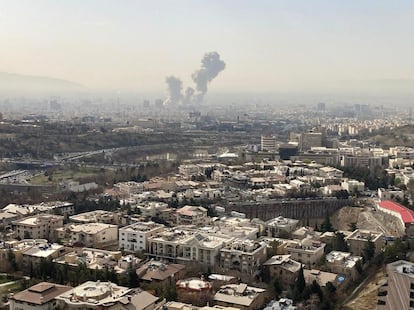
Iran launched attacks on Saturday against U.S. Military bases in at least four countries in the region in response to the offensive that the U.S. And Israel initiated early in the morning with the stated aim of overthrowing the Islamic Republic. Bahrain, Qatar, the United Arab Emirates, and Kuwait were the targets of Iranian hostilities, with the outcome still uncertain. Several of these governments have announced the successful interception of missiles, although there are also images showing the impact of projectiles on areas hosting U.S. Facilities in different states.
The Iranian authorities had warned that any attack on their territory would automatically make both the State of Israel and Washington’s bases in the region military targets. Iran put that warning into practice on Saturday. According to the Iranian news agency Farsi, the response to the U.S. And Israeli offensive includes the U.S. Base at Al Ubeid, near Doha (Qatar), the Al Salem air base in Kuwait, the Al Dhafra base in the UAE, and the Fifth Fleet facilities in Jufair, a city in Bahrain where columns of smoke have been seen rising into the sky.
Bahrain, through its state news agency, was the first to confirm three strikes against its territory just hours after the offensive against Iran began. At least one of these attacks targeted U.S. Interests.
Attacks and explosions have also been reported in Riyadh, the capital of Saudi Arabia; in Abu Dhabi, the capital of the United Arab Emirates (UAE); in Kuwait and in Qatar, according to information gathered by Reuters, AFP and the Qatari television station Al Jazeera, whose presenters were surprised during a live broadcast by the sound of alarms. These Persian Gulf countries, as well as Iraq, have reacted by ordering the closure of their airspace.
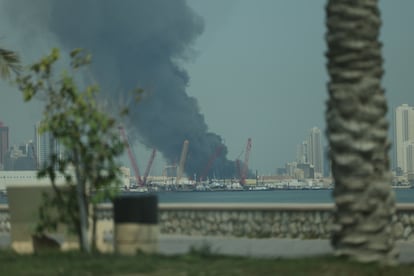
Several of the strikes that Iran has launched against these countries, which have security alliances with Washington, have been intercepted, according to government statements. Specifically, the Qatari Ministry of Defense assured that the country “has successfully thwarted” a series of successive attacks against its territory, and indicated that it had done so in accordance with “a previously approved security plan,” suggesting prior preparation for a situation such as the current one. The Jordanian army, for its part, confirmed the interception of two missiles that it claims were targeting its territory, where there is also a U.S. Presence.
One of these interceptions caused a fatality in Abu Dhabi, apparently due to a collision between the defense systems and the intercepted missiles. The UAE authorities have warned that these reprisals constitute a “flagrant” violation of national sovereignty and international law, and that they reserve “the full right to respond to this escalation.”
The authorities in Bahrain have judged the attacks against their country in a similar manner, also describing them as “treacherous.” Saudi Arabia, for its part, has “strongly” condemned the military action against the Gulf countries and has warned of “severe consequences” in the event of a continued violation “of the principles of international law.”
Several airlines, such as Air India, have canceled all operations in the region. Others, such as Turkish Airlines, have done so in several countries, including Lebanon, Kuwait, Bahrain, Iraq, and Syria. These are generally territories that have already announced the closure of their airspace or are in the path of missiles exchanged between Israel and Iran. Qatar Airways has canceled all its flights due to the closure of Qatari airspace.
In June last year, during the 12-day offensive that Israel launched against Iran, the Iranian army attacked the U.S. Base at Al Ubeid in Qatar, the largest of the U.S. Bases in the region, without major consequences.
In recent months, as the drums of war have grown louder, Tehran has warned on several occasions that it would not hesitate to attack U.S. Resources in any country in the Middle East. That statement led governments close to the Donald Trump administration, such as Turkey and Qatar, to openly acknowledge that they were working to avoid the prospect of war.
Sign up for our weekly newsletter to get more English-language news coverage from EL PAÍS USA Edition
Tu suscripción se está usando en otro dispositivo
¿Quieres añadir otro usuario a tu suscripción?
Si continúas leyendo en este dispositivo, no se podrá leer en el otro.
FlechaTu suscripción se está usando en otro dispositivo y solo puedes acceder a EL PAÍS desde un dispositivo a la vez.
Si quieres compartir tu cuenta, cambia tu suscripción a la modalidad Premium, así podrás añadir otro usuario. Cada uno accederá con su propia cuenta de email, lo que os permitirá personalizar vuestra experiencia en EL PAÍS.
¿Tienes una suscripción de empresa? Accede aquí para contratar más cuentas.
En el caso de no saber quién está usando tu cuenta, te recomendamos cambiar tu contraseña aquí.
Si decides continuar compartiendo tu cuenta, este mensaje se mostrará en tu dispositivo y en el de la otra persona que está usando tu cuenta de forma indefinida, afectando a tu experiencia de lectura. Puedes consultar aquí los términos y condiciones de la suscripción digital.