A chicken-sized dinosaur related to T. Rex debunks the hypothesis that its lineage shrank
‘Alnashetri cerropoliciensis’ belongs to a strange carnivorous lineage that refutes the idea of the progressive miniaturization of its group
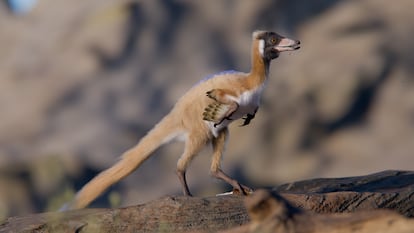
There are only two known specimens in the world of the species Alnashetri cerropoliciensis, one of the smallest non‑avian theropods ever recorded. The discovery of the second specimen — the only complete one — was published on Wednesday in Nature, authored by Argentine and U.S. Paleontologists. The first specimen, which defined the genus in 2012, consists only of a few leg bones.
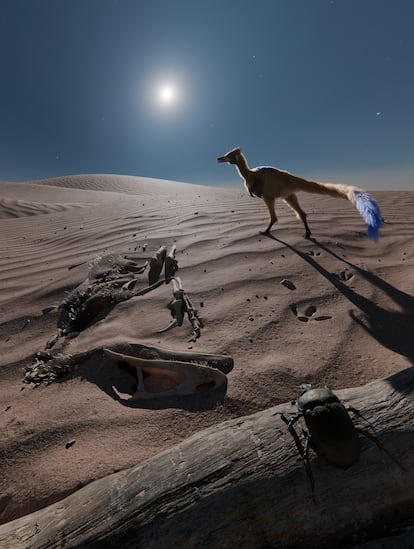
The newly presented Alnashetri cerropoliciensis, found at the La Buitrera site in Argentina’s Río Negro province, is an odd creature in the extinct world of giants. Its name means “skinny legs” in the Tehuelche language. Its body size was similar to that of a chicken — albeit a carnivorous one — with many small teeth, large eyes, and other notable differences. Like chickens, it likely had feathers, something scientists infer from its evolutionary history and its place in the phylogenetic tree.
It stood less than 40 centimeters tall, measured 70 centimeters in length (more than half of which was its tail), weighed about one kilogram, and lived 95 million years ago in a desert landscape where it fed on small vertebrates.
This animal was most likely female. Researchers infer this because it would have laid eggs that left calcium deposits in the fossil’s bone tissue. Paleontologist Peter Makovicky, from the University of Minnesota, the lead author of the study, clarifies that they cannot be completely certain, since there is a possibility — albeit small — that the buildup was caused by a pathology.
In addition, its vision and hearing may have been as sharp as those of owls, according to previous studies on alvarezsaurids, the superfamily to which this fossil — the most complete skeleton of its kind ever found in South America — belongs.
The phylogeny of this specimen resembles a tangled vine that is hard to follow, in which — surprisingly — it shares a major branch with Tyrannosaurus rex, since both are coelurosaurs, a term derived from Greek meaning “hollow tail.” But that is where their relationship ends. From there begins the tongue‑twister of the Alvarezes. Alnashetri belongs to the alvarezsauroid group, which also includes the alvarezsaurids — spelled similarly, but different. Within that group are the Alvarezsaurus (along with Patagonykus and Mononykus).
In addition to Makovicky, the article is co‑authored by Jonathan Mitchell (Coe College, Iowa) and Argentines Jorge Meso (National University of Río Negro), Federico Gianechini (University of San Luis), Ignacio Cerda (UNRN), and Sebastián Apesteguía (Fundación Azara and Maimónides University).
The family hadn’t been shrinking
Alnashetri overturns a theory proposed 16 years ago: the miniaturization of alvarezsaurids. “There was a significant sampling bias. Almost 90% of the specimens were found in Asia and date to the Late Cretaceous,” the final stage of the dinosaur era, explains Meso in a video call from Patagonia. “In 2010, the species considered at the time to be the most primitive alvarezsauroid — Haplocheirus sollers — was published. It dates to the Late Jurassic and measured nearly two meters long, like a modern ostrich. This gave rise to the hypothesis of a trend toward miniaturization emerged. In 2018, two new species appeared in Asia that supported the idea that they had gradually become smaller. Until, in 2012, Alnashetri appeared and showed that this marked trend didn’t exist,” he clarifies.
This South American specimen, less than a meter long, coexisted with other, larger members of the same group that also had other differences, such as shorter arms and a more tapered head. The evolution of this family, then, was more complex and varied than previously thought.
Alongside the idea of miniaturization, another hypothesis grew: that the Alvarezsauridae family consisted of flightless birds. Alnashetri changed that as well. “When the first species began to appear, researchers at the time — in the 1990s — thought they were flightless birds. But around 2000 — with new discoveries and new technology — this paradigm shifted, and today there is no doubt that they were dinosaurs more closely related to others like Gallimimus — the running dinosaur that appears in Jurassic Park — or even Tyrannosaurus than to birds,” Meso explains. They had bird‑like features, but they were specialized maniraptoran theropods. Like them, they had disproportionately short arms relative to their body size.
“With an estimated body mass of less than one kilogram, Alnashetri is among the smallest non‑avian dinosaur species ever collected in South America,” the Nature article highlights.
A strange species
“Alvarezsaurids are strange creatures,” summarizes Apesteguía.
“The reduced arm in a group with such a small body size and such a lightweight skull goes against what we see in most theropods,” adds Makovicky. “Just last month, an alvarezsaur — Manipulonyx reshetovi — was discovered in the Gobi Desert [Mongolia] with horn‑shaped ‘scales’ on its hand [dermal plates like those of crocodiles and armadillos]. A new type of ossification never before found in other dinosaurs. Nothing like it had ever been seen. It’s an example of the bizarre anatomy of this group.”
The later relatives of Alnashetri had a different diet from its own. They ate social insects such as ants and termites, which they captured by scratching into nests with one robust finger — one of the three they possessed — and using a long tongue. “One of the most striking features of these little animals is that the more derived species had extremely reduced arms. In fact, the hand became so reduced that the fingers practically disappeared, except for one that remained larger, with a fairly robust claw,” Gianechini notes.
“Alvarezsaurids are a very interesting group from an evolutionary standpoint. Now, with this species, we can see a dissociation between the reduction of body size and the reduction of the arms,” Makovicky emphasizes. The larger the body and head, the smaller the arms. According to the U.S. Paleontologist, this pattern is more common in large theropods such as T. Rex or Meraxes. In such bodies, the bite gained power while the arms were relegated to a secondary function.
Small and lightweight, with wings but unable to fly, these mini‑dinosaurs spread on foot to very distant regions starting in the Jurassic, when the continents were still connected. “Given their size, it doesn’t make sense that an animal could have dispersed across both Asia and South America. They are the two farthest points from each other on the planet,” Makovicky points out. “This dinosaur is the key to answering many scientific questions for which we still lack evidence.”
The exceptional and complete preservation of the fossil presented today allows scientists to expand what is known about the species: “It’s just the tip of the iceberg, because having an almost complete specimen like Alnashetri allows you to carry out many studies on muscle reconstruction, biomechanical locomotion analyses, paleoneurology. Various analyses can be performed, and that’s what’s so great about this little creature,” Meso explains.
Sign up for our weekly newsletter to get more English-language news coverage from EL PAÍS USA Editio
Tu suscripción se está usando en otro dispositivo
¿Quieres añadir otro usuario a tu suscripción?
Si continúas leyendo en este dispositivo, no se podrá leer en el otro.
FlechaTu suscripción se está usando en otro dispositivo y solo puedes acceder a EL PAÍS desde un dispositivo a la vez.
Si quieres compartir tu cuenta, cambia tu suscripción a la modalidad Premium, así podrás añadir otro usuario. Cada uno accederá con su propia cuenta de email, lo que os permitirá personalizar vuestra experiencia en EL PAÍS.
¿Tienes una suscripción de empresa? Accede aquí para contratar más cuentas.
En el caso de no saber quién está usando tu cuenta, te recomendamos cambiar tu contraseña aquí.
Si decides continuar compartiendo tu cuenta, este mensaje se mostrará en tu dispositivo y en el de la otra persona que está usando tu cuenta de forma indefinida, afectando a tu experiencia de lectura. Puedes consultar aquí los términos y condiciones de la suscripción digital.