How engineer Emelyanov was murdered in Bucha: The investigation and three Russian suspects
Police and family members explain how, desperate during the occupation by Putin’s troops, this man went out to get fuel and ended up being shot twice in the infamous massacre in the Ukrainian town four years ago


Under a light snowfall, a body lies partially covered by black plastic sheeting at one of the entrances to Bucha, on the outskirts of Kyiv. It is the morning of April 3, 2022. Silence reigns amid the immense damage inflicted on streets, houses, buildings, and vehicles. Barely two days have passed since the withdrawal of Russian troops, who had occupied this area since the end of February in an attempt to seize the Ukrainian capital.
Eventually, they were forced to retreat after being defeated in a hellish battle that lasted more than a month in Bucha and other surrounding towns. EL PAÍS has now confirmed to whom that body belonged, the circumstances of his death — exactly four years ago last Sunday, March 8 — and the identities of the three Russian soldiers whom Ukrainian police consider responsible. The invasion orchestrated by Vladimir Putin has led to the opening of more than 216,000 cases of possible war crimes in Ukraine, according to the Attorney General’s Office.
On April 3, 2022, this newspaper took photographs and videos of the body — which appeared to be a civilian — and had been abandoned, like some 500 others, in the streets, gardens, homes, and makeshift graves of Bucha and other municipalities in the Kyiv region. One of the images of this dead man illustrated the first report published by EL PAÍS on the ground regarding the Bucha massacre, also on April 3.
But who is this man? What happened to him? Panic still reigned where he lay; a few explosions could be heard in the background, and there was no one around. The local population suspected that Russian soldiers were still lingering in the area and had planted landmines as they retreated.
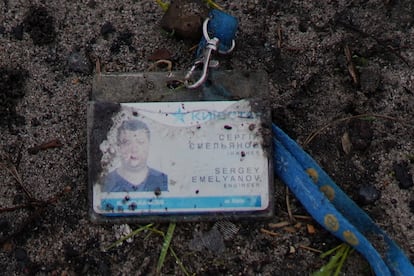
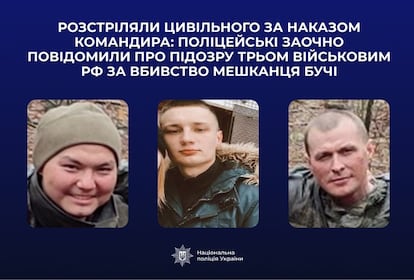
The first clue came from an ID card found next to the body, attached to a lanyard. It belonged to Sergey Emelyanov, an engineer with Kyivstar, a national cell phone company. The company confirmed his death but declined to provide further details. Over the months, the relatives are finally located, as are one of the witnesses — who prefers not to make any statements — and the agents in charge of the investigation. They finalized their list of suspects on February 26 of this year, as this report was being written. On March 2, they officially announced the charges against them in absentia.
The three men implicated are well-known military personnel who participated in the occupation of Bucha and its surroundings. They were members of the 234th Guards Air Assault Regiment of the 76th Division of the Russian Armed Forces. According to investigators, the person responsible for ordering Emelyanov’s assassination was Yuri Kim, a platoon commander based in the Moscow region who imposed his authority in the border area between Bucha and Gostomel. Two shots ended the engineer’s life; they were allegedly fired by Vladislav Pervunin (originally from the Kirov region), a 33-year-old sergeant at the time, and Andrei Isakov (originally from the Pskov region), a 19-year-old corporal. Both were subordinates of Kim, who was 25, the same sources added.
Sergey Emelyanov, then 37, and his family took refuge in the basement of a neighbor’s house when the occupation began and the streets of Bucha became a battlefield. There were about 20 of them, explains Julia, his widow, who now lives in Norway with her 15-year-old daughter, Polina. “It was a deafening and terrifying situation. We didn’t know what was going to happen. The cell phone connection was practically nonexistent. Despite the fear, we stayed close to our neighbors, supporting each other, sharing what we had, and giving each other strength. Thanks to that solidarity, we managed to hold out,” Julia, the same age as Sergey, recounts in text messages. She admits that she still doesn’t have the strength to talk about what happened.
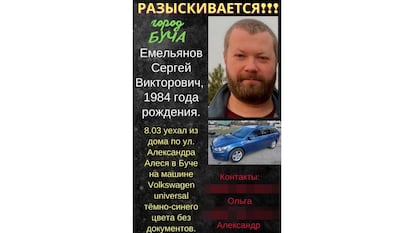
“On March 8, Sergey lost his patience. There was almost no diesel left in his car,” which was “essential simply for survival,” Julia recounts. “That day he decided to go get fuel. Other neighbors and I tried to stop him, we begged him not to go, but he wouldn’t listen. He left and never came back. Later we learned that he had been murdered,” she says. As the investigation progresses, she gratefully notes that “memory and truth are what help us preserve dignity and justice.”
“Sergey called me before he left. I told him not to leave the basement. He said they had no more food or water. During those two weeks, they had collected food from the homes of all the neighbors who had left. They did it with their consent,” explains his brother-in-law, Aleksandr.
The investigators consulted provided many more details. Shortly after leaving the house, Emelyanov encountered a Russian checkpoint on a street. They made him get out of his car, a blue Volkswagen, and the soldiers seized it. He decided to continue on foot along the train tracks to return home. But he fell into the hands of the two soldiers who, after informing Kim by phone, received orders to kill him, according to the police account. A first shot knocked him to the ground, and a second shot finished him off, ending his life.
They then searched his clothes, but only took his phone. They left behind his headphones, Apple Watch, work ID, keys, and about 3,000 grivas in cash (around $70 at the current exchange rate). The officers showed a photo from the file in which all these belongings were listed.
As in other cases, tracking the use of stolen cell phones has been key to furthering the investigation. This is especially true in this case, as it involved a Kyivstar employee’s phone line.
Just 30 minutes after Emelyanov’s last call, Corporal Isakov made his first personal call to Russia using the same number. The three defendants used up to 30 Ukrainian SIM cards during those days, and the engineer’s SIM card was used in several different phones, according to the investigation. The officers consulted did not provide details of the testimony given by the witness located by this newspaper, but acknowledged that he offered “very important” information.
The body was left abandoned on the shoulder of a road next to the railway line and in front of buildings occupied by Russian troops, right on the border between Bucha and Gostomel. Dozens of people passed through this spot, used as an evacuation route, on successive days starting on March 9 — Julia and Polina left that same day. Some of these residents reported the presence of the body. Most of those killed, however, could not be recovered or buried. Like Sergey, they remained there until the occupation ended on April 1. The family was informed of the discovery of the body on April 4 — one day after this newspaper found it — and it was finally removed on April 7.
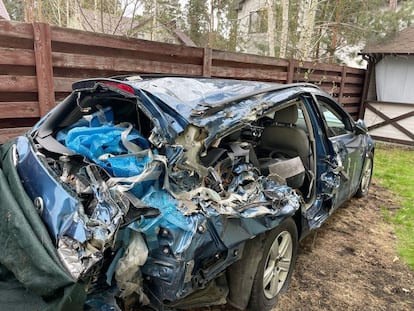
The Volkswagen was used by the Russians over several days. It was eventually found in a house that had been inhabited by its owners until mid-March and which, since then, had become a command post for the occupying troops in the town of Gostomel. It was on this property that it was found wrecked and riddled with bullet holes after the liberation of the territory.
“We are 100% certain that they will ultimately pay. We work toward that goal every day,” says one of the investigators consulted. Julia, who traveled to Kyiv to give a statement, expresses her gratitude for their work. “I believe that good always triumphs over evil. I hope that all the perpetrators responsible for this crime will be brought to justice. It is not just a matter of personal justice, but justice for the entire country. For me, it is important to know that the truth has been established and that the guilty parties have been identified,” she asserts.
But the widow of Sergey Emelyanov, buried in his native Dnipro region, remains deeply grieved despite the four years that have passed. She hasn’t even been able to tell her daughter Polina the whole truth during this time. She explained that she told her father that he died after enlisting to defend Ukraine against Russian aggression. “No investigation will bring my husband back or make this loss any easier to accept. I have to live with this pain every day,” she says.
Sign up for our weekly newsletter to get more English-language news coverage from EL PAÍS USA Edition
Tu suscripción se está usando en otro dispositivo
¿Quieres añadir otro usuario a tu suscripción?
Si continúas leyendo en este dispositivo, no se podrá leer en el otro.
FlechaTu suscripción se está usando en otro dispositivo y solo puedes acceder a EL PAÍS desde un dispositivo a la vez.
Si quieres compartir tu cuenta, cambia tu suscripción a la modalidad Premium, así podrás añadir otro usuario. Cada uno accederá con su propia cuenta de email, lo que os permitirá personalizar vuestra experiencia en EL PAÍS.
¿Tienes una suscripción de empresa? Accede aquí para contratar más cuentas.
En el caso de no saber quién está usando tu cuenta, te recomendamos cambiar tu contraseña aquí.
Si decides continuar compartiendo tu cuenta, este mensaje se mostrará en tu dispositivo y en el de la otra persona que está usando tu cuenta de forma indefinida, afectando a tu experiencia de lectura. Puedes consultar aquí los términos y condiciones de la suscripción digital.