Mojtaba Khamenei, a supreme leader under death threats and little hope of change
The new head of the Islamic Republic is considered a puppet of the Revolutionary Guard, the core of the repressive military and security apparatus that protects the regime
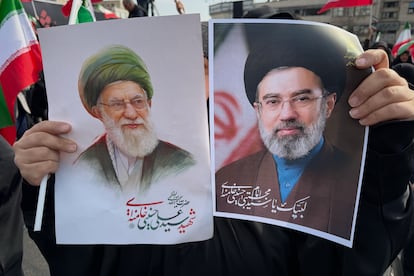
In 2005, Mehdi Karroubi, a moderate cleric who was running for president, complained in a letter to then-Supreme Leader Ali Khamenei about the interference of his second son, Mojtaba, on behalf of the populist Mahmoud Ahmadinejad, who ultimately won a victory marred by accusations of massive fraud. In his letter, Karroubi referred to the young Khamenei — named on Sunday as the third Supreme Leader of the Islamic Republic of Iran — with the epithet Aghazadeh, or “noble-born,” a word that roughly equates to the Western term nepobaby. Ayatollah Khamenei’s response was prophetic: “He [Mojtaba] is not an Aghazadeh, but Agha (Lord) himself.” This is the title used by the most devoted followers of the Islamic Republic to refer to the supreme leader.
Long before an Israeli-U.S. Airstrike killed Ali Khamenei in Tehran on February 28, the name of his second son, Mojtaba, 56, was already being floated as his successor. Shahin Modarres, an international security analyst, noted a few days ago from Rome on the social network X that his selection was not surprising, given that, as the anecdote of the letter suggests, his rise to power had been brewing since those elections more than 20 years prior. The plan to promote the then-leader’s son as the favorite for succession gained momentum after the young cleric and the Revolutionary Guard, the regime’s powerful parallel army, were implicated in orchestrating the electoral fraud that brought Ahmadinejad to the presidency.
According to Modarres, Mojtaba Khamenei was already the preferred candidate of the Revolutionary Guard, the core of Iran’s military and security apparatus, which, along with the supreme leader’s office, forms the hardliners of the Islamic Republic. These hawks are largely blamed for blocking any hint of change and also for the repression that, in the latest wave of protests, cost the lives of at least 7,000 Iranians, according to the U.S.-based NGO Hrana.
As the new supreme leader, Khamenei Jr., the expert continues, “represents the Revolutionary Guard and the oligarchs.” From now on, Modarres argues, “he will be a puppet of that force, and his rule will probably not last long.”
Modarres is not the only one who doubts the stability of this succession, and not only because of the intense bombing by Israel and the United States and the internal discontent evidenced by the recent protests. It’s also because one of the new supreme leader’s most urgent tasks will be trying to avoid being killed. On Sunday, shortly before his appointment, U.S. President Donald Trump had warned that the chosen successor “wouldn’t last long” without his approval. Since assassinating Ali Khamenei, Israel has threatened to kill anyone who succeeds him. On Monday, Trump stated in an interview with NBC that he considers the choice of Motjaba Khamenei “a big mistake.”
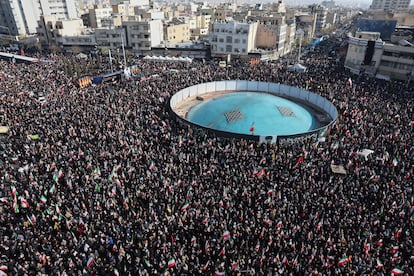
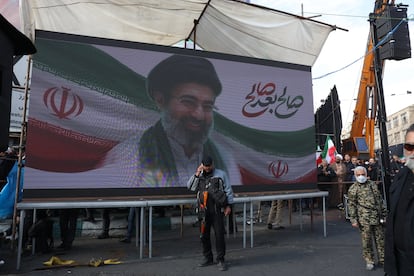
The Revolutionary Guard hopes to leverage the new leader’s close ties with the military to reduce internal divisions and ensure the regime’s survival. A demonstration of support for Khamenei filled downtown Tehran and other Iranian cities on Monday, with tens of thousands of loyalists waving flags and images of the three supreme leaders the country has known — Ruhollah Khomeini, Ali Khamenei, and the newly appointed Mojtaba Khamenei — in an attempt to flex the regime’s muscles, consolidate support among the perceived minority, and thus guarantee the continuity of the Iranian political system.
In a message intended to demonstrate unity, the country’s president, Masoud Pezeshkian, congratulated Khamenei and stated: “His election heralds a new era of honor and power for the Iranian nation.” The Assembly of Experts — the body responsible for electing the leader, at least formally — has urged the people to “swear allegiance to the new leader.”
The apparent official enthusiasm does not dispel the doubts surrounding the new supreme leader. Even some voices within the Assembly of Experts have been critical of Khamenei’s inheritance of the leadership from his father. His modest credentials as a cleric, his lack of political and administrative experience, and his limited public visibility do not project the image of stability to which the Iranian regime — threatened by attempts to overthrow it by the United States and Israel — aspires.
This is especially the case for an Islamic system that, since its founding 47 years ago, has aspired not only to rule Iran, but to become the leader of all Shiites worldwide and even the global Muslim community. Mojtaba Khamenei has not given any official speeches in his own name nor held any executive positions that would bolster his political ambitions.
Weakness
Last June, Faezeh Hashemi, an Iranian politician close to the reformist wing of the Islamic Republic — the one that believes or believed that the system could evolve from within — stated that the election of Mojtaba Khamenei could give him the opportunity to implement reforms in the style of Saudi Crown Prince and strongman Mohammed bin Salman; that is, economic development and controlled opening, but without democracy.
Modarres does not see it as likely that Khamenei’s son will even consider reforms, let alone those limited in terms of public and political freedoms, as in the Saudi case. He asserts that it is “highly unlikely that [the new supreme leader] will initiate reforms like Mohammed bin Salman and remain in power.” The younger Khamenei is “ideologically the same as his father, but at the same time, his position is one of weakness,” says this specialist, who attributes his election to the result of a 20-year process driven by the intelligence and security centers of the Revolutionary Guard.
Meir Javdanfar, professor of politics and contemporary Iranian history at Reichman University, also does not expect a significant change in the new leader’s policies compared to those of his father. He summarized this for EL PAÍS via WhatsApp messages from Tel Aviv, confirming that “Mojtaba Khamenei’s support comes from the Revolutionary Guard’s intelligence.” This intelligence stems from a “deeply ideological vision” and is geared, more than espionage, “towards war.” That “is not acceptable to Israel,” he emphasizes.
Despair
Some Iranians have greeted this appointment with despair. Majid, an Iranian diaspora resident, laments that “at least” they could have “chosen a more conciliatory person, someone who would have eased tensions.” Shadi, a cashier in a Tehran restaurant, says via Telegram — like the other interviewees residing in Iran, whose messages trickle in due to internet outages — that she is “sure” the Islamic Republic’s leaders “will never relinquish power.” “They’ve been there for 47 years. They said that if they killed [Ali] Khamenei there would be a revolution, but nothing has happened.”
Even reformists, who after the 12 days of Israeli and American bombing in Iran in June had hoped the regime would learn its lesson and support a more pragmatic successor, have been disappointed by Khamenei’s appointment. Meanwhile, for Israeli public opinion, notes Javdanfar, the designation of Khamenei’s son is “worrying.”
Hossein, a resident of Karaj, 20 miles west of Tehran, laments: “We’ve always said ‘Death to Khamenei.’” This retired Water and Sewerage Organization worker continues: “It seems that what the United States and Israel have done is kill an aging Khamenei and put a younger version in his place.”
The appointment of the new supreme leader is not only unsettling for many Iranians. Global markets have also reacted negatively to his designation. According to Reuters, the price of oil in early trading on Monday rose by about 20%, reaching $114 per barrel, the highest level since the summer of 2022.
“Only if Israel finally understands that there is no possibility of regime change and that the future leadership is willing to modify its policy toward Israel and stop threatening it, will it accept that new leader,” Javdanfar explains. This analyst clarifies that such a scenario would, in reality, represent a failure for Israel, whose objective is regime change in Iran.
The election of Khamenei has disappointed many Iranians, but it hasn’t surprised them. Nahid, a chemistry student in Tehran, says that at his university “many were talking about the possibility” of Mojtaba Khamenei’s leadership. “Nothing else could be expected,” he says, adding, “Since the Revolution [of 1979], their slogans have been ‘war, war until victory,’ and it seems they don’t care about the fate of the country.” “I think they’re going to kill him,” he concludes about the new supreme leader.
Sign up for our weekly newsletter to get more English-language news coverage from EL PAÍS USA Edition
Tu suscripción se está usando en otro dispositivo
¿Quieres añadir otro usuario a tu suscripción?
Si continúas leyendo en este dispositivo, no se podrá leer en el otro.
FlechaTu suscripción se está usando en otro dispositivo y solo puedes acceder a EL PAÍS desde un dispositivo a la vez.
Si quieres compartir tu cuenta, cambia tu suscripción a la modalidad Premium, así podrás añadir otro usuario. Cada uno accederá con su propia cuenta de email, lo que os permitirá personalizar vuestra experiencia en EL PAÍS.
¿Tienes una suscripción de empresa? Accede aquí para contratar más cuentas.
En el caso de no saber quién está usando tu cuenta, te recomendamos cambiar tu contraseña aquí.
Si decides continuar compartiendo tu cuenta, este mensaje se mostrará en tu dispositivo y en el de la otra persona que está usando tu cuenta de forma indefinida, afectando a tu experiencia de lectura. Puedes consultar aquí los términos y condiciones de la suscripción digital.