Trump warns military operation against Iran will last ‘as long as necessary’
National Security Council Secretary Ali Larijani says Tehran ‘will not negotiate with the United States’
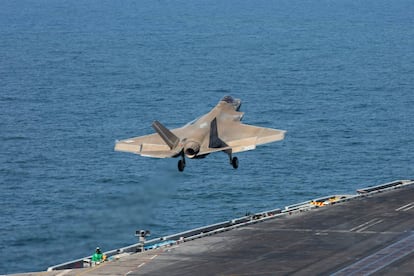
Between “four or five weeks” and “as long as necessary.” U.S. President Donald Trump made this vague prediction on Monday during his first public appearance at the White House in 72 hours. The Republican issued a warning to his compatriots: the idea of a quick, clean, and cost-free military operation against Iran that he had been selling them could well turn into one of those long wars that he had so often promised not to get his country involved in. He did so on a day that began in Washington with the confirmation of the death in combat of a fourth U.S. Soldier and the downing of three F-15 fighter jets by “friendly fire” in Kuwait. In addition, Defense Secretary Pete Hegseth announced the deployment of more “additional reinforcements” to the Middle East. As soon as, he added, “today [Monday].”
Trump listed his objectives (a list that has been changing daily since Saturday, when he made it clear in a recorded message to the nation that he is seeking “regime change”): “First, destroy Iran’s missile capabilities. Second, we’re annihilating their navy; we’ve already knocked out 10 ships. They’re at the bottom of the sea. Third, we’re ensuring that the world’s number one sponsor of terror can never obtain a nuclear weapon,” Trump said at an event honoring a group of veterans for their service. “This was our last best chance to strike and eliminate the intolerable threats posed by this sick and sinister regime.”
Regarding the United States’ motivations, Hegseth — who appeared at the Pentagon early in the morning to make it clear that Washington is preparing for a prolonged operation in Iran, but added that the conflict would not be “endless [...] This is not Iraq” — said: “This is not a so-called regime change war, but the regime sure did change and the world is better off for it.”
The secretary of Iran’s Supreme National Security Council, Ali Larijani, on Monday refuted Trump’s claim that Iran’s new leaders “want to negotiate” an end to the current conflict, hinting at a surrender that Larijani quickly dismissed with a terse message on social media: “We will not negotiate with the United States.”
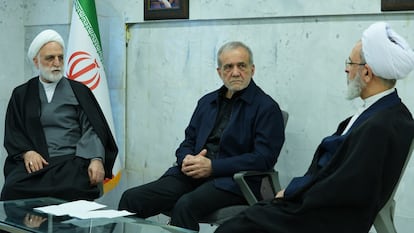
Larijani is a figure whose power in Iran is considered to be growing, and he is widely assumed to be above the Leadership Council, the triumvirate the country announced on Sunday comprised of Iranian President Masoud Pezeshkian, the head of the judiciary, Gholamhossein Mohseni Ejei, and the jurist and member of the Guardian Council, Alireza Arifi. This tripartite power is supposed to steer the country until the appointment of a successor to Supreme Leader Ali Khamenei, who was killed in an air strike on Saturday.
Some analysts see Larijani as the de facto president of the country and, above all, as the coordinator with the powerful security and military apparatus of the Revolutionary Guard. This parallel army, whose objective is to defend the Islamic Republic, is leading the Iranian response to the attacks by Israel and the United States. Since Saturday, bombings have already claimed the lives of at least 555 Iranians, according to reports from the country’s state television, citing the local Red Crescent.
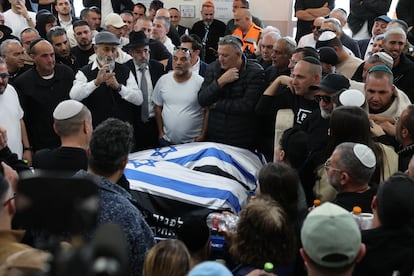
After the United States announced its first military casualties on Sunday — currently four soldiers dead and five seriously wounded — Iran scored a tactical victory, in line with the two-pronged strategy identified by military analysts. This involves trying to increase the cost in lives for Washington while simultaneously expanding the geographic scope of its attacks and attempting to draw new actors into the conflict.
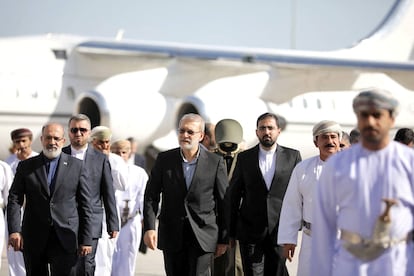
Tehran not only continues to launch projectiles against Israel and other countries in the region — on Sunday it added Oman to the list, the emirate that mediated in the failed negotiation of a nuclear agreement with Washington in the previous weeks — but on Monday it also launched a drone attack against a British Air Force base in an EU member state: Cyprus.
Negotiation, currently ruled out by Larijani, is a highly probable scenario if the United States and Israel manage to subdue the Islamic Republic with their overwhelming military superiority; but for the moment there are no signs that Tehran will submit to it, as the U.S. President has suggested. Iran aims to resist and inflict damage on its Israeli enemy and, above all, on Washington, in order to negotiate afterward, not from the position of surrender that Trump seeks, but from a position of greater strength.
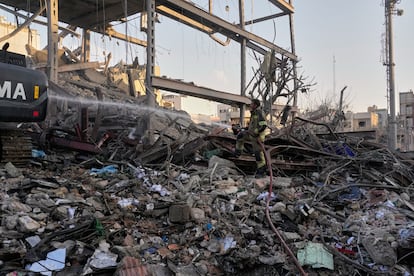
Following the death of Ali Khamenei at the hands of the United States and Israel, the Islamic Republic has also announced that it will no longer respect any red lines. It is thus abandoning the merely symbolic responses it adopted after the Israeli bombings of June 2025 — which were later joined by the United States — when it attacked the Al Udeid base in Qatar, with its personnel almost entirely evacuated.
Continuing missile attacks against U.S. Bases — the Revolutionary Guard announced Sunday that it had targeted 27, without specifying which ones — is aimed at destroying them. But above all, it seeks to increase American casualties and, therefore, the political cost of the Iran war for Trump domestically, where crucial midterm elections will be held this November. Iran knows that the U.S. Public vividly remembers the images of coffins of American soldiers killed in the wars in Iraq and Afghanistan.
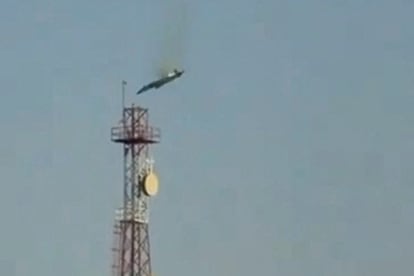
Tehran attempted to score a victory in this strategy on Monday by shooting down a U.S. F-15 fighter jet. The aircraft crashed in Kuwait, according to the Tasnim news agency, which is linked to the Iranian Revolutionary Guard.
Kuwait’s Ministry of Defense had already confirmed that “several” of these aircraft had crashed in the country — the crews survived. However, shortly afterward, U.S. Central Command indicated that the planes were shot down by “friendly fire.” Military analyst Jesús Pérez Triana believes that these incidents point to “lack of coordination and chaos” in the defense strategy of Iran’s neighbors, the Gulf Cooperation Council countries (Saudi Arabia, Bahrain, Kuwait, Oman, Qatar, and the United Arab Emirates), all of which have been attacked by Tehran.
The tone of confrontation with Tehran is escalating in several of these countries, something that points to the regionalization of the conflict that Iran had threatened before being attacked last Saturday.
Although Iran stands alone — Russia ruled out on Monday that the BRICS group, which also includes China, would come to the aid of the Islamic Republic — it received symbolic support earlier this morning. This support will not change the course of the conflict but serves as a reminder that pro-Iranian militias, albeit much weakened, still exist in the region. One of them, the once-powerful Lebanese militia Hezbollah, launched its first missiles against Israel since 2024. The Israeli army responded with renewed airstrikes — which are nothing new, as it attacks Lebanon almost daily — killing 30 people.
Kuwait has reported further missile and drone attacks, and powerful explosions have been registered in Dubai and the Qatari capital, Doha. A Qatari Foreign Ministry spokesman said its fighter jets intercepted “drones and other explosives” that Iran had directed at its civilian infrastructure, including its international airport. “An attack like this cannot go unanswered,” he said. “Iran will pay the price for this attack on our people.”
Saudi Arabia, for its part, has ordered the closure of its Ras Tanura refinery on the Persian Gulf coast after at least one drone struck the facility, causing no casualties. Shortly afterward, the semi-official Iranian news agency Tasnim, citing military sources, denied that oil facilities in countries in the region were among its targets.
Meanwhile, a British vessel in Bahrain has also been damaged by two other projectiles, the origin of which has not been disclosed, according to UK Maritime Trade Operations (UKMTO).
Pérez Triana believes that Monday marks a turning point in the Iranian response. “The high command [in Tehran] is becoming more active and has ordered an intensification of missile launches [against neighboring countries],” the analyst interprets. Following the Israeli airstrikes on Iranian territory on Monday morning, Tehran responded by launching two large waves of missiles against the Jewish State within minutes, reports Antonio Pita.
Strategy
Iran’s attack on the British base in Cyprus is very revealing about the strategy of the Islamic Republic, argues Trita Parsi, executive vice president of the Quincy Institute for Responsible Governance, located in Washington, on his X account.
“Iran is well aware that this is an attack on an EU member state. But that seems to be the point. Tehran appears determined not only to expand the war to Persian Gulf countries, but also to Europe — it has attacked a French base in the United Arab Emirates,” Parsi notes. “For the war to end, Europe also has to pay a price. That seems to be Iran’s reasoning,” this expert emphasizes.
European Commission President Ursula von der Leyen alluded on Monday to the need to “work hard to de-escalate and stop the spread of the conflict” in the Middle East; and she warned in Brussels of the consequences the conflict will have, also for the 27 member states: “From energy and transport to migration and security,” reports Silvia Ayuso. Given this scenario, Europeans must be “prepared,” Von der Leyen stressed.
The home front
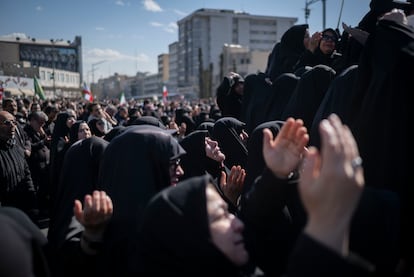
The Iranian regime faces not only external pressures but also opposition from a large part of its population: many citizens erupted in celebrations in the streets after the announcement of Khamenei’s death, while his supporters, estimated to make up a third of the population, mourned. These “expressions of joy,” Parsi points out on X, have not yet translated into the mass mobilization that Trump and Israeli Prime Minister Benjamin Netanyahu are counting on to overthrow the Islamic Republic.
“That window of opportunity is closing now, as the theocratic system closes ranks and establishes a new formal leadership,” Parsi continues, alluding to the Leadership Council, the triumvirate that will officially assume the functions of the deceased supreme leader until the appointment of his successor, although it is believed the strongman who will pull the strings of the process will be Larijani, along with other de facto powers in the country such as the Revolutionary Guard.
The Iranian regime is trying to completely close off any possibility of further protests with a classic strategy: the country has been without internet access for more than 48 hours, according to NetBlocks, a platform that monitors internet traffic and censorship. Iran is thus left almost entirely in the dark, as happened during the crackdown on the January protests, in which thousands of Iranians died: 3,117 according to the regime, and at least 7,000 according to the Iranian NGO in exile, Hrana.
Sign up for our weekly newsletter to get more English-language news coverage from EL PAÍS USA Edition
Tu suscripción se está usando en otro dispositivo
¿Quieres añadir otro usuario a tu suscripción?
Si continúas leyendo en este dispositivo, no se podrá leer en el otro.
FlechaTu suscripción se está usando en otro dispositivo y solo puedes acceder a EL PAÍS desde un dispositivo a la vez.
Si quieres compartir tu cuenta, cambia tu suscripción a la modalidad Premium, así podrás añadir otro usuario. Cada uno accederá con su propia cuenta de email, lo que os permitirá personalizar vuestra experiencia en EL PAÍS.
¿Tienes una suscripción de empresa? Accede aquí para contratar más cuentas.
En el caso de no saber quién está usando tu cuenta, te recomendamos cambiar tu contraseña aquí.
Si decides continuar compartiendo tu cuenta, este mensaje se mostrará en tu dispositivo y en el de la otra persona que está usando tu cuenta de forma indefinida, afectando a tu experiencia de lectura. Puedes consultar aquí los términos y condiciones de la suscripción digital.