Death of French ‘Charlie Kirk’ casts a shadow over mayoral campaign in Lyon
The left fears losing the city after 25 years in power while tension between extremist groups remains high ahead of Sunday’s local elections

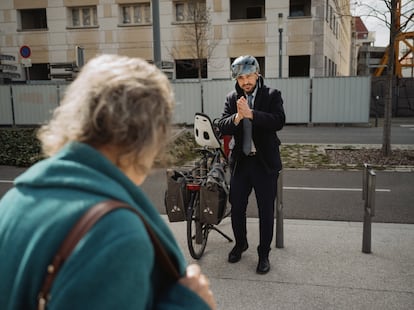
Grégory Doucet gets around everywhere by bike and public transportation. In five years, the Green mayor of Lyon has led the city through a radical transformation, flooding the city with bike paths, new tram lines, and a public housing complex that is still under construction. “That’s the problem. Sometimes people suffer through the construction phase of it, and it’s hard to see the positive side until it’s finished,” he explains, putting on his bicycle helmet just after participating in the laying of the foundation stone for a new project, and acknowledging the potential cost in votes this Sunday in the first round of municipal elections in which all of France will go to the polls.
The election was overshadowed two weeks ago by the death of a young far-right activist, Quentin Deranque, who was allegedly beaten by members of a far-left group. The tension has been palpable in certain parts of Lyon ever since.
Lyon is the country’s third-largest city. It is a bourgeois municipality with a tradition of progress and industry, deeply rooted in a conservative social fabric and indelibly marked by the presence of the Catholic Church. The city is a key location for understanding the country and its evolution. And in the first round of elections this Sunday it could take a step toward transferring power to the right after a quarter of a century under progressive forces. The leading candidate is now Jean-Michel Aulas, the long-serving president of the soccer club Olympique Lyonnais, who embodies consensus among the conservative world, precisely at a time when the city has been engulfed in intense ideological tensions following the death of Deranque, a 23-year-old nationalist and member of a far-right French group.
The killing caused a political earthquake in France. The young man died after being beaten on February 14 when he attended a protest against an event held by the Franco-Palestinian member of the European Parliament Rima Hassan, of the leftist party La France Insoumise (LFI), at Sciences Po University in Lyon. He was there to support a group of women from the collective Némesis, a racist and self-proclaimed feminist organization, and was fatally attacked by a far-left group linked to Jean-Luc Mélenchon, leader of LFI.
The Attorney General’s Office opened an investigation for voluntary manslaughter, and the police arrested 11 people. Their identification confirmed suspicions: most were members of Jeune Garde (Young Guard), which was outlawed last June. One of those arrested is a parliamentary assistant to Raphaël Arnault, a member of the National Assembly from Mélenchon’s party. There was confusion, accusations, and no self-criticism. And the first tangible result, as if to balance the scales, was that the Interior Ministry allowed a neo-Nazi demonstration in the center of Lyon, supposedly to preserve freedom of expression. But other cracks appeared.
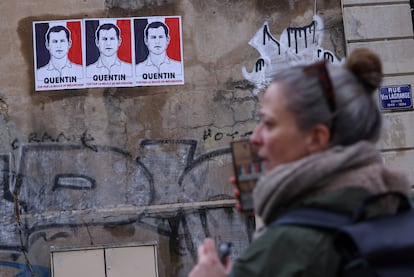
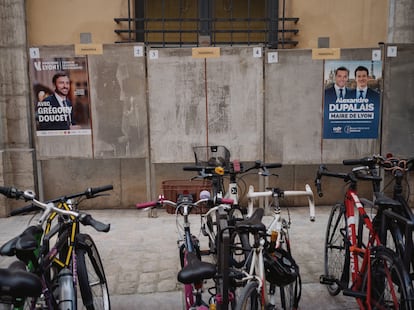
Lyon is plastered with posters bearing Deranque’s face, quickly transformed into a martyr of the far right, a kind of French Charlie Kirk. The National Assembly observed a minute of silence for his death. But the victim belonged to political groups close to the neo-Nazi and fascist sphere. “Aulas [the right-wing candidate] wanted us to hang a banner with his face at City Hall, but I refused,” explains the mayor. “It was a tragedy. But when there are people in the city who choose to use violence as a form of political action, and others who respond, the worst can always happen. And that’s what occurred,” Doucet points out. “I tried to be as respectful as possible to the family. When a family is grieving, you don’t try to gain political advantage from it. But many have exploited this issue to turn it into a national political matter,” he criticizes.
The national fallout is inevitable. And it directly affects La France Insoumise, which has refused to distance itself from the organization to which some of the alleged attackers belonged. This has accentuated the process of demonizing Jean-Luc Mélenchon’s party, with growing attempts in recent weeks to isolate it politically, just as was done for years with the far right. The party is running alone in these elections in Lyon, without the old progressive alliances that have broken down across almost the entire country. But it could be key in the run-off.
The polls are not favorable to the left. Jean-Michel Aulas, who has the support of most center-right parties, is clearly leading the race with 45% of the vote, according to the polls. The incumbent mayor would only garner 29%. Trailing behind is Anaïs Belouassa-Cherifi, the candidate backed by La France Insoumise, who would obtain more than 10% of the vote and could advance to the second round. Her position will be crucial for Doucet.
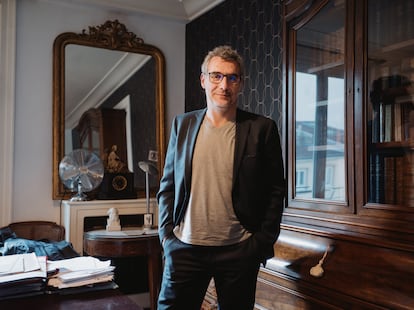
Clashes between the far right and anti-fascists in the streets of Lyon often end up in court. Oliver Forray, a lawyer and member of one of these left-wing groups, explains in his office in the multicultural Guillotière neighborhood the turn this case has taken. “What happened is the far right’s typical modus operandi. First, they send the women of Némesis [the group protesting against MP Rita Hassan’s speech at the university], and then they try to lure a few far-left activists to a more secluded spot and attack them. This time it was different,” he says.
Forray points out that La Jeune Garde, accused of being behind the death of Quentin Deranque, is not a group that rejects active violence, unlike the other antifascist groups he is accustomed to defending. “Normally it’s about self-defense, but here we have something more problematic. They beat someone who was on the ground,” the lawyer explains, pausing to detail the long history of these rival groups in the city.
The elections will be held under the shadow of Deranque’s murder, which Forray believes could also determine the city’s level of tolerance for these phenomena. “Aulas was the president of a club whose stadium is frequented by many of these far-right groups,” he insists. Many left-wing activists now fear that if he is elected mayor, the city will be more permissive with these far-right groups, which already marched peacefully two weeks ago near the site where Jean Moulin, president of the General Council of the Resistance, was tortured by SS officer Klaus Barbie in this city.
Sign up for our weekly newsletter to get more English-language news coverage from EL PAÍS USA Edition
Tu suscripción se está usando en otro dispositivo
¿Quieres añadir otro usuario a tu suscripción?
Si continúas leyendo en este dispositivo, no se podrá leer en el otro.
FlechaTu suscripción se está usando en otro dispositivo y solo puedes acceder a EL PAÍS desde un dispositivo a la vez.
Si quieres compartir tu cuenta, cambia tu suscripción a la modalidad Premium, así podrás añadir otro usuario. Cada uno accederá con su propia cuenta de email, lo que os permitirá personalizar vuestra experiencia en EL PAÍS.
¿Tienes una suscripción de empresa? Accede aquí para contratar más cuentas.
En el caso de no saber quién está usando tu cuenta, te recomendamos cambiar tu contraseña aquí.
Si decides continuar compartiendo tu cuenta, este mensaje se mostrará en tu dispositivo y en el de la otra persona que está usando tu cuenta de forma indefinida, afectando a tu experiencia de lectura. Puedes consultar aquí los términos y condiciones de la suscripción digital.