Russia cashes in on Iran war: ‘We should secure benefits for ourselves, no matter how cynical that may sound’
The Kremlin is offloading its offshore oil reserves due to the Middle East crisis, but a sustained global recession would hit its economy hard
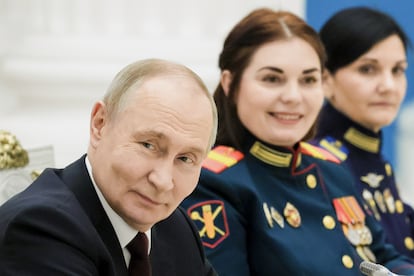

Vladimir Putin’s spokesman, Dmitry Peskov, summed up the world order in which Russia, deep down, has always believed with a single sentence last week. “We should probably secure benefits for ourselves where possible, no matter how cynical that may sound,” the high-ranking official said, in total contradiction to the Kremlin’s recently promoted narrative of a new multipolar world in opposition to the West. Venezuela, Iran, the United Arab Emirates, and Turkey, for example, are partners in BRICS (the bloc of emerging economies comprised of Brazil, Russia, India, China, South Africa, and others) and are now attacking each other or being bombed by Washington amid Russian indifference. “This is not our war,” added the Kremlin spokesman, while Moscow’s offensive against Ukraine has received a financial boost thanks to the new international energy crisis unleashed by U.S. President Donald Trump, Putin’s “frenemy.”
It’s risky to predict that Russia will emerge victorious from the U.S.-Israeli offensive against Iran. While the recent surge in oil prices has bolstered the Russian budget, beyond the Kremlin’s calculations, in the long run it could trigger a global recession or strengthen the ruble, further stifling Russian companies that have barely managed to survive until now.
Moscow has received an unexpected injection of dollars by selling off its sanctioned oil, but its international alliances, which the Kremlin had coveted for so many years, are being shaken by the Trump administration. In the Middle East, the future of the Iranian regime is uncertain; in Latin America, Cuba is in danger and the Venezuelan government has shifted toward the U.S. Orbit; and in Asia, China is watching events closely. President Xi Jinping will meet with Trump in April, and one of the points they will negotiate, according to The Wall Street Journal, is that Beijing buy less crude oil from Russia.
Furthermore, while the role of hydrocarbons in warfare is significant, it is not decisive. Russia is not “a gas station masquerading as a country,” as Republican Senator John McCain said a decade ago. Of the 40.2 trillion rubles (around $505 billion) in revenue that the Kremlin projects in its budget for this year, 8.9 trillion would come from gas and oil.
The White House tightened the screws on the Russian oil industry last fall for its refusal to make concessions in the Ukraine negotiations, and has now loosened them as it needs to contain crude oil prices due to its own aggression in the Middle East. The U.S. Treasury Department has allowed Indian refineries to buy the crude that Russia’s shadow fleet had been storing offshore because it couldn’t find buyers due to the sanctions. However, Washington is only allowing this until early April.
The Iranian conflict has caused a sudden increase in hydrocarbon prices, but nothing excessive enough for Russian coffers to be overflowing with rubles as in 2022, when Moscow invaded Ukraine and the fear of running out of gas led European countries to buy it at exorbitant prices.
Brent crude was trading around $90 a barrel on Tuesday, 25% higher than before the U.S. Intervention. “Current prices are within their historical range,” said Javier Blas, Bloomberg’s energy columnist, in an email exchange.
The expert emphasizes that the markets have absorbed this conflict much better than they did the Russian invasion of Ukraine in 2022. Back then, Brent crude reached $130 per barrel for several days, and the most important electricity contract in Germany was trading at €1,000 ($1,160) per megawatt-hour, compared to the current €85 ($98.6). “Sometimes we forget the magnitude of the crisis three years ago,” he recalls.
However, Blas believes that Russia will be one of the biggest beneficiaries of this crisis for two reasons. The first is that India and other countries “urgently need to replace the crude oil they can no longer buy in the Persian Gulf.” New Delhi, which imported 2.1 million barrels of Russian oil per day in mid-2025, was buying only 1.1 million barrels per day in January of this year due to the new U.S. Sanctions against Rosneft and Lukoil, the largest Russian oil companies. In fact, Trump managed to get India to agree to buy more U.S. Crude.
The second reason, according to Blas, is that Moscow will no longer need to offer its enormous discounts to attract customers. Days before Trump launched his campaign against Tehran, Russian oil companies were offering their biggest discount in three years to attract buyers willing to take the risk: $30 off the average market price. While Brent crude was trading at just over $70 a barrel in February, it was selling for around $40 at the ports of Novorossiysk and Primorsk, according to the energy consultancy Argus Media.
Blas, co-author of the book The World For Sale, points out that not only India, but also China and Turkey, will take advantage of this window of opportunity to buy Russian oil. “Washington and Brussels will look the other way,” the analyst opines.
The “economy of death”
The Kremlin calculated a price of $59 per barrel for Russian oil for its accounts this year and has watched with satisfaction as other countries have rushed to its floating reserves even without a discount.
The problem is that the state budget isn’t everything. Russia is mired in a visible economic crisis, and the civilian sector is in shambles. The state continues to channel almost all its resources toward the arms industry and the military, competing with companies that generate economic value and consumption, which are operating at a loss, and poaching their staff while thousands of working-age men continue to die on the front lines.
Among Russian economists, there is talk of the “Dutch Disease,” similar to what happened to the Spanish Empire with gold from the Americas. In the 1960s, the Netherlands discovered large natural gas deposits. The massive influx of foreign currency strengthened the guilder, a curse that led to the ruin of the rest of the export industries.
The war against Ukraine is consuming around 40% of the Russian budget, and Finance Minister Anton Siluanov announced further cuts just before the Iran conflict to replenish the resources of the National Investment Fund, the Kremlin’s anti-crisis parachute that also serves to control the ruble.
The crisis unleashed by Trump could also be a double-edged sword if it leads to a global recession, according to analyst Nick Trickett in an article published by the think tank Ridl. Russia is a hydrocarbon-exporting country, and the trade war could trigger an international crisis if it drags on, reducing its sales. China has cut its growth forecast below 5%, U.S. Bond markets are not showing much confidence in a recovery from this crisis, and the European optimism sparked months ago by German fiscal stimulus has crumbled.
Furthermore, since the start of the war in Ukraine, the Kremlin has been forcing its companies to convert their foreign currency earnings into rubles. Rising oil prices could further strengthen an already strong ruble, hindering industrial competitiveness and budget revenues, while simultaneously increasing the cost of all raw materials, which would exacerbate already runaway domestic inflation and potentially trigger interest rate hikes, further burdening households and businesses already enduring a significant economic crisis.
In any case, Russian economist Vladislav Inozemtsev warned last year that Putin had room to continue his war throughout 2026, even if it further impoverished the population. “Despite the lack of significant progress on the front lines, Putin wants to keep fighting. There is money for war, there always will be,” the expert sighed on the other end of the phone.
The analyst also observes another possible scenario that would harm the Kremlin. “In March and April we will see an increase in Russian budget revenues from oil and gas, but I insist, it won’t be double; it will be an increase of 25%, 30%, perhaps 40%, but that’s the maximum. And then I am convinced that the situation will normalize,” he states.
“A defeat for Iran would likely change the oil market. It won’t just mean more supply. Iran was a major risk factor for the entire region, and if it disappears, the feeling that oil needs to be expensive because something might happen there will vanish. Crude oil prices will be significantly lower by the end of the year than they are now, and the Russian problem is unlikely to have been resolved by then,” he adds.
Inozemtsev coined the term smertonomika, the “economy of death” in Russian. Following the traumatic military mobilization of 2022, Putin opted for the recruitment of volunteers with exorbitant payments. At the beginning of the invasion of Ukraine, a professional soldier cost the state around 45,000 rubles a month ($580 at the time) with a death benefit of five million rubles (just under $70,000) for the family. Last year, a volunteer signing their first contract with the army received 215,000 rubles a month (around $2,670), plus a recruitment bonus of up to 3.5 million rubles (around $46,380) and a death benefit payment to the family of between 12 and 16 million rubles ($150,750 to $203,000).
These are staggering figures for a country where the average salary is 73,400 rubles (about $930) a month. And yet, they are falling short: inflation has narrowed the wage gap with other jobs, the pool of recruits is dwindling — to older people, indebted, with criminal records and without education, that is, “not integrated into the productive economy” — and numerous regions have begun to increase payments even further as the influx of volunteers dries up.
A report by the Case Center, The Price of Life, estimates that the Russian state will have to double or triple payments to keep up with the pace of recruitment demanded by the Ministry of Defense.
In this situation, Inozemtsev points out that the only way for the Russian government to continue with its plans is through devaluation, not through the inflow of extra income from oil and gas, even if this worsens inflation and hits the population even harder.
“All the crises that Russia has experienced — in 1998, 2008, 2009, and 2015 — were always accompanied by a significant devaluation. This is the first time that the economy is doing poorly, the budget is very tight, and the ruble has strengthened by more than 30% in the last year; it’s an impossible scenario,” the economist opines.
The Russian currency is currently trading at 92 rubles per euro and 79 rubles per dollar, whereas the budgets were prepared using an exchange rate of 92.2 rubles per dollar. “Either the central bank combats inflation or they fear social unrest, but it is a factor that weakens the economy. Realistically, the exchange rate should be significantly closer to 100 rubles per dollar,” Inozemtsev warns.
The Russian statistics agency, Rosstat, reports that 2025 ended with an inflation rate of 5.9%. However, many Russian economists point to rates exceeding 12%, and a report from the Central Bank of Russia indicates that the population anticipated a 14.5% price increase last year. And 2026 has begun with a widespread tax hike, the first step in the new direction set by the Kremlin: Russians must make a much greater sacrifice for their war.
Sign up for our weekly newsletter to get more English-language news coverage from EL PAÍS USA Edition
Tu suscripción se está usando en otro dispositivo
¿Quieres añadir otro usuario a tu suscripción?
Si continúas leyendo en este dispositivo, no se podrá leer en el otro.
FlechaTu suscripción se está usando en otro dispositivo y solo puedes acceder a EL PAÍS desde un dispositivo a la vez.
Si quieres compartir tu cuenta, cambia tu suscripción a la modalidad Premium, así podrás añadir otro usuario. Cada uno accederá con su propia cuenta de email, lo que os permitirá personalizar vuestra experiencia en EL PAÍS.
¿Tienes una suscripción de empresa? Accede aquí para contratar más cuentas.
En el caso de no saber quién está usando tu cuenta, te recomendamos cambiar tu contraseña aquí.
Si decides continuar compartiendo tu cuenta, este mensaje se mostrará en tu dispositivo y en el de la otra persona que está usando tu cuenta de forma indefinida, afectando a tu experiencia de lectura. Puedes consultar aquí los términos y condiciones de la suscripción digital.