Cuba confirms talks with US amid a fuel shortage crisis
President Miguel Díaz-Canel appears live on television after releasing a video message on bilateral relations with Washington
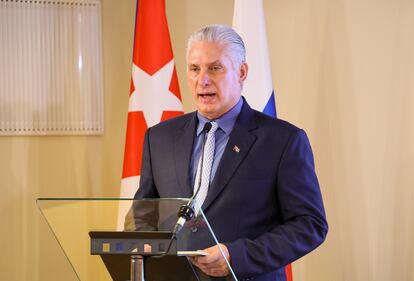

Cuban President Miguel Díaz-Canel confirmed Thursday morning that officials from his government recently began talks with representatives of the Donald Trump administration. He insisted that it has been the practice of the Cuban Revolution not to “respond to speculative campaigns on this type of issue.” Until now, despite the fact that Trump himself had indicated on several occasions that they were in talks with Havana, Cuban authorities remained silent, or at times denied that any negotiations were taking place.
Fifteen minutes before the broadcast, which had been scheduled for 7:30 a.m. This Friday, the pro-government press reported that Díaz-Canel, speaking from the headquarters of the Central Committee of the Communist Party of Cuba, said that “these talks have been aimed at seeking solutions, through dialogue, to the bilateral differences between our two nations.” “There are international factors that have facilitated these exchanges,” he stated.
“During our discussions, the Cuban side has expressed its willingness to carry out this process on the basis of equality and respect for the political systems of both states, for sovereignty, and for the self-determination of our governments,” he said.
The message was issued amid a historic economic crisis and as Havana faces mounting pressure from the United States. Hours before this appearance, the Cuban government announced the release of 51 prisoners through the mediation of the Vatican.
Without going into specifics or providing further details about the talks with Washington, the Cuban leader said that this is an issue that forms part of “a very sensitive process, which is being conducted with seriousness and responsibility, because it affects bilateral relations between the two nations and requires enormous and arduous efforts to find a solution and create opportunities for understanding that will allow us to move forward and move away from confrontation.”
During the live televised address, Díaz-Canel acknowledged that since January, Cuba has not been receiving the oil that previously came from countries such as Venezuela and Mexico, following the national emergency declared by Trump, who promised to impose tariffs on countries that sent oil to the island. “It has been more than three months since a fuel tanker entered the country. We are working under very adverse conditions, with an immeasurable impact on the lives of our entire people,” he said. He also said they were “working on several fronts” to manage the complex situation. “At no time have we relinquished our sovereign right to import oil into Cuba,” he insisted.
He also spoke about the role of Cubans living abroad, a community that has grown significantly since the last major mass exodus, in which more than two million Cubans left the island over the past three years. “It is our responsibility as a government to support them and listen to them,” and to ensure that “they have a say in our country’s social development.”
Exactly 43 days have passed since the Trump administration declared a national emergency regarding the island. Since then, life in the country—which was already precarious—has become much more unsustainable. That pressure is apparently part of the plan devised by Trump and his Secretary of State, the Cuban-American Marco Rubio, who has been leading the supposed negotiations for weeks with the heirs of the Castro family. Trump, who has been asked to take a direct stance on Cuba following the intervention in Venezuela, assured that the island would see a change before the end of the year.
Sign up for our weekly newsletter to get more English-language news coverage from EL PAÍS USA Edition
Tu suscripción se está usando en otro dispositivo
¿Quieres añadir otro usuario a tu suscripción?
Si continúas leyendo en este dispositivo, no se podrá leer en el otro.
FlechaTu suscripción se está usando en otro dispositivo y solo puedes acceder a EL PAÍS desde un dispositivo a la vez.
Si quieres compartir tu cuenta, cambia tu suscripción a la modalidad Premium, así podrás añadir otro usuario. Cada uno accederá con su propia cuenta de email, lo que os permitirá personalizar vuestra experiencia en EL PAÍS.
¿Tienes una suscripción de empresa? Accede aquí para contratar más cuentas.
En el caso de no saber quién está usando tu cuenta, te recomendamos cambiar tu contraseña aquí.
Si decides continuar compartiendo tu cuenta, este mensaje se mostrará en tu dispositivo y en el de la otra persona que está usando tu cuenta de forma indefinida, afectando a tu experiencia de lectura. Puedes consultar aquí los términos y condiciones de la suscripción digital.