An oil spill in the Gulf of Mexico is met with two weeks of evasive responses
The lack of government transparency accentuates the effects of a natural disaster that has covered over 140 miles of coastline and endangered the livelihood of coastal communities


Beaches, mangroves, fish, turtles and manatees. Little by little, oil has coated them all. About two weeks have been enough for the sticky black residue to permeate everything in its path. Its advance has been met with an outcry. Since the first fishermen in the Gulf of Mexico reported the discovery of chapapote (petroleum residue) in their nets on March 2, the progression has been documented by the affected communities of the Mexican states of Veracruz and Tabasco. But their calls for help have fallen on deaf ears, judging by the reaction of the authorities so far. The few responses to the latest environmental disaster that has already stained 142 miles (230 km) of coastline have come in dribs and drabs.
It has been 11 days since the news of the spill broke, but so far there has been no statement from the central government. In Veracruz, where most of the affected communities are located, communication has been poor. Faced with increasing accusations, Rocío Nahle, the state’s governor, initially opted for denial. Months ago, Nahle was harshly criticized when the floods in Poza Rica led to dozens of deaths and devastating images yet she claimed that the Cazones River had overflowed just “slightly.” Today, that strategy of minimizing the facts is back.
Neither the 30 towns hit by the spill in Veracruz nor the nine in Tabasco, nor the complaints, nor the videos and images of the crude oil covering entire ecosystems, have produced any efforts from the authorities to address the problem. “There is no spill from any tanker, from any oil platform,” said the governor during an event on March 10 in the municipality of Alvarado, where she also denied the presence of tar on the beaches. “We think [...] That it may be a natural seep located in the sea that is releasing hydrocarbon,” she added, without offering any details of possible plans to study the causes. It had been eight days since the oil had first been noticed.
Her initial statement had come on Sunday, March 8, almost a week after the spill, when she claimed that the problem had hit Tabasco, but had not reached Veracruz. This contradicted her statements that same day about the coordination between the state oil company Pemex and the residents of Pajapan to clean the contaminated beaches.

Then, on March 13, the official position of the Veracruz government shifted to “yes, it was a spill, from a private ship of a private oil company that does not work for Pemex.” There are 15 localities affected by the spill. The cleanup has begun in only three of the affected areas. There are 39 villages still grappling with crude oil residue.
Pemex has also been at pains to distance itself from the catastrophe. “After carrying out technical inspections to our facilities, no leak or spill has been detected. The infrastructure in the region is operating normally and in safe conditions,” said a statement released on March 2, the day the first complaints about the spill in the Gulf emerged. Ten days later, and three days after the Reef Corridor Network released a bulletin that highlighted the magnitude of the emergency, Pemex stated its “commitment” and sense of “social responsibility” in the face of an environmental disaster that, they say, cannot be attributed to them.
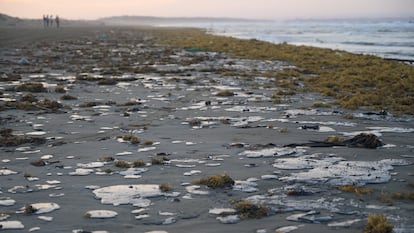
“It has been decided that responsible and supportive actions will be taken to help the environment and the coastal communities,” Pemex added, although they did not provide details of where the clean-up work was being carried out. Nor have they responded to accusations about the breach of agreements regarding the removal of tar slicks in the Laguna del Ostión (Oyster Lagoon). The residents of the surrounding communities, such as Pajapan, El Pescador and El Mangal, coordinated cleaning brigades on their own without the proper equipment and without the required training. For its part, the Secretariat of the Navy (Semar) activated the National Contingency Plan for Oil Spills on March 12.
Days have passed since the spill and the calls of the affected populations are getting louder and more desperate. In the absence of a formal study to reveal the origin and causes, the communities are still waiting for action by the authorities that will also help local economies that have been seriously damaged by the calamity. They are aware that what they are asking for is not a privilege but a legitimate demand for help. Their calls for a healthy environment and a fair and dignified life brings to mind other similar episodes in the area; they insist that a strategy be implemented to prevent accidents like this occurring again.
Sign up for our weekly newsletter to get more English-language news coverage from EL PAÍS USA Edition
Tu suscripción se está usando en otro dispositivo
¿Quieres añadir otro usuario a tu suscripción?
Si continúas leyendo en este dispositivo, no se podrá leer en el otro.
FlechaTu suscripción se está usando en otro dispositivo y solo puedes acceder a EL PAÍS desde un dispositivo a la vez.
Si quieres compartir tu cuenta, cambia tu suscripción a la modalidad Premium, así podrás añadir otro usuario. Cada uno accederá con su propia cuenta de email, lo que os permitirá personalizar vuestra experiencia en EL PAÍS.
¿Tienes una suscripción de empresa? Accede aquí para contratar más cuentas.
En el caso de no saber quién está usando tu cuenta, te recomendamos cambiar tu contraseña aquí.
Si decides continuar compartiendo tu cuenta, este mensaje se mostrará en tu dispositivo y en el de la otra persona que está usando tu cuenta de forma indefinida, afectando a tu experiencia de lectura. Puedes consultar aquí los términos y condiciones de la suscripción digital.