Christophe Galfard, physicist: ‘I think there is more life in space than we think’
The science communicator, a disciple of Stephen Hawking, believes it will be decades before we colonize Mars. But he says we could soon find extraterrestrial life
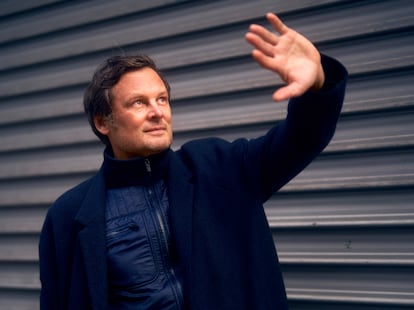

Christophe Galfard (Paris, 1976) is a prominent science communicator. After researching black holes and the origin of the universe alongside Stephen Hawking, he is now dedicated to sharing his knowledge of the cosmos. He is the author of six books, gives lectures, and hosts a program on the French radio station Radio Inter. The author of the bestselling The Universe in Your Hand: A Journey Through Space, Time and Beyond is a scientist who demands precision in both his answers and his questions. He was ultimately unable to meet with EL PAÍS in person, and the interview was conducted via video call. Accustomed to working with objects millions of light-years away, the one kilometer separating the journalist’s life in Paris from that of the most brilliant disciple of the world’s most famous scientist, as the book’s blurb proclaims, was far too small. Everything is relative. And that is something that Galfard will also talk about next week during his visit to Spain: he is one of the participants in the Valladolid Culture Forum, and will be present at the Telefónica Foundation Space in Madrid.
Question. Thinking about the immensity of the universe makes us feel very alone. How can we overcome that feeling?
Answer. However gigantic it may be, it is human discoveries that make us think about its scale. It fits in our minds. Our imagination can encompass it completely. And our heads aren’t very big, so that’s comforting.
Q. Who or what created the universe?
A. That’s a religious question I can’t answer. The scientific question would be: does the universe we see around us have a history? And the answer is yes, we discovered it 100 years ago. And if there’s a history, there’s a beginning. Twentieth-century science showed us that there are structures that explain the universe. But these structures have limits. What existed before what we call the Big Bang is inaccessible. That doesn’t mean it doesn’t exist; we just haven’t found the instruments to get there.
Q. Stephen Hawking, your mentor, said that the Earth had a limited lifespan. What about the universe?
A. We know that our planet is not eternal. That is certain. We do not know, however, about the universe. We do not know its future, we do not know if other universes can be born within this one.
Q. What does the word God tell you?
A. My religious beliefs are personal. My religious opinion is not public. Everyone has the right to think what they want.
Q. And the concept of truth, does it mean anything to you?
A. When a theory is linked to experience, we touch upon something called scientific truth. But in science, a truth is never exact. There is always a point of imprecision in all experiences. And in those imprecisions, or uncertainties, another truth may be hidden. But some experiences cannot be questioned. The fact that the Earth is round or that the Sun is a star… these are truths of our time. The notion of truth means something in science, but it is not absolute.
Q. What impact does the lack of scientific knowledge have on democratic life?
A. Scientific knowledge allows us to avoid being deceived. It is essential for democracies to transmit it. That is what I do in my work. Not only to inspire vocations, but also for the general public. There are those who try to manipulate opinions through false knowledge. This knowledge helps to restore a certain degree of trust and happiness in understanding the world. It is extremely important for democracy.
Q. Well, people have accepted believing in what they cannot prove.
A. There are far fewer people on that spectrum than we think. But we give them a voice or talk about them, as you are doing right now. Most people are much more intelligent and critical thinkers. But some try to profit from those cheap theories and fake news.
Q. You wouldn’t know it, looking at election results and how those who propagate these theories are prevailing.
A. It’s not the scientific side that’s involved in the elections. Fake news isn’t scientific. I’m talking about what is scientific. Today, the amount of knowledge is so vast that we have to trust certain people, and some place that trust in people who say anything. The only way to combat this is to offer an honest perspective, one that includes questioning.
Q. Space has also become a new battleground between the great powers. What’s happening out there?
A. There are colossal challenges in space linked to Earth. And there will be inevitable conflicts, unfortunately that’s the way it is. But I prefer wars between satellites than between humans [laughs]. May I say something?
Q. Of course.
A. Most of your questions fuel fear, catastrophe… You forget the great discoveries made possible by technology.
Q. You say that science serves to combat cheap theories, and that’s what I was trying to do, now that I have you on screen. But give us some good news, by all means.
A. The potential discovery of extraterrestrial life. We’re starting to have the technology to detect it, and if there’s anything there, we’ll get there soon. And then there’s that 95% of the universe that’s still unknown. We don’t know what dark matter is. We’re starting to have satellites that allow us to see the universe like never before. Just discovering that these mysteries exist is incredible.
Q. We’ve been talking lately about the colonization of Mars due to Elon Musk. Is it possible?
A. It’s technologically impossible. Sending a few scientists might be possible, but it would be incredibly expensive and complicated. But sending hundreds of people? No. We don’t know how to do it. And the conditions are terrible. In 100 or 1,000 years, I don’t know. But in the next few decades, no. We can go to the Moon. Getting to Mars is a nine-month journey, plus finding the resources there, returning…
Q. And why do you think it’s being promoted?
A. Musk earns billions and won’t stop. He’s backed by NASA to take over ground stations with those satellites. And he’s achieved some technologically impressive things. But the dream of colonizing Mars is impossible in the coming decades.
Q. So, what will be the big revolution of the next 10 or 15 years?
A. AI and its advancement in medicine. In space, I’d like us to start detecting interesting things related to life. I believe there is more life in space than we think; it’s a personal belief.
Q. If you’ll allow me another frivolous question, what is your favorite planet?
A. I’ll take Earth; the rest is absurdly hostile. When you’re on Earth, you can gaze at the stars. But if you’re in space or farther away, you only see Earth and long to come back.
Sign up for our weekly newsletter to get more English-language news coverage from EL PAÍS USA Edition
Tu suscripción se está usando en otro dispositivo
¿Quieres añadir otro usuario a tu suscripción?
Si continúas leyendo en este dispositivo, no se podrá leer en el otro.
FlechaTu suscripción se está usando en otro dispositivo y solo puedes acceder a EL PAÍS desde un dispositivo a la vez.
Si quieres compartir tu cuenta, cambia tu suscripción a la modalidad Premium, así podrás añadir otro usuario. Cada uno accederá con su propia cuenta de email, lo que os permitirá personalizar vuestra experiencia en EL PAÍS.
¿Tienes una suscripción de empresa? Accede aquí para contratar más cuentas.
En el caso de no saber quién está usando tu cuenta, te recomendamos cambiar tu contraseña aquí.
Si decides continuar compartiendo tu cuenta, este mensaje se mostrará en tu dispositivo y en el de la otra persona que está usando tu cuenta de forma indefinida, afectando a tu experiencia de lectura. Puedes consultar aquí los términos y condiciones de la suscripción digital.