A ‘wonderful’ new dinosaur species with a colorful crest is unearthed in the Sahara Desert
An international team of scientists led by the American paleontologist Paul Sereno spent three months in an extreme and hostile landscape before finding ‘Spinosaurus mirabilis’ skull material for the first time in over a century
“I can’t believe it,” exclaims the renowned American paleontologist Paul Sereno when his top aide Daniel Vidal shows him the biggest discovery of the expedition. “It’s the first time we’ve found Spinosaurus skull material in over a century. It’s the most fragile and impossible thing to find. It’s the jackpot.”
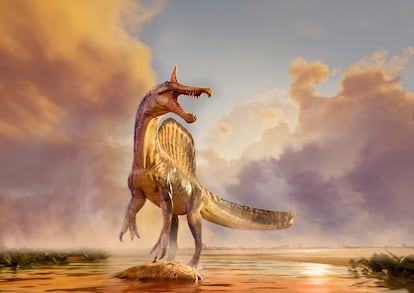
The scene appears in a video released to the press as part of a dossier announcing the discovery of a new species: Spinosaurus mirabilis. It is the second Spinosaurus species, following the 1915 discovery in Egypt of the holotype that defined the group. This new “wonderful spine lizard” — which is what its name means in Latin — was discovered in 2022 in the Sahara Desert in modern-day Niger, and its discovery was published this Thursday in the journal Science, in an article co-authored by 29 scientists from five countries.
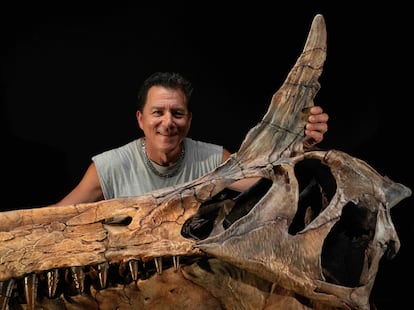
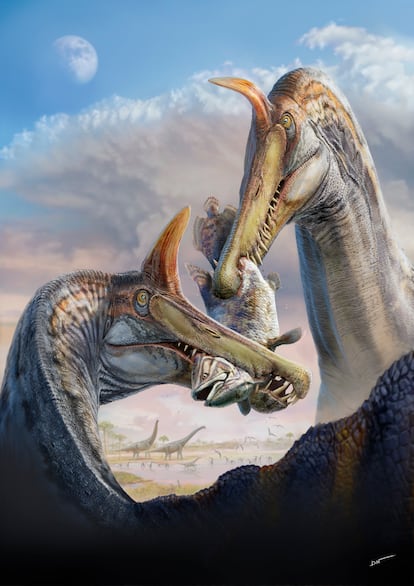
This extinct carnivore inhabited North Africa about 95 million years ago, measured approximately 42 feet (13 meters) in length, and weighed between six and seven tons. It had interlocking teeth that functioned as a perfect fish trap and a large, scimitar-shaped crest on its skull — resembling a traditional Persian sword — which researchers believe would have been brightly colored. This feature, along with the typical dorsal sail that distinguishes the entire group, confirms that it was a visual display ornament, not a functional structure for hunting.
The research compared the animal’s skull morphology, neck proportions, and hind limbs with 43 extant and extinct predators. The authors conclude that spinosaurids — including the new species — were piscivores that fished by wading in shallow water, like modern herons, and not diving aquatic predators like crocodiles. Furthermore, their distance from the coast refutes the theory that these theropods could have been entirely aquatic.
A long-awaited and extreme expedition
The team of scientists, led by the American paleontologist Paul Sereno, spent three months in an extreme and hostile landscape with main funding from an anonymous donor and small private contributions.
Almost no one wanted to invest in Sereno’s risky paleontological endeavor—the most ambitious of his career, according to him. Searching for dinosaur fossils in one of the most inhospitable places on Earth, with temperatures reaching 122ºF (50ºC) under the desert sun in August, was a risky investment for some scientific institutions. However, the legendary 68-year-old paleontologist was determined. In 2019, he had collected several fossils and the remains of a spinosaurus jawbone from the site. This University of Chicago scientist needed to delve deeper into those discoveries, so he spent the two years of Covid pandemic and lockdown planning his return and seeking funding. He secured it in 2022.
The nearest town, Agadez, is 186 miles (300 km) away, about six hours across the roadless sand if all goes well. Access to drinking water is limited by the capacity of the available water truck. Dangers include snake and scorpion bites, sandstorms, food poisoning, malaria, breakdowns of all kinds, theft, and even coups (like the one that disrupted the fossil transport in 2023). To deter treasure hunters, local authorities provided the team with an armed guard of 64 men who escorted them throughout the excavation. As his right-hand man for this adventure, Sereno selected the Spaniard Daniel Vidal.
In 2019, nearly 100 people, including scientists, technicians, guards, and filmmakers, set up camp in the desert to explore two areas over three months. Unexpectedly, two weeks before the end of the expedition, a Tuareg man approached them on a motorcycle and revealed the existence of an area that did not appear on any maps and that no scientist had ever visited before. Following this lead, they reached the third site (Jenguebi) in 2022.
Several Spaniards besides Daniel Vidal participated in the search. For the young paleontologist Ana Lázaro, this expedition came at the perfect time. “I was able to accept it without hesitation because it was August, I was on vacation, and I had just finished my master’s degree. I had my whole life ahead of me, and it was a unique opportunity. I didn’t think about it much. Afterwards I did think about the dangers, about how crazy it really is. Maybe a sane person wouldn’t have done it, but I did.”
Álvaro Simarro recalls that at just two years old he had already decided to dedicate his life to dinosaurs, and that the Spinosaurus was his favorite. He grew up watching Sereno’s documentaries. “I remember when I received the email from Paul inviting me to the expedition. It was one of the happiest moments of my life.”
María Ciudad Real was in charge of studying the peculiar crest in detail using computed tomography scans and then creating three-dimensional images. “Although I wasn’t exactly there when they found the Spinosaurus, I experienced that discovery and so many others that followed with great excitement,” she recalls.
Noelia Sánchez Fontela was recruited for her knowledge of geology and her experience as an excavator. “I joined without any university backing me. It was entirely voluntary and independent.” Her contribution was crucial in reconstructing the extinct ecosystem of all the animals that were found. In the case of the spinosaurus, it was discovered that, although it lived far from the coast, it was surrounded by large, winding rivers, without a direct connection to the ocean, where freshwater fish were abundant. The discovery of large herbivores also indicates an environment with abundant vegetation, enough to feed them all.
Paul Sereno is now working to open two museums in Niger to exhibit the fossils after they are studied in Chicago and repatriated to the African country. The plan includes the creation of an institute to train Nigerian museum professionals, archaeologists, and paleontologists under the supervision of his foundation, Niger Heritage.
The Spinosaurus mirabilis will be one of the most prominent dinosaurs in a series that will include other large carnivores such as the Carcharodontosaurus, a dozen new sauropods, a small burrowing carnivore, an unarmored crocodile, a giant fish, and other new species.
Sign up for our weekly newsletter to get more English-language news coverage from EL PAÍS USA Edition
Tu suscripción se está usando en otro dispositivo
¿Quieres añadir otro usuario a tu suscripción?
Si continúas leyendo en este dispositivo, no se podrá leer en el otro.
FlechaTu suscripción se está usando en otro dispositivo y solo puedes acceder a EL PAÍS desde un dispositivo a la vez.
Si quieres compartir tu cuenta, cambia tu suscripción a la modalidad Premium, así podrás añadir otro usuario. Cada uno accederá con su propia cuenta de email, lo que os permitirá personalizar vuestra experiencia en EL PAÍS.
¿Tienes una suscripción de empresa? Accede aquí para contratar más cuentas.
En el caso de no saber quién está usando tu cuenta, te recomendamos cambiar tu contraseña aquí.
Si decides continuar compartiendo tu cuenta, este mensaje se mostrará en tu dispositivo y en el de la otra persona que está usando tu cuenta de forma indefinida, afectando a tu experiencia de lectura. Puedes consultar aquí los términos y condiciones de la suscripción digital.