‘Therians’, the baseless viral phenomenon used by extremists to fuel their ‘anti-woke’ rhetoric
This supposed subculture unleashes hatred on social media through hoaxes and exaggerations that target trans people and feed the far-right narrative about a decadent society
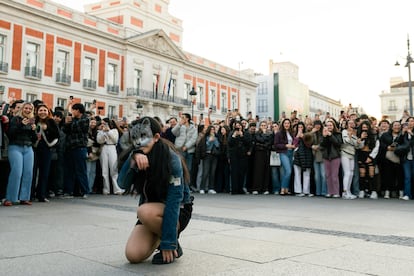
In Spain, talk about “therians” has been going on for over a week. But where are these famous therians? Websites and television shows, enthralled by the issue, have circulated dozens of images on TikTok and Instagram of alleged members of this marginal subculture who supposedly identify with some animal species. But in the Spanish squares where they were meant to appear this past weekend, drawn by vaguely defined calls amplified by the media, they’ve barely shown up. What did make an appearance are elements that were already central to the same phenomenon in the Americas: moral panic—the exaggerated reaction to the behavior of a particular group, presented as a threat—, hoaxes, and far-right manipulation to fuel the narrative of a supposed moral decline of society, with diversity as the target.
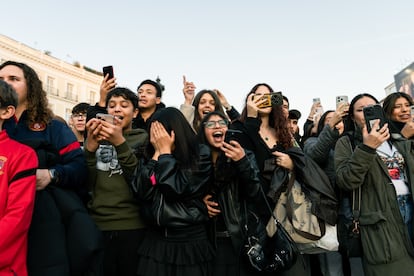
Amid the excitement that gripped Madrid’s Puerta del Sol on Saturday, a cry went up: “Where are the therians, man? I really want to kick their asses!” But among the hundreds gathered to witness the phenomenon that has taken social media by storm over the past week, the therians were conspicuously absent. It was a similar scene to those that unfolded across the country: squares and parks packed with onlookers, and a few far-right agitators, waiting for the promised human/animal hybrids.
In cities like Ávila, Salamanca and Segovia, the local media reported on the failure of the therians to show up. Those who did make an appearance were activists for the far-right party Vox with their green tents. The chants and shouts against the Socialist prime minister surprised many, who wondered aloud, “What does Pedro Sánchez have to do with all this?”
“The therian phenomenon is a perfect example of how algorithms and social media, with a mixture of political interest and morbid curiosity, can fabricate a news story out of thin air,” says Adrián Juste, an analyst at the Al Descubierto think tank, who has seen how, before arriving in Spain, this “cultural bubble” has already inflated in several countries in the Americas despite being a relatively insignificant subculture, concentrated among adolescents and consisting simply of dressing up as “non-humans” for “leisure” or just to “act silly.”
In the “therian” community, person-animal identification is often presented as a playful device, nothing more, Juste explains. These aren’t people with an “identity crisis,” he points out. However, the unusual nature of the phenomenon has caused it to go viral despite its “triviality.” That’s what we’re seeing in Spain, Juste explains, noting how some groups are capitalizing on the attention it generates to present it as the latest expression of supposed excesses in the acceptance of diversity. “Tolerance for difference is at an all-time low, and there’s clearly a discourse fueling this,” he notes.
The virality of the therians thus becomes, in the hands of the far right and fueled by algorithms that reward scandal, “an attack against trans people, against LGBTQ+ people, reinforcing the narrative about the decadence of modern society, according to which going against human nature or the designs of God ultimately leads us to decadence,” he explains. “The therians are held up to say, ‘Look what’s becoming fashionable! It’s ridiculous! We’re going to hell!’ This is how society’s anger and frustration are redirected toward something that doesn’t even exist. Out of every 100 comments on this topic, 95 are hateful, along the lines of ‘bring back conscription’ or ‘they need to be beaten up.’ And all of it is divorced from reality. It’s a cultural bubble.”
Marcelino Madrigal, a network and cybersecurity expert, explains that the surge in social media conversations about therians is due to the influence of extremist groups: “They find it very easy to attack children’s identity, gender, and choices, motivated by what they call ‘woke’ policies.” Madrigal sees this as a direct assault on the recognition of gender diversity and transgender people, those with a gender identity different from the sex they were assigned at birth: “They want to differentiate themselves as those who ‘defend normal children,’ going so far as to exaggerate and say that people are turning into dogs and cats.”
Latin America
This modus operandi is not new. Madrigal recalls that during 2021 and 2022, certain sectors of the Republican Party in the United States used furries (a subculture of people who dress as animals with human characteristics) to spread misinformation in schools. A false rumor circulated on message boards like Reddit claiming that some schools were providing litter boxes in the bathrooms for students who “identify as cats” or who participate in the furry, otherkin, or therian subcultures. All of this was intended to emphasize that, after trans people, animal-people are next.
It’s easy to trace the hysteria surrounding the therian boom in Latin America. During the first week of February, the trend exploded on social media in Argentina. The first meeting was scheduled for February 10 in downtown Buenos Aires. In the following days, it dominated the online conversation due to events such as the alleged bite of a 14-year-old girl by a therian in the province of Córdoba. By the end of the week, the topic had umped onto the far-right agenda. Media outlets like La Derecha Diario described the phenomenon as the expression of a mental illness.
The journalist Fabiola Solano points out that Argentina has functioned as a laboratory for constructing “a functional enemy”: “The framing is systematic: pathologization, ridicule, and direct association with progressivism, the ‘woke’ agenda, and gender identities. The subculture is presented as a mental disorder, an identity delusion, or the result of supposed cultural engineering that is blurring human identity.” One only needs to look at the far-right groups on Telegram where users speak of “retards in costume” and “animals that must be treated as such, sleeping in the garden all year round.”
Far-right figures like Agustín Laje in Argentina and Eduardo Verástegui in Mexico, both with a long history of attacking trans people, whom they portray as symptoms of the moral degeneration of the West, have now joined the wave of denigration of the therians. For them, these individuals serve as proof of the delusion of the left’s obsession with so-called “identity politics.” Laje, one of Javier Milei’s key agitators, has referred to the phenomenon as “degeneration of the trans animals” and “germination of masses without identity.” Verástegui has stated that “they should be in a psychiatric hospital” and has presented them as proof that his claims of social degeneration were on the right track. “They said this would never happen and called us alarmists. Families, this is beyond worrying. We have to do something URGENTLY,” Verástegui has written these past few days.
In Spain, a hoax has been circulating since the weekend claiming that Pedro Sánchez’s government is considering approving a monthly subsidy of €426 for citizens who identify as animals. The way the fake news presents this “payment,” supposedly due to a “discrepancy in gender self-perception” among therians, directly alludes to transgender people. Fake videos generated with artificial intelligence are also circulating on mobile phones, showing dogs attacking humans wearing dog masks and walking on all fours.
Meanwhile, far-right influencers in Spain have joined the anti-therian offensive. One example is Sr. Liberal, whose rhetoric is aligned with Vox and who has provided his more than 160,000 followers on X with messages like this one, commenting on the rally in Barcelona: “Young people without homes or a future prefer to identify with dogs to escape [...]. And the system wants us to applaud them. We’re going to hell as a society.”
Virality without basis
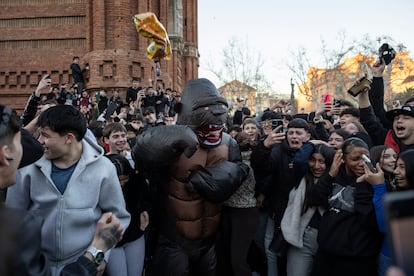
In Barcelona, the gathering ended with four arrests for disorderly conduct, but with a very small turnout of therians. This is a recurring theme. There’s been a lot of noise, but little substance. Last weekend, at least a dozen “therian meetups” were organized across Spain. These gatherings were promoted on social media with AI-generated images, often without a clear organizer. Only curious onlookers showed up at most of them. In Madrid and Zaragoza, a few minors dressed as cats, lynxes, and foxes showed up. Some of those who came expecting many others in costume ended up being ridiculed and harassed.

Gabriela, a 15-year-old girl behind a fox mask in Madrid, said she went to Puerta del Sol looking for others like herself. The teenager said she felt overwhelmed and disappointed at what was supposed to be “her first meet-up with people like her,” after being yelled at to jump against her will, surrounded by people filming her with their phones. There were only influencers looking to make their content go viral and hundreds of kids gathered to watch the phenomenon and make fun of it.
The green tents were nowhere to be seen in Puerta del Sol, but the hateful comments were certainly audible. For Madrigal, this is exactly what the far right needs: “When Vox sets up a tent, it’s not for the kids, it’s for their parents.” Amid the murmurs and astonished faces of those in attendance on Saturday, José Carvajal, father of two girls aged 12 and 17, asserted that the therians are “a load of rubbish.” His daughters had asked him to come to Sol to see “if anything was happening,” and they stayed because of the presence of the YouTuber Mihail Amoli, with nearly a million followers, who did indeed draw a crowd.
What are ‘therians’?
Therians are people who identify, on a psychological, playful, or spiritual level, with a non-human animal. It is a social and cultural phenomenon that does not imply a physical transformation or the belief of possessing a different body, but rather an internal experience of identity. The term comes from the English therianthropy , which in turn derives from the Ancient Greek therion —meaning beast or wild animal—and Anthropos—human—. Thus, the term refers to the spiritual capacity to transform into an animal, but this transformation would not occur physically, but only in the sense of experiencing an inner connection with a particular animal.
Sign up for our weekly newsletter to get more English-language news coverage from EL PAÍS USA Edition
Tu suscripción se está usando en otro dispositivo
¿Quieres añadir otro usuario a tu suscripción?
Si continúas leyendo en este dispositivo, no se podrá leer en el otro.
FlechaTu suscripción se está usando en otro dispositivo y solo puedes acceder a EL PAÍS desde un dispositivo a la vez.
Si quieres compartir tu cuenta, cambia tu suscripción a la modalidad Premium, así podrás añadir otro usuario. Cada uno accederá con su propia cuenta de email, lo que os permitirá personalizar vuestra experiencia en EL PAÍS.
¿Tienes una suscripción de empresa? Accede aquí para contratar más cuentas.
En el caso de no saber quién está usando tu cuenta, te recomendamos cambiar tu contraseña aquí.
Si decides continuar compartiendo tu cuenta, este mensaje se mostrará en tu dispositivo y en el de la otra persona que está usando tu cuenta de forma indefinida, afectando a tu experiencia de lectura. Puedes consultar aquí los términos y condiciones de la suscripción digital.