Power vacuum in Yemen threatens biodiversity of the one-of-a-kind Socotra archipelago
The small paradise in the Indian Ocean, known for being home to numerous endemic species, has suffered significant environmental damage since civil war broke out in 2014
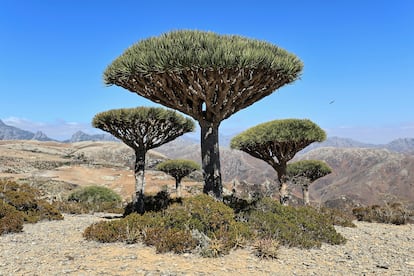
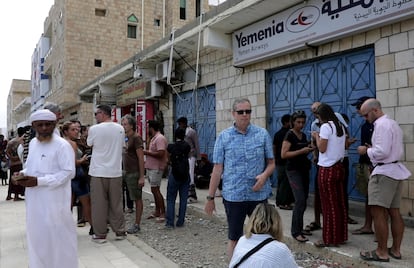
Up until very recently, Socotra had not received much international news coverage. Mention of the paradisaical Yemeni archipelago in the Indian Ocean, located near the Gulf of Aden, was typically limited to travel magazines and tourism guides. But at the end of December, some 600 visitors became stranded there, due to tensions between Saudi Arabia and the United Arab Emirates, allies that now have conflicting interests in the southern region of Yemen, which has been devastated over the last 10 years by civil war. Discussion of how the foreigners were to be evacuated drew attention to another issue in Socotra that had previously been eclipsed: how its unique and abundant biodiversity, which led it to be recognized as a UNESCO World Heritage Site in 2008, has suffered aggressions whose effects may be irreversible.
Socotra lies some 155 miles from the coast of Somalia, and more than 186 miles from Yemen. Its position is strategic to global maritime trade, due to its location between the Persian Gulf, the Red Sea and the Indian Ocean. Since 2020, Socotra has found itself under the de facto control of a separatist group, the Southern Transitional Council, funded by the Emirates, which has also contributed financially to the reconstruction of its airport and other infrastructure. These investments, many of them running contrary to UNESCO recommendations, have led indirectly to the arrival of tourist masses and, by extension, earnings.
This support for the secessionists has left the alliance between the Saudis, who back the internationally recognized government, and the Emiratis to crumble. On December 30, Riyadh attacked a port in the south of the country, where there was reportedly a shipment of weapons that the Emirates was sending to the separatists. After the incident, the Emirates decided to withdraw its troops from the country and wound up imposing an air blockade, which meant that tourists could not leave the archipelago. The visitors were finally evacuated to Jeddah, Saudi Arabia last Saturday, according to Reuters.
UNESCO estimates that Socotra, whose archipelago is composed of four islands and two islets, is home to hundreds of endemic species. 37% of its 825 kinds of plants, 90% of its reptiles and 95% of its land snails are not found in any other part of the world. All are now in danger, say environmental experts and local leaders.
“Socotra has suffered a lot of damage, particularly due to urbanism and the development of protected areas and nature reserves. Unlicensed investment violates regulations for places on the World Heritage list,” Mohammed Jumaih, Yemeni ambassador to UNESCO, tells EL PAÍS.
Business or solidarity?
Deterioration accelerated after the outbreak of civil war in Yemen at the end of 2014, when Houthi rebels deposed the leadership in Sana’a, the country’s capital, and Saudi Arabia, with support from the United Arab Emirates, staged a military invention in support of the internationally recognized government. Today, the country is war-torn and impoverished. The Houthis continue to control Sana’a and other areas in the northeastern region of the country. At the same time, in the south, the secessionist movement supported by the Emirates has gained strength. This vacuum of power and resulting confusion has led to abuse in Socotra, where according to activists, Emirati entities began to purchase vast protected areas, including the Diksam Reserve and Delisha Park, claiming that they would be used for non-profit projects through the Khalifa Foundation, an Emirati charity group that focuses on health, education and development.
According to Abdul Latif Amer, a Yemeni specialist in biodiversity and ecotourism, the actions of the Emirates are a violation of the World Heritage Convention treaty, which established that signatory nations must not “take any deliberate measures which might damage directly or indirectly the cultural and natural heritage.” The Emirates ratified the treaty in 2001.
But in addition, the acquisitions also violate Yemeni law concerning foreign ownership of assets and its presidential decree on environmental protection and development zones. “The purchase of these large areas hurts the species that live in these places, which suffer from uncontrolled development. 90% of the area of Socotra is made up of reserves and national parks,” says Amer.
The International Union for Conservation of Nature has repeatedly warned about the loss of biodiversity in conflict areas, particularly isolated, insular ecosystems that are especially vulnerable to exploitation during periods of weak governance.
Local leaders pay a price for speaking out
Inhabitants of Socotra are trying to resist these aggressions. “Social leaders who speak out have faced prison sentences and continuous threats from local authorities,” says Ali Amer al Qahtani, who is the head of a committee that is organizing a meeting on the future of Socotra in which local leaders will sit down to debate what comes next for the archipelago.
Al Qahtani explains that despite informing Yemeni authorities of the threats to the island’s biodiversity, “there has been no movement nor clear position on behalf of the internationally recognized government, which is a reflection of its impotency and lack of authority on the island,” he concludes.
In a Facebook post, Jumaih wrote that these alleged violations “must be addressed and those responsible must be held accountable.”
UNESCO has sent an international monitoring delegation to the island following such denouncements, and it will submit its report to the World Heritage Committee for review at its session later this year.
“UNESCO, and not the Yemeni government, will determine the nature of these violations, to avoid suspicions that the report may be politicized,” says Jumaih.
The leader trusts that Socotra will not be included on UNESCO’s List of World Heritage in Danger because, though the designation could unblock technical support and additional funds, it might also damage Socotra’s image as a tourist destination and complicate its recovery.
Ahmed al Rumaili, a Socotra environmental activist, describes the Emirates’s activities as “a real threat to Socotra’s unique environmental diversity.” One example is overfishing, the product of which is sold, according to several local sources, to a factory owned by the Emirates that is situated on the island, and then transported by plane or ship. A 2022 UNESCO report by Belgian researcher Kay Van Damme also documented the “devastating consequences” of local trawling for marine wildlife and coral reefs.
Another example of environmental aggression is the theft and sale of coral, which is vital to the seas’ stability, and the introduction of at least 126 invasive species, primarily plants imported for local agriculture or ornamental use, in addition to insects, which have also altered the ecosystem. One devastating case, according to activists, is that of the red palm weevil, an invasive beetle that came to the island via palm plants imported by the Khalifa Foundation.
There is also a lucrative market for sales of the archipelago’s endemic species. According to UNESCO, in 2021 it was discovered that the area’s butterflies were being sold online for more than $1,200 a piece.
Sign up for our weekly newsletter to get more English-language news coverage from EL PAÍS USA Edition
Tu suscripción se está usando en otro dispositivo
¿Quieres añadir otro usuario a tu suscripción?
Si continúas leyendo en este dispositivo, no se podrá leer en el otro.
FlechaTu suscripción se está usando en otro dispositivo y solo puedes acceder a EL PAÍS desde un dispositivo a la vez.
Si quieres compartir tu cuenta, cambia tu suscripción a la modalidad Premium, así podrás añadir otro usuario. Cada uno accederá con su propia cuenta de email, lo que os permitirá personalizar vuestra experiencia en EL PAÍS.
¿Tienes una suscripción de empresa? Accede aquí para contratar más cuentas.
En el caso de no saber quién está usando tu cuenta, te recomendamos cambiar tu contraseña aquí.
Si decides continuar compartiendo tu cuenta, este mensaje se mostrará en tu dispositivo y en el de la otra persona que está usando tu cuenta de forma indefinida, afectando a tu experiencia de lectura. Puedes consultar aquí los términos y condiciones de la suscripción digital.