Western Sahara conflict underpins Morocco and Algeria’s ‘selective silence’ on attack against Iran
Rabat and Algiers have avoided condemning the US and Israeli strikes, amid ongoing talks over the African territory in a dispute that’s about to turn 50 years old

Morocco and Algeria are observing the U.S. And Israeli attacks against Iran through the lens of the Western Sahara conflict. Washington’s latest attempt to resolve the long-running dispute over the former Spanish colony, through a round of direct dialogue launched last month in Madrid, is conditioning Rabat and Algiers’ response to the escalating conflict engulfing the Middle East.
Both North African countries have avoided condemning the bombings on Iranian soil amid ongoing diplomatic talks, which are scheduled to resume in Washington in May in a regional dispute that is about to turn 50 years old. Last year, the U.S. Announced major investments by its companies in the Morocco-controlled Western Sahara, considered by the United Nations a non-self-governing territory.
Morocco—which severed relations with Iran in 2018 after accusing it of rearming the Polisario Front national liberation movement in Western Sahara—has once again ignored the attacks on a fellow Muslim state. Meanwhile, Algeria has reversed course on its earlier rejection of the U.S.-Israeli offensive against the Islamic Republic conducted in June.
Instead Morocco, through its Foreign Minister Nasser Bourita, has condemned Iran’s “atrocious” attacks against its Arab neighbors at the Arab League. However, this expression of solidarity with “brotherly Arab countries” failed to mention Lebanon, which is suffering a large-scale Israeli offensive, and also made no reference to the attacks against Iran, a Shia Muslim state. Rabat also holds Tehran responsible for “creating terrorist entities and groups.” The severing of diplomatic relations occurred eight years ago after the same minister accused the Ayatollah regime of sending anti-aircraft missiles to the Polisario Front, a group with which Morocco is waging a low-intensity war in the Sahara after the ceasefire between the two sides collapsed in 2020. Bourita also denounced the presence of military experts from Hezbollah, a pro-Iranian Lebanese Shia militia, in the camps of Tindouf, in southwest Algeria, which are home to Sahrawi refugees.
This “selective silence” about the attacks on Iran, as dubbed by the media, is viewed from different perspectives in the Arab countries of Northwest Africa. Besides fearing that the conflict in the Middle East will overshadow the search for a political solution for Western Sahara, the government in Rabat is examining the potential economic consequences for its own economic growth.
Morocco may be particularly affected by rising energy costs and spiraling inflation. Algeria, as a hydrocarbon-producing country, views the rising oil and gas prices as a blessing. With a projected 22 million visitors in 2026, Moroccan tour operators also fear a potential exodus of Western tourists, as holiday bookings are lagging due to ongoing conflict in the Middle East, where cancellations are already cascading.
Convened by the United States in Madrid and Washington following UN Security Council Resolution 2797, adopted on October 31, the Algerian government has agreed to dialogue—along with Morocco, the Polisario Front, and Mauritania—on the basis of “genuine autonomy” as the “most feasible” objective for a political solution to the Western Sahara conflict. While favoring Sahrawi independence through self-determination, Algiers now seeks to maintain its relationship with Washington to counterbalance the close alliance the U.S. And Morocco have established in the Maghreb region.
Escalation of rearmament
Over the past five years, Morocco has become the leading arms importer on the African continent, surpassing Algeria. The 2025 Global Arms Transfer Trends Report published by the Stockholm International Peace Research Institute (SIPRI) shows a 12% increase in arms imports by Morocco between 2021 and 2025, compared to the previous five-year period. Algeria experienced a 78% decrease during the same period, although SIPRI cautions that the secrecy surrounding its arms procurement operations may skew the figures. Its main suppliers are Russia (39%) and China (27%).
The United States is Morocco’s largest military supplier, accounting for 60% of imports, followed by Israel at 24%. U.S. Defense authorization legislation explicitly conditions arms sales to Morocco on the maintenance of normalized relations with Israel. Rabat agreed to reopen its diplomatic mission in Tel Aviv in 2020, as part of the Abraham Accords signed during Donald Trump’s first term. In return, the Republican president recognized Moroccan sovereignty over Western Sahara.
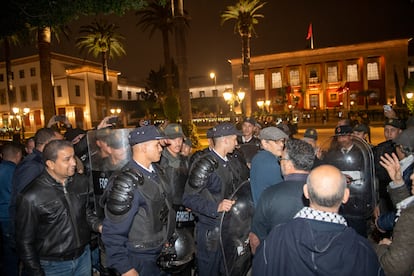
A widening chasm has opened between the Moroccan state apparatus—which seeks to preserve the assets of its relationship with Israel—and civil society, which has overwhelmingly expressed outrage at the images of Palestinian suffering in Gaza, revealing a latent crisis in the North African country. Following the Israeli and U.S. Attacks on Iran, groups of demonstrators have attempted to protest in the streets of Moroccan cities against the aggression on an Islamic country with which they feel connected through the umma, the community of Muslim believers cited in the Quran as an identity that transcends borders.
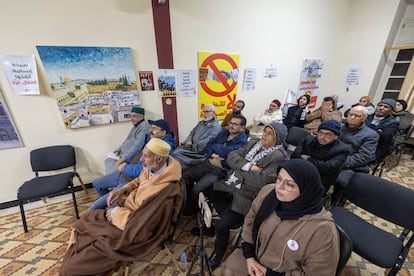
The protest marches were contained by a large deployment of security forces outside the parliament building in Rabat and in Tangier’s Iberia Square. The Justice and Development Party, an Islamist movement that led the government from 2011 to 2021, and the far left Federation of the Democratic Left have openly condemned the attacks, which they say violate international law.
A statement signed by several Moroccan ulama (Muslim legal scholars) along with other Islamic clerics from the region, cited by the online site Yabiladi, maintains that, despite the ideological clash between the Shiite Iranian regime and Sunni Muslim countries such as Morocco, “attacking Iran in an alliance of crusaders and Zionists constitutes an external aggression against a Muslim country, regardless of the regime that governs it.”
Fifty years of stalemate
The dispute over Western Sahara has poisoned diplomatic relations in the Maghreb region since 1975, when Spain abandoned what was once its 53rd province following the Green March, the massive mobilization of tens of thousands of Moroccan civilians promoted by Hassan II, father of the current monarch, during the death throes of dictator Francisco Franco in Spain.
Sign up for our weekly newsletter to get more English-language news coverage from EL PAÍS USA Edition
Tu suscripción se está usando en otro dispositivo
¿Quieres añadir otro usuario a tu suscripción?
Si continúas leyendo en este dispositivo, no se podrá leer en el otro.
FlechaTu suscripción se está usando en otro dispositivo y solo puedes acceder a EL PAÍS desde un dispositivo a la vez.
Si quieres compartir tu cuenta, cambia tu suscripción a la modalidad Premium, así podrás añadir otro usuario. Cada uno accederá con su propia cuenta de email, lo que os permitirá personalizar vuestra experiencia en EL PAÍS.
¿Tienes una suscripción de empresa? Accede aquí para contratar más cuentas.
En el caso de no saber quién está usando tu cuenta, te recomendamos cambiar tu contraseña aquí.
Si decides continuar compartiendo tu cuenta, este mensaje se mostrará en tu dispositivo y en el de la otra persona que está usando tu cuenta de forma indefinida, afectando a tu experiencia de lectura. Puedes consultar aquí los términos y condiciones de la suscripción digital.