Today’s birds are up to 72% smaller than those of 80 years ago in Indigenous territories
A global study based on the collective biocultural memory of 10 local communities in Latin America, Asia, and Africa warns of the environmental and cultural impact of the ongoing loss of biodiversity
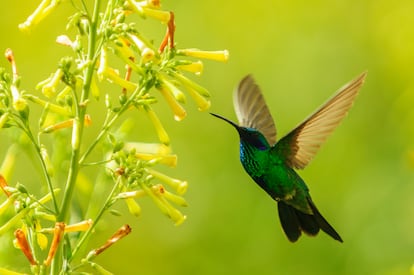

The Tsimane’ people live deep within the Bolivian Amazon rainforest. This community of some 16,000 people has been protecting the Tsimane’ Indigenous Territory, the Pilón Lajas Community Land of Origin, and its surrounding areas for centuries, long before the state began to do so. When the elders of the community were just children, they saw macaws and Amazonian guans (Penelope jacquacu) flying over the Maníqui River basin. Today, they themselves acknowledge seeing only ruddy pigeons (Patagioenas subvinacea) and giant cowbirds (Molothrus oryzivorus), birds that are much more homogeneous and urban, and which have little or no connection to their territories.
This realization is not unique to Bolivia. An international study, coordinated by the Autonomous University of Barcelona, documents that, between 1940 and 2020, the average body mass of birds in 10 Indigenous and local communities on three continents declined by up to 72%.
Fifteen years ago, Álvaro Fernández-Llamazares lived with this community to work on his PhD and get to know a group of people who understand the implications of the climate crisis better than any scientist. There, he began to hear, time and again, the elders’ sorrow at no longer seeing the birds they had grown up with. “The loss for them was very profound and went far beyond a mere number,” explains the Spanish ethnobiologist and lead author of the study, published in the journal Oryx, in a phone call.
For the Indigenous communities who were interviewed, birds often hold immeasurable symbolic and ceremonial significance. Thus, ritual dances, songs, and place names are at risk of being lost in the face of this loss of biodiversity. Yolanda López Maldonado, PhD in Natural Sciences, fondly cherishes videos from her childhood of herself imitating the mating ritual of the thick-knee (Burhinus bistriatus) as part of traditional Mayan dances. In them, a young girl moves her skirt as if feathers were hanging from it and “pecks” with her mouth alongside a partner in a beautiful and symbolic game. “If the thick-knee disappears, our culture is disappearing in a way. Passing this tradition on to younger generations is an enormous challenge if these birds are no longer seen in our territory,” she laments.
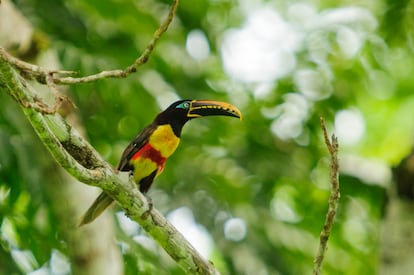
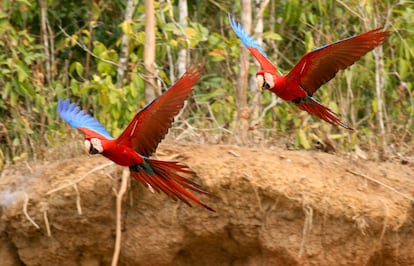

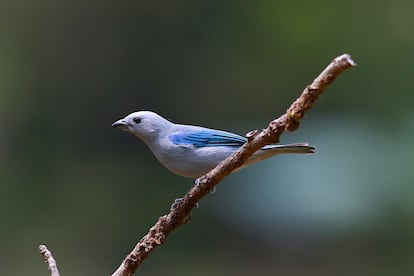
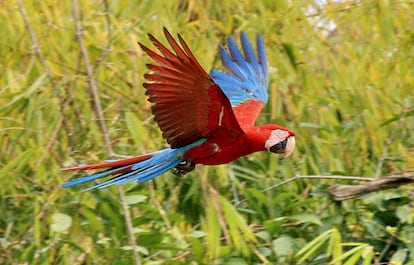
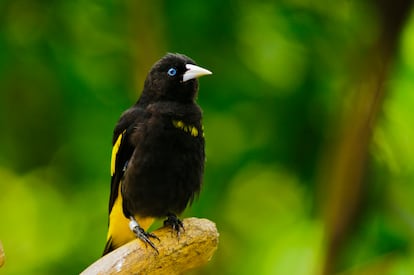
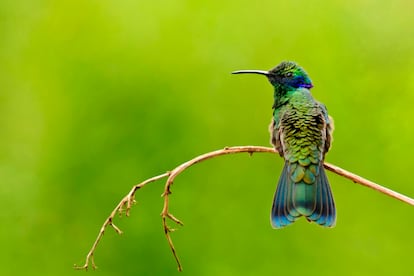
The study is a unique record of the ecological memory of 1,434 adults scattered across Latin America, Asia, and Africa. Participants recalled the three most common bird species they saw as children and the three most common species they see today. The team compiled 6,914 unique bird sightings across 283 species, allowing for comparisons of the same phenomenon in more than 40 different locations. The research reveals a painful reality: our generation has witnessed accelerated extinction. While in the 1940s the average body mass of reported birds exceeded 1,500 grams, by the 2020s the average had fallen to around 535 grams.
The Tsimane were the first domino piece to fall in a five-year collaborative investigation across 10 countries – Mexico, Brazil, Bolivia, Chile, Senegal, Ghana, Kenya, Madagascar, Mongolia, and China – that revealed they are not the only ones who mourn the largest and most majestic birds in their territories.
While the study did not aim to delve into the causes, Fernández-Llamazares points to the climate crisis, wildlife trafficking, and deforestation as the main triggers. “The species we see today are better adapted to human disturbances and coexist well in urban environments. We are witnessing a homogenization of biodiversity, with the consequent loss of the ecological and cultural functions of these birds,” he laments.
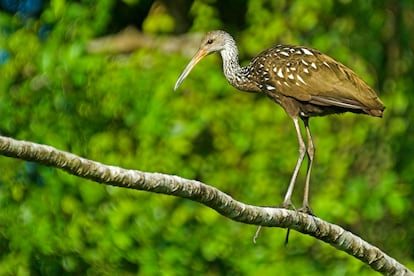
The importance of this study, achieved through exhaustive research, transcends its results or the evidence of this homogenization of biodiversity. Part of its revolutionary aspect is that it places other systems of knowledge at the center, systems that were not previously considered valid in Western science. “It respects and demonstrates that this epistemology is also relevant for addressing the climate crisis,” López Maldonado notes.
The Spanish scientist adds that while it still doesn’t have as much space in science “as it should,” the fundamental value of ecological memory is gradually being recognized. “It is extremely relevant because of its precision, the knowledge inherited from generation to generation, and constant observation,” he concludes. Far from considering this knowledge as mere supplementary data, the lead author explains, “we advocate for a respectful and equitable dialogue between scientific and Indigenous knowledge systems, recognizing its potential to strengthen biodiversity conservation policies.” Only when the thick-knees once again fill the skies of southern Mexico will the people of López Maldonado continue to dance. No need to show the video.
Sign up for our weekly newsletter to get more English-language news coverage from EL PAÍS USA Edition
Tu suscripción se está usando en otro dispositivo
¿Quieres añadir otro usuario a tu suscripción?
Si continúas leyendo en este dispositivo, no se podrá leer en el otro.
FlechaTu suscripción se está usando en otro dispositivo y solo puedes acceder a EL PAÍS desde un dispositivo a la vez.
Si quieres compartir tu cuenta, cambia tu suscripción a la modalidad Premium, así podrás añadir otro usuario. Cada uno accederá con su propia cuenta de email, lo que os permitirá personalizar vuestra experiencia en EL PAÍS.
¿Tienes una suscripción de empresa? Accede aquí para contratar más cuentas.
En el caso de no saber quién está usando tu cuenta, te recomendamos cambiar tu contraseña aquí.
Si decides continuar compartiendo tu cuenta, este mensaje se mostrará en tu dispositivo y en el de la otra persona que está usando tu cuenta de forma indefinida, afectando a tu experiencia de lectura. Puedes consultar aquí los términos y condiciones de la suscripción digital.